The way people talk about increasing the resilience of children who have experienced trauma makes me deeply uncomfortable. Likewise the way we talk about people who have lived through traumatic experiences in their work, bullying or coercively controlling relationships needing to “toughen up” or learn skills to “shake it off”. Worse still, the idea of attributing better outcomes to people with a “positive mental attitude”, “determination” or “grit”. It seems to suggest that there is some inner strength that allows some people to weather trauma better than others in a way that implies that anyone who doesn’t manage to do so is somehow weaker or missing skills we need to equip them with, rather than acknowledging that how our brains and bodies respond to trauma is largely out of our control. None of us know how we will cope under adversity, or how it will affect us later down the line.
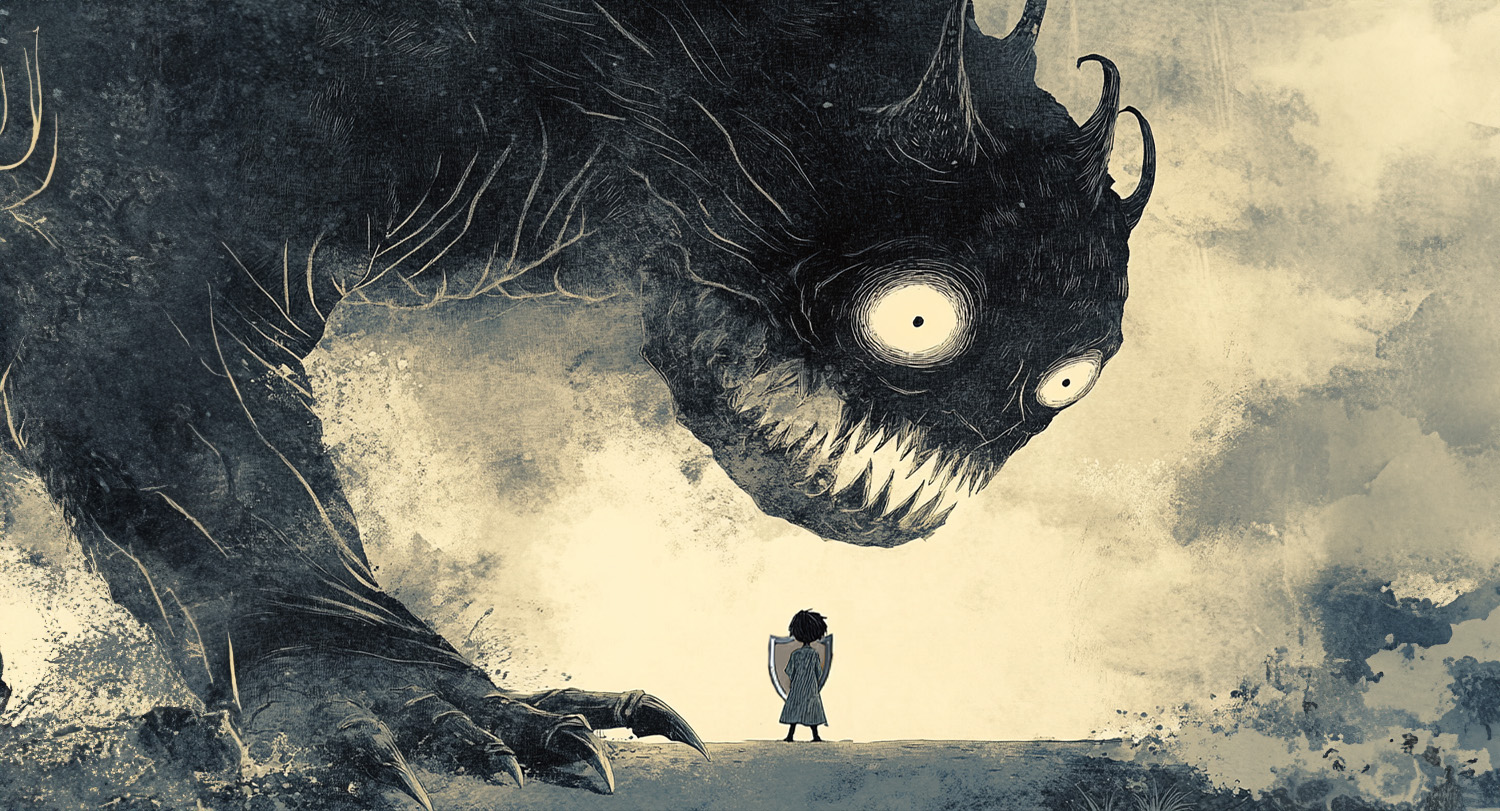
It feels like saying the outcome from the scenario in the picture above is defined by how well the character can use his shield, not by the size or temperament of the monster, the landscape, the weather, or even the character’s age, size, speed, intelligence or strength.
Resilience is defined as “the capacity to withstand or to recover quickly from difficulties; toughness” (Oxford English Dictionary) or within psychology as “the process and outcome of successfully adapting to difficult or challenging life experiences, especially through mental, emotional, and behavioral flexibility” (APA) and they tell us that “the resources and skills associated with resilience can be cultivated and practiced”.
I’ve got a number of problems with this.
First and foremost, I don’t think it is a helpful way to conceptualise the issue. The responsibility for the impact of trauma should sit with those who perpetrate harm*, not on victims. If you think about other forms of adversity like cancer, car accidents or crime, we work on prevention and recovery; we don’t expect people to be resilient to these things. We broadly understand that the extent of their injuries, the treatment required, the impact on their life, and the time it will take to recover, are largely out of their control. In the same way, we need to understand that there are many types of trauma, with different qualities like duration, severity, numbers of perpetrators and the degree to which it undermines trust. Each trauma is set in a different context, and impacts on different individuals, with different resources and sources of support. But even if we map the type and severity of trauma there is no direct relationship between the nature of the trauma experienced and the symptoms the individual will experience.
Secondly, the individual factors in outcomes from trauma seem to be outside of the person’s control. They are determined by chance (eg being in the wrong place at the wrong time), or our biology and epigenetic factors (eg the length of our telomeres, the protective caps at the end of DNA strands that shorten with each cell division, are impacted by our genes but also shortened by trauma), or related to the quality of our relationships (eg having any one reliable attuned relationship is protective), and our socioeconomic status (eg ability to eat a healthy diet and avoid stress) rather than to do with an individual’s mindset. Research that purports to measure individual differences often appears to measure elements that are impacted by experience. For example, one pop psychology article explains “instead of falling into despair or hiding from issues by using unhealthy coping strategies, resilient people face life’s difficulties head-on. People with resilience do not experience less distress, grief, or anxiety than other people do. Instead, they use healthy coping skills to handle such difficulties in ways that foster strength and growth, often emerging stronger than they were before”. But it seems to me that the ability to use these coping strategies depends on intelligence, relationships and past experience.
In the same way, survivor stories are often framed in terms of perseverence, bravery and determination rather than factors outside their control. I’m not denigrating the value of people with lived experience telling their stories – they are important for other people to hear to understand the nature of problems in society, and important role models that life after trauma is possible for people earlier in that journey. But we need to be careful not to extrapolate that the admirable qualities they now demonstrate were the reason they now seem to be unscathed by their experience (or part of post-traumatic growth). Actually it might have taken immense work to get to the point that their lives are going well and they are able to talk about their experiences. Just like the way the people we see most in the gym are the fittest people, the people able to talk about their experiences of trauma may be those who have the intelligence, reflective capacity, time and support to process their experiences and talk about them in a way that appeals to the audience.
Thirdly, we all tend to attribute too much of many outcomes to individual factors, and too little to external factors that come down to luck. Rich people frequently attribute their success to hard work, without realising that many people who work harder fail to reap the same rewards. Top athletes attribute their success to talent and hard work, but fail to recognise that month of birth and access to facilities play a significant part in their success (people born earlier in the school year tend to be larger and better coordinated, and therefore get more practise and experience of success that leads to greater confidence and opportunity). And it is the success stories that get told to larger audiences and seep into the culture. Was the key factor in the story of a six year old who saved his mother by alerting a delivery driver to her seizure his bravery or was it the stroke of luck that someone was around at the right moment? We like the story with internal locus of control as it gives us hope and makes us feel less powerless in the face of overwhelming or unpredictable threats.
That isn’t to say that there aren’t things that can be done to aid recovery from trauma. Of course learning to be compassionate to yourself, being able to talk about your experiences and having ongoing supportive relationships that help you recognise that what happened was not your fault are all important in aiding recovery. However, these aids to recovery should be focused on how the individual feels, rather than to what degree their distress is visible from the outside. We have learnt from social skills training in neurodiversity that looking normal to others can be performative, and something done at high personal cost to wellbeing. I think there is a risk that in some cases perceived resilience might be just how well a person can mask the impact of trauma.
*and anyone who knows about abuse and has the power to prevent or report it, but fails to do so (from politicians, heads of the church, and powerful figures in each industry through to relatives, colleagues and bystanders).
 ClinPsyEye