Diagnosis vs difference

I read a recent editorial on LinkedIn about the way that the diagnostic criteria for neurodiversity require “impairment” in functioning for a person to reach the diagnostic threshold. It was an interesting topic for a paper, and raised a set of broader interlinked questions in my mind about whether diagnosis is a recognition of difference-from-the-norm in the way some people’s brain or body functions, or whether it is about recognising something that is harmful (like a disease), or whether it causes distress or impairment / difficulties in functioning (like a disability or mental health condition). In particular it is interesting to think about how neurodiversity fits into that framework, compared to mental health conditions or physical health conditions. It opens questions about the purpose of diagnosis and whether that is about recognition of difference and understanding ourselves, or for gatekeeping access to certain types of support. It also raises questions about terminology – whether we acknowledge that many patterns of need or difference fall on a spectrum, and what we call a disorder or condition.

As it stands, in the current diagnostic rules (DSM 5 or ICD 11) each diagnosis has a minimum set of symptoms described. For example, in the DSM for a diagnosis of autism the individual must have “persistent deficits in social communication and social interaction across multiple contexts” and two or more areas in which they show “restricted, repetitive patterns of behavior, interests, or activities”. These difficulties must have emerged early in development, and not be “better explained by intellectual disability or global developmental delay”. However, to be diagnosed, the person doesn’t just need to have the neurotype of autism or ADHD but to struggle significantly with work, life, mental health or relationships because of it. Symptoms must cause “clinically significant impairment in social, occupational, or other important areas of current functioning”.

On first glance it seems a pretty clear description that could be consistently applied, but the more I’ve thought about it the more problems I see. First of all, the impairment criteria mean that people could waver in and out of the diagnostic category according to how well they are doing in their lives at that point, how well their environment and network support their needs, or their developmental stage. For example, a person could be autistic as a child, but then find a lifestyle, job, community or other niche in which they are happy and successful, and therefore fall below the diagnostic threshold – until a change or stressful life event means that they become distressed, when they would be diagnosable once again. Or they could have very subtle challenges that would not meet the criteria in primary school, but increasingly struggle during secondary school and meet the criteria for diagnosis, but then escape the sensory overload and/or social demands of that setting and no longer meet the criteria again.

That doesn’t make much sense given that autism, ADHD and other forms of neurodiversity are currently conceptualised as lifelong, inate differences in how people process information and interact with the world, rather than conditions that come and go. Neurodiversity isn’t a disease that temporarily disrupts a person’s normal functioning and can be treated to return them to normal. Neurodiversity is normal for that person; it is intrinsic to the way they experience and interact with the world for the whole of their lifespan. A neurodiverse brain is set up with a much wider focus of attention, or more attention to detail, or more propensity for sensory overload than a neurotypical one. A person doesn’t stop being autistic or having ADHD or a learning disability even if they learn strategies to fit in better with other people’s expectations or cope better cope at school or in the workplace any more than a person who is colourblind stops being colourblind if someone provides glasses that increase the red-green contrast.

For that reason, neurodiversity doesn’t fit into the medical model of diagnosis in the same way as mental health problems that may come and go, where a diagnosis may be helpful during the period when a person is experiencing depression or anxiety or psychosis, but may cease to be relevant at a later point – as for many people the symptoms will entirely resolve (spontaneously or with treatment) and no longer impact them. In the case of a mental health condition it wouldn’t be relevant to continue to use the diagnostic label after their symptoms resolve, as the individual may return to population-normative ways of experiencing the world. If we retained the diagnosis it would lose all meaning, as about half the population would end up with it, but most of those would have no symptoms that differentiate them from those without the diagnosis.

I also wondered how the idea of impairment fits with masking. In some cases a diagnosis could be withheld from a person who subjectively feels like they are struggling enormously if they were able to mask their difficulties enough for them to not impair their ability to function in their workplace or relationships during the assessment period. Or could it be considered a signficant impairment that it is exhausting to mask difficulties? Or that the effort of masking or coping with sensory overload all day at school or work means the person then struggles to function at home, withdrawing or becoming dysregulated in a way that might on first inspection suggest the difficulty is located within the home.

However, despite all the reservations I have raised, it is possible to think about diagnosis as only being meaningful when it applies to functioning, and a label for a degree of symptoms that is outside of the normative range. Many conditions are not binary variables that are either present or absent. Illness is quite often a matter of degree rather than the presence or absence of a condition. For example, a person’s glucose metabolism can indicate that they are becoming insulin resistant, but it is only above a certain threshold that the diagnostic label of diabetes would be applied, and certain treatments would be considered. Likewise our blood pressure or weight can be in the healthy range, or below or above that, but a diagnosis is only given if it is sufficiently high to cause significant health risks. There are numerous variables where we can be tested to see whether we fall into the typical range, or whether further investigation or treatment would be benficial – from our levels of white and red blood cells, iron, vitamin D, cholesterol, hormones, to the functioning of our liver and kidneys, markers of inflammation, infection or tumours. The threshold at which doctors diagnose conditions is typically the point at which symptoms start interfering with functioning and/or the pattern identified is known to cause harm, risk or distress to the individual.

Sometimes medics have to determine appropriate treatment without a diagnostic test being available, or where there is not a direct relationship between symptoms and the scores from blood tests or scans. For example, calcific tendonitis can affect the shoulder joint causing pain, reduced movement or even functional paralysis. However, sometimes people with scans that show a lot of calcification don’t report any symptoms, and sometimes people with very little visible in the scans have a lot of functional impairment. Physiotherapy and/or steroid injections seem equally effective at treating symptoms regardless of what shows in the scans. So treatment is typically determined by impairment alone. Likewise, a woman might have lower levels of oestrogen during or after menopause, and this might be associated with certain symptoms like brain fog, anxiety, hot sweats or disrupted sleep. But there is a degree of variation in what level of oestrogen the woman’s body is used to, and the effect she will experience from it dropping that means some women glide though menopause naturally without much ill-effect, whilst others (myself included) would find it entirely disabling without HRT – and this doesn’t map directly onto the level of oestrogen detected in blood tests. For this reason, it is the pattern of symptoms rather than the blood test results that should guide treatment.

Likewise, depression is something that ocurs along a spectrum from very mild to totally disabling symptoms. As is anxiety. There are even levels of the unusual beliefs or sensory experiences that occur in psychosis that would be considered normative – such as thinking you’ve seen a person who has recently died, hearing an internal voice giving you advice, or having strange or intrusive thoughts that you are able to quickly dismiss. In the same way, arguably we are all neurodiverse to some degree – we each have different patterns of cognitive strengths and weaknesses, different ways of processing sensory information, and subjective experiences of the world. But some of us are able to function in the world more successfully than others, with some people constantly feeling discomfort, distress or having to put in huge amounts of effort to do things that others find effortless. It therefore seems logical that it is the level of impairment rather than the neurotype that determines whether a diagnostic label is appropriate – even though this brings both a level of subjectivity to the judgement of whether the label is appropriate and an acknowlegement that the degree of impairment reflects not just the qualities of the individual, but also the qualities of the environment and network that they function within.

It might be that like height or hair colour, sexuality or personality traits, our strengths and weaknesses, there are ways in which we all vary that are not “conditions” that need to be diagnosed but simply differences between individuals. If we conceptualise neurodiversity as this kind of difference, then recognising it can still be a helpful way to understand ourselves, and how we differ from others. It can also help us find our tribe – the people that share our struggles or our interests and talents.

However, all this theoretical debate misses the elephant in the room of how widening the diagnostic range helps people with more subtle impairment recognise their neurotype, at the cost of negating the experience of those with more profound impairment who had historically been able to convey their needs with a label that now gives most people a false impression of much subtler difficulties. What terminology do parents or carers of people with the “autism” described by Kanner (or at the more impaired end of the spectrum described by Wing and Gould) use to describe their pattern of needs? These individuals may be non-verbal, with significant developmental delay, very atypical ways of interacting with others, and obvious stims/stereotypies that instantly mark them out as different to members of the public. This group includes people with autism who are profoundly disabled to the point that they will need signficant financial and practical support across their lifespan – attending special schools, not being able to communicate their needs except through their behaviour, unable to reach independent living, or have the capacity to make decisions about their lives. Having an appropriate diagnostic label functions as a gatekeeper to accessing this kind of financial and practical support.

The problem being that whilst this group have used the label “autism” to describe their needs for eight decades, this is not the same population as now use the word “autism” to describe themselves on social media, to friends or in the workplace. As the diagnostic threshold has lowered to recognise more subtle impairments the label of autism has been claimed by many quite “high functioning” people to self-describe their struggles in a neurotypical world, and – because this group is more articulate and able to speak for themselves – they have come to dominate the discourse about autism, overshadowing the smaller numbers of people with more profound disabilities who had previously been described by this label. The larger number of people who are now included in the same diagnostic category but were previously given the diagnosis of Asperger Syndrome or High Functioning Autism, or seen as having difficulties that were below the diagnostic threshold, typically don’t have the moderate to profound learning disabilities, or need for support in their daily living skills as those who were diagnosed with Autism a few decades earlier. This population group might be independent, articulate, intellectually able, employed, and/or involved in interpersonal relationships including friendships and romantic/intimate relationships. Whilst it is evident that they do find some elements of life harder than neurotypical people, and it is a very helpful and affirming label that lets many people understand why they have felt different to the norm and have struggled with elements of their life, the level of support they require is not equivalent – despite the diagnosis on paper now being the same. A parallel process of widening the diagnosis has happened with ADHD and other elements of neurodiversity, to the point that 10-15% of people now identify with at least one element of neurodiversity, when historically only 1-2% of people were given these diagnostic labels.

This mismatch has therefore become the grain of truth that underlies some very toxic discussions about the growing rate of diagnosis, and the expanding numbers of people claiming disability benefits and adjustments or support within education and the workplace. With larger, more articulate and more powerful groups of voices advocating for the needs of the able end of the spectrum (who often object to any implication of there being a spectrum or such a thing as high vs low functioning or find such labels pejorative), it is hard for the voices of those representing more disabled individuals to be heard. I can understand that we need to respect the voices of lived experience about what terminology they are comfortable with. But some people don’t have voices in this conversation. And it wouldn’t be honest or fair to pretend that the needs of everyone with autism are equal.

The changing use of the diagnostic label doesn’t necessarily relate to the type or degree of support people require, and therefore it may no longer be able to function as a gatekeeper of services. That might still have to rely on an understanding of impairment – the areas in which we are struggling or require more support than the rest of the population. We can’t support everyone equally, that just isn’t viable. We also can’t allow resource rationing to lead the decisions about terminology or diagnosis. But it will have to be consideration of impairment that helps systems to differentiate what levels of support are appropriate – even if that involves subjective judgements, of functional states that are impacted by the environment, and will need to be regularly reviewed over time. Because without us evolving the right language to accurately reflect levels of need, the most disadvantaged will struggle to get their needs met at all – with tragic consequences for them, their caregivers, and the public purse. And, as Mahatma Gandhi is believed to have said, “the true measure of any society can be found in how it treats its most vulnerable members.”
Give and Take

I’ve run the clinpsy forum for 18 years, and before that I spent a couple of years as a moderator on a precursor forum. I’ve compiled and/or written about 200 wiki posts that have been viewed millions of times between them. Some individual posts have had over 100,000 page views – the most popular being a giant list of interview questions I compiled, a post about transference and counter transference, and one about keeping a reflective journal and one I wrote on clinical vignettes, followed by my post about formulation, and one about clinical interviews. There are also popular posts such as one about what to do with a low degree mark, a more general post on reflective practice, one on supervision and posts about preparing for assistant psychologist and IAPT interviews. The site peaked at about a million page views per month, but has slowed a little as technology has moved away from forums towards WhatsApp groups, and various people have tried to cultivate this audience via social media (often selling products and/or services).

I’ve never really seen running the forum as potential source of income. In fact, it has been a huge drain on my resources – I spent an hour a day for a decade building the content and community, and I’ve paid the server fees, programming, design and other costs out of my own pocket (subsidised at times by a trickle of advertising income). Even now I have to check and activate the new members, respond to emails and PMs at least 2-3 times per week. On the other hand, I have saved a little bit of money on advertising, I’ve been able to promote my own book without cost (and various courses and jobs offered by people that I know). It has given me reach that I might not have had otherwise (I’ve got about 10,000 followers on Twitter, over 5,000 on LinkedIn and this blog has had over 100,000 reads). And I’ve saved a little time in accessing information or publications. So whilst it has cost me about two years of full-time work, and about £5000 overall (plus the cost of the clinpsy URLs and the time spent on social media, but those aren’t constrained to this purpose or audience), I don’t feel like the time has been wasted.

Maybe that is because I don’t do it for the money. I’ve mainly seen it as a way to undermine the added value of nepotistic networks, where information was kept amongst a privileged few who had access to CPs. I wanted to democratise the profession, by puting that information into the public domain, and allowing equal access to sources of support for people from all different demographics. I quite intentionally undercut those who marketed to this group, by offering forum membership and access to various activities for free, and by asking only for a charitable donation for the various webinars, training days, professional development workshops and reviews of applications that I offered (with the level of donation being recommended, but the option being available to pay less or even nothing for people of low means or groups who have been traditionally excluded from the profession). That has also led me to raise thousands of pounds for charities like UNHCR, Magic Breakfasts, food banks, refugee support, and various other causes from replacing the broken electronic whiteboards at a local primary school to dementia care, to educating girls in Africa.

I also get the intangible reward of the people who thank me for the impact that the forum and/or my input has had on their lives. Their notes that say that my feedback made all the difference to them gaining a job or a place on training. Or that my workshop helped them convey their competencies more confidently at interview, or find the next step in their career. It means I am quite widely known in the profession, which builds trust and reputation. And, perhaps most importantly, there are people who have met me through the forum have later become friends, employees and colleagues.

At a few points, people have expressed interest in buying the forum off me. Sometimes that has been an easy no – like when the offer came from the owner of the profit-making travel agency that masqueraded as a charity giving people psychology experience in Sri Lanka and other developing nations. But there have been more benign offers, and now I am so preoccupied with my business, and the other moderators who helped me run the site have mainly fallen away, I do feel like the time and resources I have available to pour into it is limited, and there might be advantages in bringing new energy to the community. So I am torn between a plan to reinvigorate the community, and the idea of handing it over to a new owner.

I also wonder about the balance of give and take, and whether passing on ownership would relieve me of an undue sense of responsibility. After all, there is only one of me, and over 9000 members* and I’m also spinning quite a lot of other plates – I’m Mum of teenagers doing their GCSEs, we are in the midst of building work, and I run my own business which could use my time five times over. There is also something strange about running a forum that feels like the service I provide is taken for granted, assumed to be financed by a professional body, or is treated like public property. Sometimes people have quite unrealistic expectations – demanding immediate responses to messages, sending grumpy emails if their account is not activated right away, breaking the minimal simple rules, or complaining about moderation. People post adverts or self-promoting content without permission or payment (even though our charges are minimal and support the costs of providing the forum). It is as if they believe it is their right to post on the forum to get free promotion for their blog/website/book/course or whatever.

It sometimes feels like a lot of people put very little in but expect to take out as much as they want – asking questions but never contributing to any other discussions, or signing up to request a form review or to apply for a place on a low-cost event without ever contributing to the forum or being part of the community. I like to raise money for the charities and to give people access to information, but each form review takes me 30-40 minutes, and I currently have a queue of 47 requests – which will take about a week’s working time out of my weekends and evenings over the next month. I’d be much better off financially if I donated £1000 to the charities myself and spent the time on income generating work!

But the alternative is to give those selling services to aspiring psychologists an open market to exploit, or for me to have a paid tier of forum membership or to sell products and services, which doesn’t sit right with me, as it reinforces the privilege filter that has always biased our profession towards middle class, able-bodied, white women. Given I don’t want a website and forum full of intrusive advertising, and I haven’t got money to throw at it, the alternative is running the forum on a shoestring – which is fine when we have lots of volunteers contributing to keep the discussion lively and assist with the admin, but more difficult the more of the work I need to shoulder alone.

There are echoes of the same theme in decisions I need to make about my business. As we scale I need to decide whether we continue to bootstrap our growth, or we borrow or seek investment to grow faster (making more impact for more children, but with the cost of being pulled towards earning enough to repay a loan, or delivering a financial return for investors). I need to weigh up the value of locking in the mission to the company structure, versus optimising the business for investment. My gut instinct is to lock in our values with a pledge to prioritise impact, and to donate a percentage of profit above a certain threshold to a charitable foundation that can offer access to the tools to those that can’t otherwise afford them. But it might be that keeping a traditional company structure and taking on investment allows us to reach more children and make more impact to a wider population than we would by being too rigid and narrowing the pool of investors that would be interested.

So I need to think more about how I value and prioritise my time. I’m not sure I owe anything more to aspiring clinical psychologists than any other member of the profession does. So I wonder why I felt obligated to take up this mantle, and continue to stubbornly carry it? And why am I willing to sacrifice my leisure time, or the time I get to spend with my family or on my business, to do things with minimal personal benefit? Whilst I love that I live my values – and the way they permeate almost everything that I do – they do have costs, and I think I probably need to prioritise myself and my family a bit more. I’m not sure I’ll look back on my deathbed and think “I wish I sank more time into that website”, or “if only I had offered more professional development support to aspiring psychologists”, or “I should have achieved more with my business” rather than “I should have spent more time with the people I loved, given more focus to my health and wellbeing, and seen more of the beauty of the world”.

*I haven’t pruned off the dormant accounts for a while, so once I do this may well return to the approx 8000 figure where it has stabilised for the last decade.

Why I dislike the concept of resilience

The way people talk about increasing the resilience of children who have experienced trauma makes me deeply uncomfortable. Likewise the way we talk about people who have lived through traumatic experiences in their work, bullying or coercively controlling relationships needing to “toughen up” or learn skills to “shake it off”. Worse still, the idea of attributing better outcomes to people with a “positive mental attitude”, “determination” or “grit”. It seems to suggest that there is some inner strength that allows some people to weather trauma better than others in a way that implies that anyone who doesn’t manage to do so is somehow weaker or missing skills we need to equip them with, rather than acknowledging that how our brains and bodies respond to trauma is largely out of our control. None of us know how we will cope under adversity, or how it will affect us later down the line.

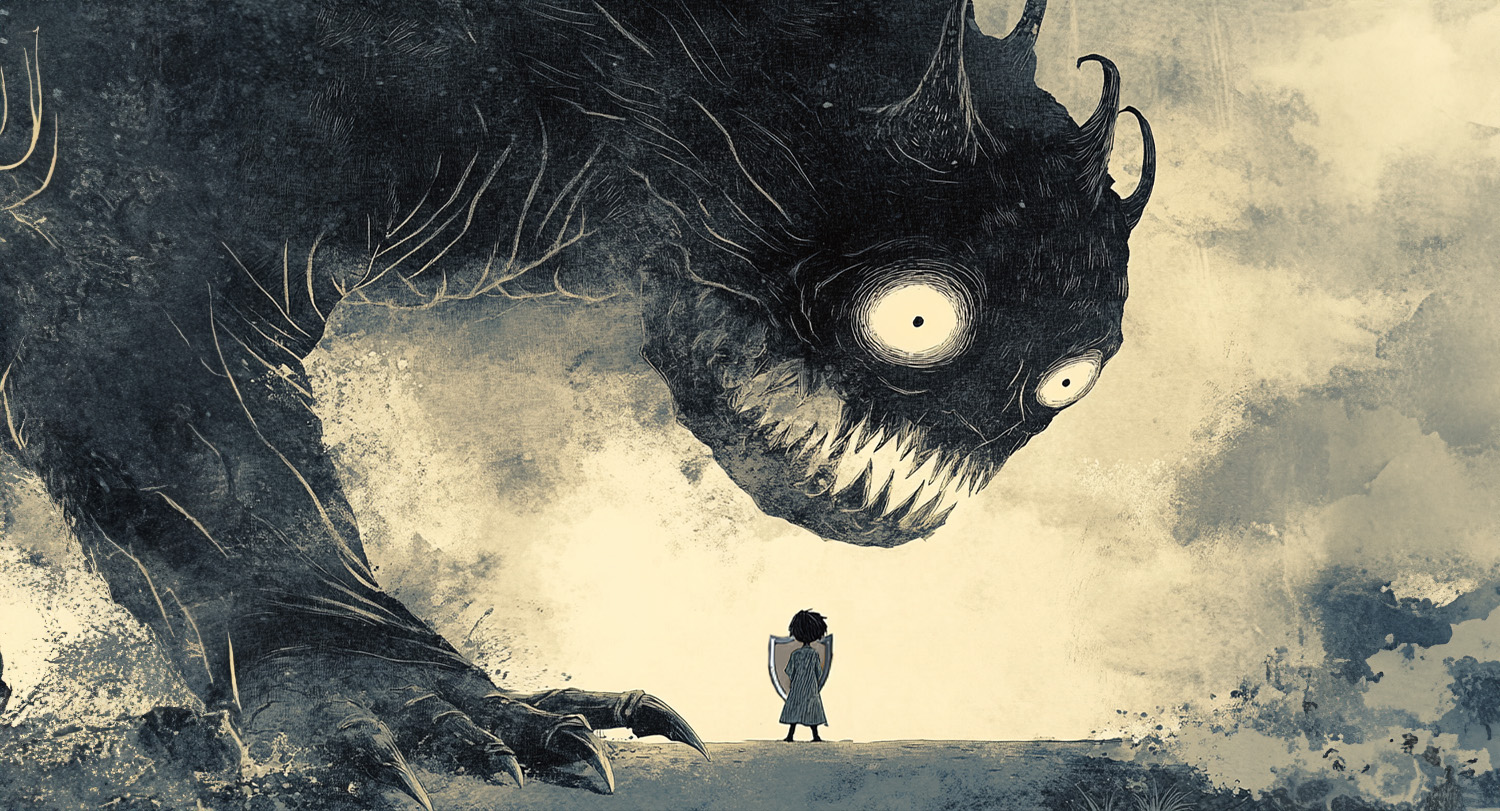
It feels like saying the outcome from the scenario in the picture above is defined by how well the character can use his shield, not by the size or temperament of the monster, the landscape, the weather, or even the character’s age, size, speed, intelligence or strength.

Resilience is defined as “the capacity to withstand or to recover quickly from difficulties; toughness” (Oxford English Dictionary) or within psychology as “the process and outcome of successfully adapting to difficult or challenging life experiences, especially through mental, emotional, and behavioral flexibility” (APA) and they tell us that “the resources and skills associated with resilience can be cultivated and practiced”.

I’ve got a number of problems with this.

First and foremost, I don’t think it is a helpful way to conceptualise the issue. The responsibility for the impact of trauma should sit with those who perpetrate harm*, not on victims. If you think about other forms of adversity like cancer, car accidents or crime, we work on prevention and recovery; we don’t expect people to be resilient to these things. We broadly understand that the extent of their injuries, the treatment required, the impact on their life, and the time it will take to recover, are largely out of their control. In the same way, we need to understand that there are many types of trauma, with different qualities like duration, severity, numbers of perpetrators and the degree to which it undermines trust. Each trauma is set in a different context, and impacts on different individuals, with different resources and sources of support. But even if we map the type and severity of trauma there is no direct relationship between the nature of the trauma experienced and the symptoms the individual will experience.

Secondly, the individual factors in outcomes from trauma seem to be outside of the person’s control. They are determined by chance (eg being in the wrong place at the wrong time), or our biology and epigenetic factors (eg the length of our telomeres, the protective caps at the end of DNA strands that shorten with each cell division, are impacted by our genes but also shortened by trauma), or related to the quality of our relationships (eg having any one reliable attuned relationship is protective), and our socioeconomic status (eg ability to eat a healthy diet and avoid stress) rather than to do with an individual’s mindset. Research that purports to measure individual differences often appears to measure elements that are impacted by experience. For example, one pop psychology article explains “instead of falling into despair or hiding from issues by using unhealthy coping strategies, resilient people face life’s difficulties head-on. People with resilience do not experience less distress, grief, or anxiety than other people do. Instead, they use healthy coping skills to handle such difficulties in ways that foster strength and growth, often emerging stronger than they were before”. But it seems to me that the ability to use these coping strategies depends on intelligence, relationships and past experience.

In the same way, survivor stories are often framed in terms of perseverence, bravery and determination rather than factors outside their control. I’m not denigrating the value of people with lived experience telling their stories – they are important for other people to hear to understand the nature of problems in society, and important role models that life after trauma is possible for people earlier in that journey. But we need to be careful not to extrapolate that the admirable qualities they now demonstrate were the reason they now seem to be unscathed by their experience (or part of post-traumatic growth). Actually it might have taken immense work to get to the point that their lives are going well and they are able to talk about their experiences. Just like the way the people we see most in the gym are the fittest people, the people able to talk about their experiences of trauma may be those who have the intelligence, reflective capacity, time and support to process their experiences and talk about them in a way that appeals to the audience.

Thirdly, we all tend to attribute too much of many outcomes to individual factors, and too little to external factors that come down to luck. Rich people frequently attribute their success to hard work, without realising that many people who work harder fail to reap the same rewards. Top athletes attribute their success to talent and hard work, but fail to recognise that month of birth and access to facilities play a significant part in their success (people born earlier in the school year tend to be larger and better coordinated, and therefore get more practise and experience of success that leads to greater confidence and opportunity). And it is the success stories that get told to larger audiences and seep into the culture. Was the key factor in the story of a six year old who saved his mother by alerting a delivery driver to her seizure his bravery or was it the stroke of luck that someone was around at the right moment? We like the story with internal locus of control as it gives us hope and makes us feel less powerless in the face of overwhelming or unpredictable threats.

That isn’t to say that there aren’t things that can be done to aid recovery from trauma. Of course learning to be compassionate to yourself, being able to talk about your experiences and having ongoing supportive relationships that help you recognise that what happened was not your fault are all important in aiding recovery. However, these aids to recovery should be focused on how the individual feels, rather than to what degree their distress is visible from the outside. We have learnt from social skills training in neurodiversity that looking normal to others can be performative, and something done at high personal cost to wellbeing. I think there is a risk that in some cases perceived resilience might be just how well a person can mask the impact of trauma.

*and anyone who knows about abuse and has the power to prevent or report it, but fails to do so (from politicians, heads of the church, and powerful figures in each industry through to relatives, colleagues and bystanders).

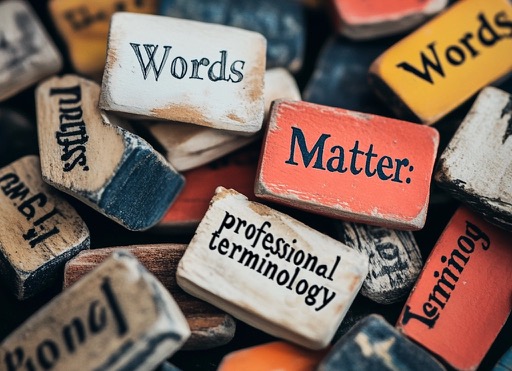
Words Matter: Prejudice, progress and professional terminology

How we talk about things influences how we think about things. Whether you believe the people arriving in small boats after perilous journeys are “illegal immigrants” (who have come here to exploit the system and harm us) or “asylum seekers” (desperate people who are seeking better/safer lives for themselves and their families) frames how you treat them. If you believe people who have complex offshore tax arrangements are “legitimate successful business people” or “tax dodgers” frames how you treat them. If you believe that trans people are “men in a dress (who present a threat to women)” or vulnerable people who desire to live in a way that is aligned to their deepest sense of self frames how you treat them. Words matter because they set the Overton window – the range of discourse that is considered acceptable in a society – which frames the prevalent perception and accepted understanding of key issues.

That is why the “culture wars” in politics and social media is so dangerous. People are being swept up into bubbles where if you believe one misleading thing (eg that the difficulties young white men now face are not being recognised because all the focus is on uplifting women and people from the global south, or that immigrants get preference for housing or benefits or are taking away job opportunities from your community) you are suddenly exposed to more and more hideous things – from the incel mindset to vaccine misinformation, transphobia, racism, islamaphobia, antisemitism, sexism, and regressive views about reproductive rights or the value of people who don’t have children – until your understanding of the world can completely detatch from the reality. Once swept into a bubble like that people end up dividing the world into allies (who think like themselves) and enemies (who think differently). To align with the allies who defended you when you faced one area of legitimate criticism is to align with all their beliefs. So otherwise sensible and progressive people can end up defending the indefensible and entrenching into deeper and deeper prejudice and antagonism. Once it becomes about alliances and identity, it seems our ability to apply any critical thinking to evaluate claims is undermined.

Yet progress has made huge strides over the decades before this recent setback. The public are broadly supportive of gay marriage, of women’s rights, of a health service funded from taxes, of a social care safety net, of the need to take better care of the environment and avoid climate change. These have been positive changes over time. There is also less tolerance of prejudice. You can see it when you watch old TV shows, and hear their casual jokes that have a sexist, racist, homophobic or transphobic edge to them, and realise that such content wouldn’t be commissioned now (and rightly so) – although portrayal of people with disabilities by actors without them persists. Problems are most obvious when we look back 50 years or more, where the issue was overt in shows like the Black and White Mistrel Show and sitcoms contained overtly racist content. Disney have had to add content warnings to some of their old films and cartoons. However, shows that were not seen as problematic in my youth have also been reviewed. Episodes of Little Britain, League of Gentlemen and the Mighty Boosh have been withdrawn for blackface. But even relatively recent content can age badly. If you rewatch episodes of Scrubs or Psych (both still highly rated and available to stream) there is content that feels really uncomfortable now. The former has had three episodes pulled for blackface. Psych remains up in full, but has repeated caricatures of people of different nationalities, and lots of casual sexism, racism and transphobia, despite being made from 2006-2014. Times have changed for the better in this regard. The acceptable discourse changing is a sign that progress is being made to reduce inequalities. Frustratingly, as I wrote in my last blog post, the last government and various figures on the right have managed to reverse some of that progress, with inflamatory discourse about immigrants, islam and trans people. Thankfully there are signs that is being addressed by the new government and that the majority of people don’t share such toxic views.

Language also matters when it comes to the terminology people use about their skills and professional status. It might sound boring and pedantic, but it is super-important to use the right words to describe yourself – especially when it comes to the terms that identify your professional status or qualifications. When I go to my GP it matters whether I get seen by a qualified doctor with five or more years of training with signficant breadth and/or depth, or another form of clinician who may only have a year or two of training and a much lower level or narrower area of expertise. If I have stress and worries, it makes a difference if I see a “wellbeing worker” who only has administrative experience or a qualified mental health professional. At the hospital it matters if it is a or “physician’s assistant” or a doctor that examines you – it can be life or death.

So when I read a CV in which someone claims to be a “Chartered member of the BPS” when they only have GBC – the graduate basis that is the first step towards gaining a qualification that could lead to later Chartered Status* – that is a problem. Yet this mistake was made by more than one applicant for one of our recent vacancies. If I read that someone is a “clinical psychologist” but they are not on the HCPC register as a practitioner psychologist, that is misleading and unlawful – yet I’ve seen three examples this month alone (in applications, and on LinkedIn profiles). I suspect that people in the psychological career paths are being impacted by the lack of clarity in the legislation and professional bodies, just as the public are, because there is no clear single source of this information. It is particularly confusing for people entering the UK from countries with different training paths, terminology and regulatory frameworks. Someone who is legitimately a “clinical psychologist” in another country can’t continue to use that title when living or working here unless they gain HCPC registration. Yet it is interesting that it isn’t as obvious as someone not being allowed to practise as a medial doctor or dentist or social worker without the right regulatory status – perhaps because the regulatory framework for psychology is so weak that if they drop the word “clinical” they are free to claim to be a psychologist with impugnity**.

It also bugs me when people self-adopt the term “consultant” because this is not protected by law and they think it will make them sound more impressive, when that title should reflect external validation of the level of responsibility of your role and expertise. I had to earn that title through a process involving a panel interview for a job with national assessors appointed by our professional body. I gained my consultant grading after many years of service gaining specialist skills with a particular client group, only when I gained a post with responsibility for a multidisciplinary team in a multi-agency context, working with highly complex presentations. Whilst the professional bodies haven’t yet resolved the issue of defining use of the consultant grade outside the NHS or large employing organisations, there are some professional recommendations and correspondence. Consultant is a term designed to mirror our medical colleagues in the NHS and is used to designate an individual who has been assessed as having attained a high level of specialist skill, doing a job with a high level of responsibility for leading a service and managing others, as well as having a deep expertise in a particular model of psychology and/or population. It isn’t obtained by time served or by specialist knowledge alone, it is a reflection of holding a post that scores above a particular threshold on the KSF – normally leading a substantial area of service delivery and being accountable for the outcomes and the team that deliver that service. For that reason, it makes me bristle to see self-employed sole practitioners who have claimed the title “consultant” either because they offer consultations or because they think they have earned it through time served or depth of knowledge of a model of therapy. That isn’t how it works. Not only was I judged to be the strongest candidate for the post and to have the required competencies to work at that level, my NHS role was judged to require consultant banding because of its level of responsibility. I have retained the title “consultant clinical psychologist” after leaving the NHS because I have continued to work in complex multi-agency contexts, leading teams and being accountable for their performance. But if individuals within my profession don’t understand and respect this differentiation, how can we expect the public (or the courts, or private service managers, or colleagues in social care or education) to understand what the terms mean, which of them are regulated and how to recognise when people are using them inappropriately and what to do about it?

I still hope that the government will grasp this nettle and regulate the title “psychologist”, require professional indemnity insurance for anyone offering therapy or mental health services to the public, and give the public much clearer information about how to find a suitably qualified practitioner who can meet their needs. I hope that this will then bring clarity for the terminology that people can use, and for public understanding of that terminology. But we are a long way from this happening. For now, I can only try to share clear information on the clinpsy forum, which continues to get millions of page views and to be one of the most accessible sources of information about the career path for clinical psychology in the UK.

*The BPS have lowered all the standards for what it takes to be a member, and how you can become chartered, so this is less and less meaningful, and they have encouraged members (even student and graduate members) to use letters after their name that I believe the public and non-psychologists would find misleading, so they are at least partly to blame.

**The issue of regulation of titles in psychology is something I feel passionately about and consider an important issue of public protection. The UK is the only country in the developed world not to regulate the term “psychologist” so this is a necessary first step. But I believe that absolutely everybody offering any form of wellbeing service to the public requires professional indemnity insurance and to be within the scope of a regulator. Otherwise people will continue to be preyed upon by unscrupulous, abusive and incompetent practitioners when they are at their most vulnerable.

The worst and the best of us

I wanted to write something about recent events. They’ve had a powerful emotional effect on me, and lots of people that I know. People who are muslim, asian or black have been particularly affected, but I think many people will have been a bit more wary of unrest or concerned about what was going on and what it means about us as a nation. I also wanted to express solidarity to those who have felt fearful over recent times, and to think a bit about what we can do going forward.

There will be those who say that commentary on recent events isn’t professional or think it doesn’t relate to psychology, and more generally claim that politics shouldn’t enter professional settings. But, as you’ll have gathered from my past posts on here, I don’t shy away from politics. I think all human behaviour is worth trying to understand, and everything is ultimately influenced by wider political issues and decisions. Mental health does not happen in a vacuum. It is related to physical health, and to our ability to meet our basic needs for safety, shelter, food and relationships. There are also numerous socio-political issues underpinning the wellbeing of individuals and the trauma that many experience, from poverty to employment stress, polarisation (“culture wars”) to waiting lists.

As anyone who has read any of my blog will know, I’m politically progressive. I’d like to think I’ve always been very active in naming the racism/islamophobia on show in person and on social media, supporting my team to think about and deal with the repercussions (and I’ve been a long-time supporter of Hope Not Hate, Stop Funding Hate and various social justice organisations). I’m also have some skin in the game. I’ve previously talked about being a second-generation immigrant myself*, but never experiencing the same prejudices as friends who are black or asian or muslim because I am white, middle class and non-religious (although I was recently rightly reminded of the way white eastern european immigrants were treated around Brexit). I also believe in the golden rule to treat others as we’d hope to be treated. If there was a massive disaster in the UK, we’d hope that another nation would let us take our family to safety there, and give us the opportunity to work and contribute and become part of the community. We can’t resent the people who move here wanting the same thing.

So where do I stand on the recent riots? As I see it, they were the inevitable consequences, not of “reasonable concerns about immigration” or the tragic events in Southport, but of ignorance and hate stoked by the far right boiling over into acts of terrorism, vandalism and aggression. What happened over the weekend was the fruition of a long process of politicians, media and hatemongers shifting the window of acceptable discourse to include racism and islamophobia, with a thin veneer of patriotism to give it cover. It is a story that began before Brexit or the Trump presidency, and is tied into the growth of social media (see my prior blog here). The riots were the symptoms of a sickness that has been intentionally cultivated and allowed to fester for too long. I have watched it grow with revulsion and a sense of powerlessness. I can only hope that the people who instigated the violence face consequences as easily as the saps who enacted it, who have already started appearing in court and await prison sentences.

On the flip-side, as always, where bad things happen, we see good people stepping up. In this case we saw people coming out in force to clear up their neighbourhoods, repair damage and guard mosques. And today we saw thousands of people turn out to face down fascism in every city there was expected to be a far right protest, donating to fundraisers to cover repair costs for vandalised libraries, shops and cars, and expressing abhorence for the rioting. I also got some joy from watching how far right figureheads were throwing each other under the bus to try to seem less personally culpable, further protests failed to materialise and the media that had stoked hate for so many years was suddenly changing its tune. It was a relief to see that the majority of the population believe in a diverse and inclusive society, not in mob rule, and that those promoting or participating in violence will face consequences.

So where do we go from here? I think the government will need to act to prevent the spread of hate and instigation of violence, by considering how they regulate it on social media and in the press. The move towards rapid and visible justice was something we need to see applied to all violent crime, as the current court system isn’t able to keep up with demand**. We need to see changes to the immigration system too – moving people who are entitled to stay rapidly into work and allowing them to integrate in communities, rather than cooping them up in hotels at the tax-payer’s expense. And we need to address poverty, health and quality of life, so people don’t feel they have missed out on progress. It is much easier to whip up hatred against foreigners when people are struggling in their own lives. If we can offer a functional health service, a benefits safety net of minimum income that means people can afford to pay their rent and bills and feed their families. If we can offer hope for the future, educate people to recognise fake news, and show the value of diversity to our society, it will be harder to whip up hatred again.

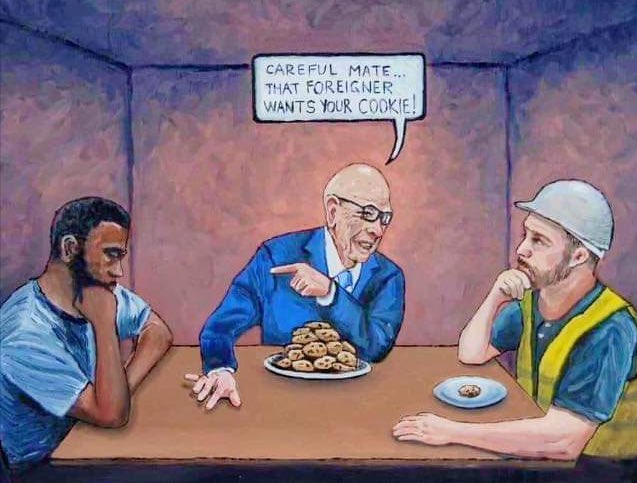
There is an illustration of three men sitting at a table that I often retweet. One man has a pile of cookies on his plate, one has a single cookie and one has none. Sometimes the man with many cookies is drawn to look like a banker or a press baron or a billionaire, and the man without as an immigrant. The man with plenty of cookies tells the man with one “careful mate, that foreigner wants your cookie”. It is an apt metaphor for how the those with the greatest wealth and power have always targeted resentment towards those with least, so that they can maintain the unfairness of their privilege. It is no coincidence that the peddlers of hate are often selfish and narcissistic millionaires and billionaires, wanting the majority of the population to focus their anger on disadvantaged groups like single mothers, immigrants or people who claim benefits, rather than looking at who is really hoarding a disproportionate share of the world’s wealth and resources***.

*My great grandparents fled religious persecution in the USSR, my parents moved continent again to avoid complicity with a regime that was racist and to take up educational opportunities, and arrived in the UK in 1969. My mum returned 40 years of service in the NHS, my dad over a decade in education/care/justice. And they had me and my brother who haven’t been too bad for the UK either – I’m an award-winning CP and social innovator working in health and care, and he’s a world-leading AI researcher. Accepting a fair proportion of people fleeing persecution is the morally right thing to do. But it also makes economic sense. Without immigration, the UK would miss out on amazing people, and essential health and care staff.

**I also think that the draconian laws about peaceful protest, especially when applied to issues like climate change, need to be reconsidered. I don’t have an issue with prosecuting those who cause disruption or damage, but I think preventing them being able to explain their reasons for doing so in court is a concerning precedent, and some of the sentences have been disproportionate when compared to other crimes.

***The scale of wealth held by the richest few is mindblowing. This illustration starts with a single pixel to represent a dollar. Remember that a billion people in the world live on less than a dollar a day. A tiny square represents the household median income in the USA of £69,000 dollars (this seems higher than UK salaries, but they have to pay for health insurance and various other costs, and get minimal paid leave, and employers don’t have to contribute to employee pension schemes). A small square is a million dollars (a level of wealth that would place you in the top 3% of the world). Elon Musk’s wealth is a block so big it seems endless.

Hindsight and reflection

When I watched The Usual Suspects, the twist at the end made me immediately re-watch the whole film. The extra bit of knowledge meant the same information from the earlier plot had entirely different meaning. The same thing happens when you realise someone has lied to you, or manipulated you for some secondary gain – you suddenly need to reappraise all the prior interactions you have had in light of this new insight. It is inevitable as we go through life that we learn additional information that helps us understand things in more sophisticated ways. Just as we learn that our parents are flawed human beings, rather than always right and almost omnipotent, a lot of relationships transpire to be less perfect when the first thrill of connection wears off. It can be quite a challenging process to understand why you were fooled, what you should have noticed, and how you could have avoided the bad feelings that come with realising all was not as it seemed.

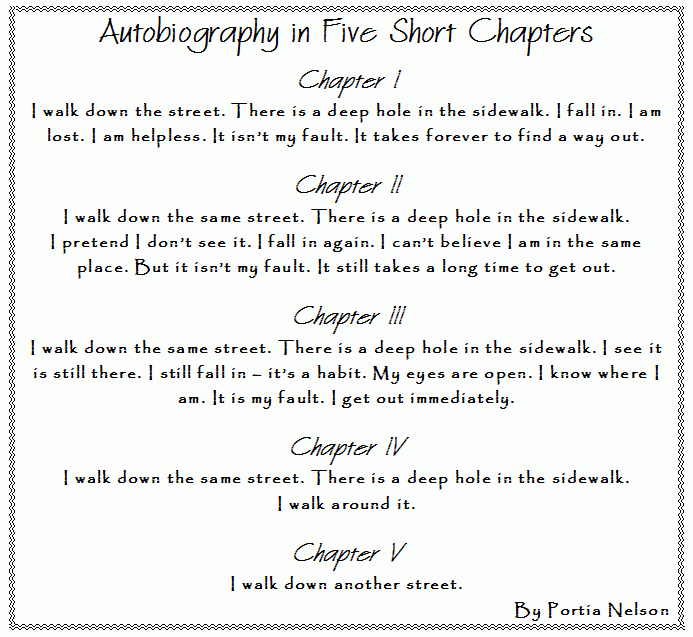
In one chapter of my book I talk about the poem “Holes, An Autobiography in five short chapters” by Portia Nelson. It is a nice summary of the patterns we can all fall into, and how it is only reflection and insight that lets us climb out, and eventually learn to avoid falling into similar holes in the future. I found it really helpful realising that there were certain “holes” that I recurrently fall into. In particular, I was susceptible to one when others seem to need my help and support, but keep on taking without recognition of the value of that help or any cost it has for me, until I feel exploited. An early example was a student who volunteered when I was an AP, who I supported to apply for similar posts and to get onto clinical training, before becoming aware she had presented some of my work as her own, and named me as a reference for a job she had been fired from (when I wasn’t her supervisor and didn’t work there, in the expectation I’d say only positive things).

Related to this, perhaps, is my sense of myself never living up to the high expectations I set myself. It means I often assume I’ve done something wrong, until I find out that the other person is getting me muddled up with someone else, or has put the wrong time for the meeting in their diary. I feel acutely guilty if I take too long to write up the notes from a consultation, even if I’ve had time off sick or other crises to deal with. And I always first reflect on my part if there has been a misunderstanding (eg if the builder is asking for much more money than the written quote, and implies that we agreed additional costs for changes to the design – even though I know I would have kept track of that). It also made for very difficult dynamics with an AP who appeared really hard working and humble until I wrote them a reference for training, then started being increasingly critical and undermining, blaming me for their lack of progress in any of the tasks they were employed to do until I felt quite upset. It was only when I shared my feelings with trusted advisors and peers that I was able to recognise that the problem wasn’t with me. I then started to recognise I’d been gaslighted, and that if someone else makes me feel bad, I have no obligation to kept bending around them until they are satisfied.

Sometimes it isn’t new information about what happened or the other person’s motivation, but a new perspective or frame of reference that shows past experiences in a new light. I’ve reflected in past blogs about how what seemed like normal teenage boy behaviours, that were a socially acceptable way for them to show their interest in me (and portrayed in my peer group as something I should be flattered by) were actually quite inappropriate – unwanted, overly persistent and at times clearly non-consensual. Likewise, I learnt the term “stealthing” meant the guy at university who knew my consent was contingent on condom use, and made a show of using one but transpired not have to used it after the fact, was not just a selfish scumbag (as I thought at the time), but had committed a form of rape. The new insight gave a different perspective on past experiences that helped to bolster my trust in my own feelings and ethical judgements. And helped make me even more determined that I wouldn’t be complicit with these patterns again even if it means I sometimes have to risk looking emotional or being seen as a “difficult woman” when I assert my position.

From these relatively small examples in my own life, I also gained a new respect for the task of reprocessing past experiences for those who have lived through abuse and trauma. If a tiny piece of new information, or a new way of looking at things can throw my certainty about my past experiences into doubt and demand a high emotional load to process, how much more demanding it must be for those whose lives were impacted by much more serious or sustained experiences such as childhood sexual abuse, grooming, or coercive control in a relationship. It will take time and effort to reprocess their own story when they are no longer in the sway of the person who is normalising the abuse. But often we are also fighting against social norms (eg many women are socialised into accepting “grey rape” as being not the real thing, if they didn’t say a clear “no”, or were intoxicated, or went back to his place/invited him home/consented to kissing or prior sexual activity). The meaning of experience is very much in the eye of the beholder, and shaped by cultural narratives. And there are forms of cultural oppression that change our whole sense of self, such as messages from family or religious/cultural groups that lead to people not feeling able to show their authentic sexuality or gender identity (the latter issue somehow being co-opted by both TERFS and right-wing figures who see trans people as an easy target for their “culture wars”). Finding a safe place and social network in which to be your authentic self is so critical for our happiness. Even feeling okay about your body and appearance is a challenge for many people, and finding body positive role models and reaching acceptance of ourselves that isn’t conditional on weight-loss or conforming to popular beauty standards can be life-changing.

A similar shift of needing to reappraise the story by which I understand my experiences happened to me recently in terms of my own body and health. After some quite unpleasant side effects to coming off HRT, including excessive bleeding to the extent I ended up in A&E, I had an ultrasound that suggested I have adenomyosis – a thickening of the endometrium, where lining tissue is mixed in with the muscle wall. Reading up about adenomyosis I discovered that this could explain the nature and extent of the period pains I have experienced since adolescence. It might also explain my negative reaction to the Mirena/Jaydess coil (despite this being a recommended treatment for excess bleeding due to adenomyosis) and the problems I’ve had with menopause. It may also explain why I’ve been prone to gain weight, as excess oestrogen can increase fatty tissue and fatty tissue can increase oestrogen production. But the most striking new info for me was the fact it is associated with premature delivery – as I’ve carried a lot of guilt about not having managed to sustain the pregnancy with my twin daughters to full term, and I’ve never had an explanation for why this happened. So I’ve started to reevaluate what I thought were the truths of my own life and how my body operates. I’ll learn more as I follow up with the consultant gynaecologist next week, but it seems bizarre to have lived with something that has potentially had significant impact on me throughout my adult life without being aware of what it was. But women’s health has always been an area in which medicine has lagged, and for the most part when it comes to menstrual or menopausal issues we suffer quietly. I’ve blogged before about how we need to assert our needs, and yet here I am realising I haven’t done so, as I didn’t realise my experience wasn’t the norm until the symptoms became too intrusive to work around.

Health symptoms also remind us of our own mortality, and the privilege of being healthy and able bodied. Having to reappraise our plans in light of health challenges or functional limitations can be another trigger for reflective hindsight. As can the illness or death of a loved one – or a public figure like the queen. Health is not a meritocracy, and lifespan does not reflect the value of a person. We are not guaranteed to live the average lifespan. We may get more time, we may get less. If we knew today that our time was limited, would we look back and wish we had done things differently? If so, maybe it is worth reflecting on our priorities now, because time is always limited – even if I live another 50 years. I feel incredibly lucky to have spent over a quarter of a century feeling loved by someone I love, to have had the benefit of a supportive family, and to have wonderful children who I get to spend time with every day. So the big building blocks of my life are firmly in the right place. However, I’m sure that there are small changes that could help me to spend less time on work and trying to make the future opportunities we have better, and to focus on the joy available within each day. Reading back over this blog, which I started eight years ago, I can see progress in some areas (I’m much clearer about my values, and what I want to do professionally, and have a tighter focus in how I want to make impact in the world). But I also see themes where I identified the need to make positive change that are still pertinent in my life today. So I need to think why I haven’t been able to prioritise self-care more, or to get rid of the physical or metaphorical clutter in my life, and how I can make space to be creative, spend more time in nature and connect with like-minded others. Maybe I should get some more coaching or personal therapy to reflect on this.

Gaining insight about ourselves is a particular kind of opportunity to grow and learn. Whilst it can be challenging, that reprocessing of experience over time and with greater information is a core part of personal growth (and a key foundation of the scientific method – that as we understand the facts better, we look again at our working hypotheses and adjust them to fit the new information). Understanding ourselves better can help us reach greater happiness and self-actualisation, and also helps us to understand our place in relationships with others, and in the wider world. It is a key part of the journey towards both happiness and wisdom, and lets us hang onto our values, despite the storms of political decay, inequality and climate change raging around us, which could so easily lead to feelings of despair and helplessness. Maybe the key to happiness in challenging times like this is to reflect on the things that you can change, and find a way to not dwell too much on what you can’t.

I sometimes find it heartening to think about how each honey bee makes less than 1/12th teaspoon of honey in their lifetime, yet pooled together it is enough to ensure the future of the colony. It helps me to remember that to make the world better, you don’t need to solve the big stuff, just focus on doing your 1/12th teaspoon to help others. A bee won’t directly benefit from the honey she makes; instead, it will allow future generations to thrive after she is gone. This too is how we can change the world — by each doing the small things we can, and inspiring others to do likewise.

Playing the part: Some comments on political cosplay

Both Liz Truss and the disgraced PM have been pictured in the media cosplaying over recent weeks and months. Johnson dressing up as a fighter pilot, a soldier, a fishmonger, and in numerous hard hats and reflective jackets, and Liz Truss mimicking famous photographs and outfits of Margaret Thatcher have received the most coverage. But they aren’t the only ones. Priti Patel had her police jacket for her publicity shoots about immigration enforcement, and Sunak has been photographed in army camouflage, reflective jacket and hardhat, or white coat and mask during various visits, Sajid Javid likewise.

They are dressing up to play-act different roles, and carefully curating their image more generally (even when they are not overtly dressed up) to engineer public perceptions to create a desired public persona. Just as millionaire Nigel Farage likes to be pictured with a pint, play-acting an everyman whilst ranting about the elites (of which he is actually more representative), these outfits in which they don the trappings of those performing highly skilled, socially valued or manual jobs attempt to show that these posh self-serving elites identify with the working class and those who serve the country in the public sector that they are stripping bare. They want to look like they support the police, health, science, education, construction, armed forces by dressing up like them – but their actions say otherwise.

I suspect it is no coincidence that many actors have made it into positions of power (like Ronald Reagan, Arnold Schwarzenegger, Volodymyr Zelenskyy) and that politicians who wish to rise up the ranks seek out visibility on reality TV and panel shows (Johnson appeared seven times on HIGNFY, four as host). These opportunities don’t show how well they can do the job, or how well they understand key issues, but they try to make the individual likeable and human by showing their charisma and sense of humour. That plays well for those who like to be centre of attention and have learnt to entertain, but it is a poor metric for selecting people into positions of influence, where it could be argued that more serious skills (like getting on and doing a job, rather than doing something performatively or simply arriving to take credit when it is done) should take precedence. For example, Johnson ineptly mopping the floor at my local specsaver for the cameras didn’t mean that he took any helpful actions about flooding or understands the wider consequences of climate change. In fact, it merely illustrated that he is used to other people cleaning up around him, rather than doing so himself.

Over recent years, we’ve seen a move towards comments from the public and funny responses from social media becoming part of the content of news coverage and newspaper websites. The outfits, relationships and trivial events in the daily lives of celebrities are presented as headlines, alongside coverage of the war in Ukraine or the emerging international health risks from monkeypox. Superficial fluff that wouldn’t have been seen as worthy of coverage before is now everywhere, along with clickbait headlines driving traffic to advertising. News has to compete for attention more than ever before. Has reality TV and social media led to this shift away from issues of substance and judging people by what they do, towards celebrity and appearance? Or is it a deliberate tactic to make incompetence and corruption more palatable?

In Johnson’s case it not only seems intentional, but was a tactic he openly discussed in a newspaper column. The formula became wearily predictable: When news coverage about the government is negative, they create a “dead cat” story to change the conversation and focus of attention away from it. Most typically, if stories break that that he doesn’t like, he distracts attention by saying or doing something controversial. For example, when it came to light Johnson had promoted various women he has had affairs with for public funding or employment, demonstrating clear misconduct in public office, suddenly he was visiting Ukraine. Like Donald Trump, he also likes to create so much noise and controversy that he is always in the spotlight, but fact checkers and those who apply any other perspective are always one step behind and swept away in the next headline. Hence the litany of racist, sexist and homophobic quotes. You could even argue that some of the roots of the public vote for Brexit (compounded by Russian misinformation and the outright lies of the £350 million for the NHS paraded on the bus, and the racist posters of queues of refugees, and the fake threat of Turkey joining the EU) were in his made up stories about bendy bananas, condoms or vacuum cleaners being subject to EU red tape. These were amongst more than 500 misleading UK headlines about the EU prior to the Brexit vote.

But it isn’t just the stories that are weaving a fiction in which the public are encouraged to believe something other than the truth, it is the whole persona Johnson has created. Boris isn’t even his real name, or the one he uses with friends and family, but Alexander Boris de Pfeffel Johnson sounds like the posh entitled man that he is, not the the one he wants the public to see. It is well documented that he intentionally messes up his hair before TV appearances or being photographed, and he dons a silly costume for every possible publicity stunt, because he wants to be seen as that funny, harmless oaf and not as the dangerous corrupt risk to national security that appears if anyone pays enough scrutiny. In the case of the outgoing PM, it is hard to know what is beneath the construction of the scruffy buffoon he plays. He seems to have no sincerely held beliefs, to the extent he claims to have written both pro and anti-Brexit articles before deciding which one will serve him better to publish. The only constants that appear through reports about him over his professional life are his lying, his corruption and his infidelity.

So, when I see Liz Truss posing like a pound shop Thatcher, it seems to me to be a symptom of something bigger. Her history too shows weathervane opinions that shift according to what will help her access increased power. From her early Liberal Democrat politics, and her anti-monarchy speech, to her change of heart over Brexit, there is nothing that Truss will not 360 on if she thinks it is in her interest to do so. The latest shift to the far right with increasing racism and populist tax cuts that are likely to lead to both increased inflation and massive reductions in public spending is designed to please the Tory membership and secure her as the next PM. It shows she is cut from the same cloth as Johnson, and bodes badly for the country.

In some ways, the fact she is so unlikeable and insincere, coupled with the far right nature of her policies, might be helpful in the long term. The public are starting to see through the false promises of Brexit, and to see the harm that having such a self-serving government is doing to our NHS, the handling of the pandemic, our international relationships and standing in the world, and the cost of living. I hope that they will want future governments who care about standards of public life in the UK and recognise that self-interest by those with the most wealth and power harms all the rest of us, and the current incarnation of the Conservative party will never be electable again. Hopefully we are simply counting down until a general election, though I fear how much harm can be done in the interrim.

I’m also worried (after Trump and Brexit and the Johnson majority) that the public are too easily fooled by the characters that are being performed by those in and seeking power, and the biased coverage of the major newspapers. There is unprecedented lack of trust in politicians – which research suggests is not entirely unfounded. I’ve heard too many people say “but they are all as bad as each other” as if this government represents all politicians in the UK. The desperate headlines claiming Kier Starmer has millions of pounds of development land (rather than a field in which his mother keeps rescued donkeys) or that he also partied during the lockdown (rather than had a beer and takeaway where they had been working during election campaigning whilst restaurants and hotel catering were closed) seem to have made people think that nobody in politics is honest or genuinely cares about the issues affecting the population any more. I’ve even heard people equate Starmer having been honoured with a knighthood for his work as Director of Public Prosecutions to him being part of the crony establishment, like Lebedev and Johnson’s numerous other patrons who have joined the peerage.

I desperately want to believe that the next government will bring in immediate reforms to correct the course we are on. Some obvious changes would be to bring in electoral reform, to move away from the two party system in which most votes do not matter, towards a more representative system. They also need to make an independent committee to judge standards in public life, with the power to suspend and strike off any politician or public figure for gross misconduct. This could include sexual, criminal, professional or financial misconduct, serious or repeated lying, or making practical or financial gain for themselves, connected persons or donors. This should lead to prohibitions on second jobs consulting to businesses or working for them in the three years after leaving office, or on holding shares or interests in businesses that could be advantaged by their position or policy influence. I want to see immediate reforms to the House of Lords, striking out all recent appointments, hereditary peers, religious representatives and any member who has not participated sufficiently in the work of that office, and instigating transition to a second elected house which contains a wide range of subject experts. I also want to see stronger rules against misinformation, and support for the independence of the media (including the BBC and Channel 4). Social media companies should be made financially liable for harm caused through their platforms, as this is the only way they will act to prevent it.

But most of all, I want to see people I can trust in positions of power (as, it seems, do 97% of the population). I want individuals who have empathy and expertise, rather than just those with expensive educations. People who are motivated to do the right thing for others, rather than self-enrichment, and who have enough integrity to stand down if they are seen to have acted with impropriety. I want politicians who spend less time curating their image, and more time attending to the best interests of the population. Where you see the real person, not a persona they have created, and where being willing to work hard is not a costume they are putting on for the day.

At the top of the hill

I have posted in the past about the feeling of running a small entrepreneurial venture, and how it can feel like pushing a giant boulder up a hill without much help, and how every time I think I’ve reached the summit a new peak appears. Well, for the first time, it feels like that feeling has changed. Suddenly it feels like I’m at the top of the hill, and I have a team of people to help me think about how to make the boulder roll. It is still a daunting task to get the thing to roll in the right direction, and there is still no guarantee it will start to gain momentum and size, let alone reach a good destination. But it does feel like possibilities are opening up that weren’t in my line of sight before. In fact, I now have the task of trying to scale up my ambitions – which is a really strange thing, after trying to keep my focus very much in the present and not falling backwards for so long!

So what has actually been going on? Well, in 2019 we secured a local small business grant to allow us to prepare to scale up. That gave us £50,000 to cover half the costs of getting some basic equipment and taking on an operations manager. We replaced some very dated laptops, and got some new desks and cupboards for our offices, only for the start of the pandemic to lead us to need to move to working from home.

That was particularly pressing, because the office we rented shared a stairway with three other units, which had just changed from very low risk, low traffic businesses (a geological survey company and a quantity surveyor) to a domicillary care company with over a hundred staff that were coming and going from the office in and out of elderly and vulnerable people’s homes. As an employer with staff who had various pandemic-related challenges (eg an employee with asthma who had to travel on public transport that included a lot of children on the school run; an employee in a multi-generational household; a vaccine-hesitant employee) and as a person with increased vulnerability myself due to preexisting medical conditions, we were quite proactive in that decision. I closed the office the week before the government officially locked down, and made the decision four months later to give up renting the office and go to a fully home-based working pattern until the pandemic risks resolved. Whilst that was a big adjustment, and I miss physically getting together with my team, having that social element and bouncing ideas off each other, in a lot of ways it has worked to our advantage. I’ve personally appreciated not having to travel as much, and reducing my carbon footprint, and it has allowed us to deliver projects all over the UK as everyone has become familiar with working remotely over Zoom.

We then secured a £220,000 Innovate Smart Grant to work with local authorities and complete our data set for BERRI. That allowed us to recruit a research team in the Anna Freud National Centre for Children and Families/UCL, where I also have my Senior Research Fellowships, to help us make sense of the data we collect and publish the validation, factor structure and early findings from BERRI. We have then set up partnership projects with eight local authorities (six in London and two in the north east). We added an Operations Manager and two Assistant Psychologist/Fieldworkers to our team to deliver the project. Working remotely meant we could also provide some light-touch input to placement providers across the UK, so we’ve continued to grow the number of organisations with BERRI subscriptions, and our ability to deliver training and consultancy online. We then secured a £96,000 Resilience grant to mitigate some pandemic related delays in the project, add some clinical staffing, commission an independent social and economic impact evaluation of our work, and use some sessional input from psychology graduates for a project in which we plan to build a wider “ecosystem” of resources around BERRI. Coupled with using the government Kickstart scheme (which subsidised businesses taking on young employees who were claiming Universal Credit) to take on three new members of staff, our team has grown rapidly. We now have input from two other qualified clinical psychologists, a small in-house data analytics team, a post to look at identifying and securing further grant opportunities, and a digital training administrator.

There have been other positive side-effects of the move to remote working. We’ve been able to recruit from a national pool of applicants and become more disability friendly – so our team now includes members from Kent, Cardiff, Somerset, Bradford, London, Buckinghamshire, Birmingham, Essex, Suffolk, Liverpool and the north east, rather than just local colleagues around Derbyshire. So I think we will probably work towards a hybrid model in which we have a small office space we use for meetings and training events, that local staff can choose to use when they want to spend more time with colleagues, which should be ready by the time the latest Omicron wave subsides. As well as continued court expert witness work, training and consultancy, and two new projects with additional local authorities, on the clinical side we are also setting up a second base in north Birmingham, where we plan to run a small neurodevelopmental assessment service. So we have recruited another AP to support that location, bringing our team up from me plus six employees in 2019 to me plus 19 today. We also have a network of placement students, researchers, contractors and sessional workers that mean we have over 40 colleagues in our wider network.

That’s a huge shift, and the rapid growth looks set to continue. We’ve secured two more small grants to develop a digital training platform and a demonstration app version of BERRI, and we’ve just submitted a large grant application to build on our work with with local authorities. The independent social and economic impact evaluation has generated some amazing stories of how BERRI has changed the way that services are able to deliver psychological support to young people in care, and their lives have been positively impacted as a result. Whether it is a young person who was stuck in an inpatient secure bed with a negative prognosis who is now living in the community with aspirations of employment, a carer who is able to be more empathic to a child’s trauma history rather than seeing them as naughty, or a professional who feels more able to do their job effectively, it is amazing and rewarding to hear that my little project to develop an outcome measure for children in care is helping to create these increasing ripples of positive impact. It has also shown a remarkable level of economic impact, with over £108 return to the economy for every £1 invested in our service! My goal to change children’s social care and to find a better way to identify and support children’s psychological needs is no longer just a wild fantasy, but might be something we can actually achieve.

The other positive side-effect for me personally, is that I’m finally paying myself the salary I would be on in the NHS. After having started the company by investing my redundancy pay, a decade of subsidising the project through my court expert witness work, and some months where I drew down money from my own mortgage to pay staff, that is no small milestone! It means we are secure enough financially to firm up the social purpose embedded in the business into a formal social enterprise structure, where the majority of profits are pledged to delivering the social impact goals (which isn’t a hard task, given the vast majority of our turnover has always been spent on research and delivery of clinical psychology services).

So, what are the next steps? We have lots of new developments in the pipeline. The BERRI system itself is constantly being improved in various ways, so the next steps are adding third party reporting (eg if a social worker wants to get a questionnaire filled in by a foster carer, or a psychologist wants to get the school to complete a BERRI about a child they are assessing), putting percentile ranks into the reports for greater granularity, and improving our reporting of data to organisation by adding a dashboard with new data visualisations. We are exploring the potential of a Personal Edition of BERRI for concerned parents to fill in to know how best to support their child. And we are building an “ecosystem” of information sheets and videos to advise parents and carers about common issues.

We have several current research studies:

  1. Meryl, our PhD student, is collecting the community norms for BERRI. So if you are a parent of an adolescent in the UK, or know anyone that is, please use this link: https://uclpsych.eu.qualtrics.com/jfe/form/SV_9um9UfYGd2HX9gW (ethics granted by UCL). We really want as many participants as possible, and you don’t need to be concerned about your child or have any involvement with social care – we just want to hear from as many parents as possible (and if your child has no difficulties it should only take 5-10 minutes to compete). If you don’t have kids yourself, please share the link with others, and post the link to our research facebook page on your social media: https://www.facebook.com/BERRIResearch/
  2. If you live outside of the UK or your child is not aged 11-18 to qualify via the UCL research link, and you want a link to the questionnaire to rate a child or young person aged 5-21, just email earlyaccess@BERRI.org.uk, as I can offer free early access to the system to anyone willing to give us some feedback about your experience.
  3. We wanted a few people to complete a BERRI about their child (of any age) and then to complete a short interview about their experience, an MSc student at NTU undertook this as a research project. Another MSc student on the same course interviewed foster carers about how different life experiences impacted upon children in their care.
  4. We are also going to look at how we incorporate the young person’s voice into BERRI, and recognise signs of progress, strengths and post-traumatic growth.

I’m going to apply for some larger grants to look at scaling up our impact, and we are busy expanding the clinical side of our services to deliver more assessments and consultancy. BERRI has been used to review the use of residential care in some authorities, and to idenfity when children are able to return to family based care (either a foster placement, or to a member of their birth family) and what support is required to make this successful. This has generated significant cost savings for some authorities, so we have been commissioned to provide a similar review for a new authority. We are also supporting the growth of in-house residential provision in a couple of authorities, and expanding our clinical services to support fostering and edge of care consultancy in others.

So the future seems full of opportunity to make impact and – provided I can keep up with demand and keep all the plates spinning – maybe that boulder I’ve been pushing up the hill will start to roll. I just need to work out where we want it to get to!

What a bloody mess!

This post is about periods. It is personal and somewhat more visceral than the things I usually write, so if you don’t like descriptions of blood and gynaecological issues, you might want to skip it. It does feel a bit uncomfortable to share something that feels quite private, so I have waited a while to click post. But I want the information to be out there for other people to find, and to encourage research about the impacts of hormonal contraceptives on women’s wellbeing, so I wanted to share my personal experience. And I figured that I wanted to support other people who have spoken out, like Caitlin Moran and Naga Munchetty.

I’ve never had easy periods. Since being a teenager I’ve had marked PMS the day before, with aching belly and back, tearfulness, labile mood, moments of anxiety and irritability, as well as an increased risk of migraine. Over the decade since having children (which my Mum had always told me was the end of her period pains) they got worse. I would often experiencing clusters of sharp “spike” pains as my period approached, which seemed as if they sent needles from womb to bowel and could double me over in pain, and make it impossible to get comfortable, but were thankfully intermittent and would rarely stick around for more than a few hours. During the actual period days I would get disconcerting numbness in my upper legs, as well as abdominal pains which were almost disabling on the first day of my period, and would often transmit through my lower back. They were also associated with changes to my energy level, appetite and mood. Doctors didn’t seem to think this was a medical issue, and the only medication I tried led to cramps so severe I was curled foetal on the floor for an hour, so I never took a second dose. By trial and error I learnt that heat around my midriff seems to help, so at times I would need to retreat to bed, or my last resort of sitting in a hot bath for hours on end. When it comes to medication Ibuprofen helps the most, but I often need to combine it with prescription strength co-codamol to manage the first day.

I never really thought about how my periods compared to other women, or whether my experience was normal or a condition like dysmenorrhea or menorrhagia. I guess I just accepted that I would always have period pains, and tried to schedule my life so I didn’t put anything important on the day my period was due or anything that might need a level head the day beforehand. I’d been brought up that periods were something private, that you didn’t talk about with others, so I generally tried not to complain about it. This was reinforced by a head of year that would make me run around the school field if I asked to be excused from class in secondary school when my legs went numb and the level of discomfort prohibited me from being able to sit in the classroom. She said exercise was good for period pains, which may be true, but I suspect she just wanted the overweight girl to stop complaining and get extra exercise.

After having twins I had heavier periods with more marked blood clots, so I joked to my husband about bleeding for two. I become anaemic a few times, perhaps because I’m vegetarian and my iron stores were depleted by the twin pregnancy and never fully restored. I don’t know for sure, but I was told to take vitamins with iron every day, and have done so reliably for several years now. On the good side my periods were always as predictable as clockwork, and using a menstrual cup has helped a lot with the discomfort and length of my periods, as well as reducing the risk of embarrassing leaks (and being more ecologically sound). As a result the pain rarely lasts after the first day or two, and the period itself is short and usually tails off after three days. That gives me 24 good days per month, and only two days that seriously interfere with my functioning. I can normally manage to do some work even on the worst days if I take painkillers and wear soft warm clothing around my abdomen, but my functioning is definitely reduced and given the choice a warm bath, or a duvet day is better.

However, in 2017 I mentioned my heavy periods and the fact I get marked period pain to my GP, who suggested I try a hormonal IUD, telling me these much reduce bleeding and stop it altogether for a large proportion of women. I had previously tried the Mirena in 2002, long before having children, but had found it uncomfortable and asked for it to be removed after a few weeks. However this time the GP said it would be much more comfortable since I had carried twins and delivered them naturally (albeit prematurely) so I agreed to give it another go. After a ridiculous delay of nearly a year to find an appointment when it could be fitted at my GP practice, I found a sexual health clinic and booked an appointment during June 2018. My GP had prescribed a Mirena and a Jaydess, and I had collected both and took them to be fitted. There was no mention of potential side-effects in any of the conversations I had with the GP or the clinic where it was fitted, although I was told to take a painkiller just before it was fitted, as they said “for some people it isn’t a comfortable process”. I think I had also read that there might be some cramps whilst my body adjusted to it.

The first problem was the fitting. It hurt. Enough to make me considerably uncomfortable. It was a right-to-the-nerves-at-the-core-of-my-being-do-not-pass-go pain that was different to ordinary pain, of which I’m normally pretty tolerant. The nurse and care assistant tried to make conversation to distract me, but the pain meant I kept losing concentration and wasn’t really able to talk properly, and I felt like I was going to faint at several points. It hurt being dilated. It hurt being measured. It hurt when the nurse tried to fit the Mirena and removed it when it didn’t fit correctly, and then it hurt when he inserted the Jaydess. He said my cervix spasmed, and that the whole area is very near the vasovagal nerve and can be very sensitive. But once he had finished and removed the speculum I had high hopes that I’d done the hardest part. As I drove home the painkillers kicked in and the pain settled to much like the level of period pains.

However, that period pain feeling stuck around in variable intensity for much of the time I had the Jaydess in, which ended up being nearly four months. I also had aches and spike pains throughout the month, to the point I needed painkillers on more days than not. There were times it felt painful to stand, or that I couldn’t sleep for the pain. I got hot flushes. My boobs ached for three weeks out of every four, to the point they were tender to the touch and hurt if I took my bra off. There was severe bloating and intermittent nausea, and a feeling like having a perpetual bug of some kind. I had loose bowels and painful stomach cramps after eating that meant I couldn’t enjoy food. I had lots of headaches, and a kind of aching in my bones and joints (particularly my hip joints) that made me feel old and unwell. My hair became really greasy, to the point it was visible by the end of the day, and looked awful on day two, when previously it was fine for two or three days and I never had to think about it between the times I went swimming. I got painful cystic acne on my face, shoulders, back and bum. Not in huge numbers, but there was always a new zit or two visible in the mirror each day, they took several days to rise to the surface of my skin, and it increasingly felt uncomfortable (when prior to the IUD I’d only get a couple of visible spots per month, and they were never painful).

It also changed my mood. Like the worst examples of how I had been on the day before my period before, I found myself on the verge of tears about anything sentimental or sad, and my feelings felt less rational and less within my control. I had patches of acute anxiety, and generally lower mood, with greater irritability. That may have been compounded by the fact I had weird dreams and disrupted sleep, and would often wake in the night with stomach pains, cramps or aching and find it hard to get back to sleep. And to cap it all my periods were longer and heavier than before, with a shorter gap in between, leaving me only one week of feeling relatively good, and even that was characterised with lots of low level aches and pains. A minor additional problem was I couldn’t reach the coil’s strings to check it. I don’t know if that is my short fingers or inflexibility, my slightly retroverted cervix, or whether they were clipped a bit short. But it was a bit unnerving to be told to check it and not to be able to.

Weirdly, I was prepared to tolerate all that for month after month on the basis that it might get better over time and reach a point where the side effects disappeared and the promised effects appeared. They had told me to stick with it, and that things would get better, and I was determined to do so. But the symptoms seemed to get worse month by month, rather than reduce or resolve. The final straw was that my vision started to blur. I noticed that I couldn’t see the TV properly from the sofa, and was moving forwards to sit on the floor closer to the screen. I couldn’t see the road signs or number plates when driving until much closer to them than usual. And anything at a distance seemed fuzzy and indistinct. That made no sense, given I’d just had an eye test that said my vision was fine only a couple of weeks before I got the IUD. In fact, my prescription had not changed for over a decade, and I’d been wearing the same contact lenses and glasses for as long as I could remember. My eyes started to feel dry in the evening, and my contact lenses also started to feel uncomfortable, after being almost unaware of wearing them for most of the last thirty years. I read online that levonorgestrel can affect your eyes. So I went back to the optician. He said there was nothing overt wrong that he could measure, except that my astigmatism, which had previously been below the level at which they correct it, had markedly increased and I now needed toric lenses to compensate for this. He didn’t think it was related to the Jaydess, but the sudden change seemed very strange.

Looking up the side effects of Jaydess/Mirena made me realise quite how many I was experiencing, and how this wasn’t typical of the official reported level of side effects, or the miraculously lighter and easier periods I had been promised. So I phoned the GP, who tried to get me to persist, promising it would settle, and really didn’t seem to listen to or appreciate the level of discomfort it was causing. After nearly four months I insisted it was removed. That actually went pretty smoothly. I managed to get an appointment with the one female GP with an interest in contraception. She listened and said it didn’t seem to suit me and agreed to remove it on the spot as I had not had unprotected sex in the prior seven days (to be honest, it had been a pretty effective contraceptive in that it put me off sex altogether for the entire time that sharp anchor of metal was inside me). The removal was equivalent to having a smear test. The awkwardness and discomfort of the speculum, then one second of that direct-to-the-vagus-nerve pain and it was done. Afterwards mild aching that was relieved by analgesics. So I figured it had gone pretty well. Again, there was no warning from the GP or in anything I was given to read of any symptoms likely to appear because of the artificial hormones disappearing from my body.

However, that mild aching came and went for the next few days, and then I started to get cramps and traces of dark brown blood as my period approached. That developed into a fairly typical PMS level of discomfort, but the volume of blood was still very small and much darker than usual. Typically my periods arrive quite quickly after the PMS and cramps, with two days of moderately heavy flow (about 40-60ml per 24 hours) and the bleeding then tapers off during the third day (making a total volume of about 80-120ml shed during the whole period). Hence the use of a femmecup, which can normally see me through the night, or through a working day, without any problems. However this time around my period started slowly, but then on day three there was suddenly large volumes of thin bright red liquid blood like the stuff they squirt around for a horror b-movie. At times it filled the 30ml of my menstrual cup in under an hour and if I didn’t catch it, this unusually liquid blood then leaked out onto my clothing or bedding spreading obvious bright red stains. No form of sanitary protection helped. I had more leaks and mess in that two days than in the last decade of periods combined, and had to change enough clothing and launder enough bedding to run the washing machine twice (both times having to interrupt it to add more items after the wash cycle had started). I’d estimate I bled 250ml of this thin bright red blood over 48 hours – that’s seven times the volume of an average woman’s period, and more than double my usual total in a very short period of time. It was incapacitating because of the need to empty the cup so often and the risk of embarrassing leaks, but it didn’t hurt at all. I just felt a little nauseous and faint, which might just have been a reaction to seeing so much blood. And no matter how careful I was it kept creating crime scenes for a low budget horror movie.

It would have utterly freaked me out, and perhaps even sent me running to A&E, except that I found other reports of similar bleeding after the removal of Mirena on the internet. Thankfully after the second day of flooding it petered out. I’d guess I bled near 300ml in total, which is ten times a typical period and nearly the amount I donate from my veins when I give blood as a donor. I really think they should warn women about that, as that much blood without warning has the potential to be pretty traumatic.

By then I had read about the “Mirena crash” and was prepared for massive emotional symptoms that might spiral me into a depression, but thankfully they were not too bad compared to what others report – perhaps because (like any review site) it is only the more extreme experiences that motivate people to write about them, or perhaps I’m normalised to some hormonal symptoms, or because the Jaydess uses lower doses of hormone, or because it had only been in for three months. I did have increased emotional lability, to an extent that was very out of character for me and created a couple of protracted emotional confrontations with family members about minor things I would normally have let pass without comment. Plus for a week or two I was in a generally more negative headspace. Possibly the most disconcerting element was patches of free-floating anxiety; I’d get a sudden sense of having remembered something I should have done, or had done really badly, or that had made someone else react really negatively to me, or foreboding about something terrible happening, but without anything to pin it to. And then, gradually, it settled back down to more or less how things had been before. The breast ache, abdominal pain and cystic acne dispersed and I went back to the prior level of period pain I had been having for the decades before.

About 18 months ago I finally saw an endocrinologist who tested lots of things and didn’t find anything he needed to treat, but referred me on to a gynecologist. Whilst I hadn’t had symptoms I’d associate with menopause, like hot flushes or cessation of periods, loss of libido or vaginal dryness, she seemed particularly swayed by the fact I was 45, had missed one period (albeit with timing that seemed related to other stress/health issues) and had experienced anxiety, minor memory issues, and joint stiffness (though the latter has been present since an RTA in 2015), and concluded the underlying cause of all my symptoms was probably perimenopause. She recommended I try HRT – even though most of the symptoms I reported had been the same throughout the prior decade, and many had been fairly consistent since I was about 15 years old. I was cautious, given the one ingredient in the HRT is the same as the hormone used in the coil, but I didn’t have any better options and decided to give it a go.

I went onto HRT just as the nation went into lockdown for the coronavirus pandemic, so it was hard to pick out what was the result of the acute anxiety I felt at that point and what was side effects of starting the meds. Subsequently it has been hard to unpick the impact of the HRT from the impact of pandemic lifestyle changes. When I weigh up the positive and negative changes I have observed, it is a fairly close-run contest, but overall I think it has more benefits than costs, particularly in my mental state. On the good side, I have less marked emotional swings prior to my period, and my anxiety has reduced. My periods are slightly less heavy, and there has been a small reduction in pain. On the down side, my skin is now very dry and I seem much more prone to heat rash in my armpits and groin, and thrush-like discomfort. I’ve also put on some extra (and very much unwanted) weight – but I’ve been much less physically active as I haven’t been swimming or to the gym. Given the risk of stroke, I decided I’d rather be on patches than tablets, but was closed to gynecology and none of the GPs felt able to review my HRT since the female partner left. However, I kept pushing and eventually did get the patches, and they seem to have continued the positive effects whilst they have reduced the heat rash (and risk of stroke). I can also slightly extend the days I use the first type (which don’t have negative effects) and shorten the other type. And I have returned to predictable as clockwork menstrual cycle.

Whilst clearly everyone’s experiences of health conditions and treatments are different (and I’ve known several colleagues who raved about Mirena) there are some wider themes that I think are more universal. I’d say my experience of putting up and shutting up is probably quite typical, in that lots of women just get on with things. We are taught not to moan. Women’s reports of pain are taken less seriously, and conditions like PCOS and endometriosis are massively underserved with unreasonably delayed diagnosis and limited treatment options. Medical research treats men as the default, and sees women as innately skewed by our hormones. The funders setting priorities and the people leading the research are more often male, so they don’t give women’s health issues the same level of priority. Contraception is seen as a problem women must shoulder the burden of, and menopause something shameful we must hide and suffer in silence (Davina McCall’s TV program on this topic captured it well). These issues really aren’t things men would be expected to tolerate. I was really struck by the furore about the few awful cases in which people had blood clots after receiving their covid vaccination, and how the probability was a fraction of that caused by the contraceptive pills millions of women take without the same level of public or professional concern. Women’s health is too often forgotten and devalued. No wonder periods and contraception are so poorly addressed, and so many women suffer in silence. So I’ve broken my silence, and I hope I can encourage you to break yours, because talking about this stuff will show that it exists and impacts millions of people.

Our relationship with alcohol

Today an article from WHO about reducing the harm caused by alcohol around the world has got people all fired up on social media. The article has slightly clumsy wording about prevention of harm to unborn babies from alcohol, that some people have interpreted as a recommendation to prevent women of child bearing age from being allowed to drink. In response people have jumped in as much to defend/normalise drinking as to stick up for women’s rights (and to rightly criticise the way certain other types of risks from alcohol are only mentioned by reference to other documents, such as the risk of interpersonal violence, or not mentioned at all, such as the risk of perpetrating or becoming a victim of sexual assault). Having tried to reply on twitter but ended up with a mega-thread, I thought it might be preferable to respond fully in a blog post about our relationship to alcohol, including some links to relevant psychological theory.

Before I begin, I should note that I’m not an unbiased observer on this topic. For the last 30 years or so, I have chosen to drink very little alcohol (typically about 5 units per year) as I don’t particularly like the taste of most alcoholic drinks, or the way I feel after the effects have worn off. I also had a very negative experience of being drunk early in my life (see this blog entry, which comes with a trigger warning about sexual assault). That led me to often choose to be the driver or the person who stayed sober on nights out, which also gave me a rather atypical perspective on alcohol – as I was often the person who was looking after the person who had puked up or passed out, or was vulnerable to sexual assault. Speaking of which, I have previously expressed some strong opinions about whether alcohol is an excuse for behaviour (it isn’t; blog also deals with sexual assualt).

So, I am fully on board with the criticism that any global policy about alcohol needs to mention its association with interpersonal violence and sexual assault. We know that drugs and alcohol are often the source of disinhibition for abusers (and can be a step used in overcoming inhibitions for those who feel guilt or social pressure, such as in Finkelhor’s model of factors neceesary for child sexual abuse to occur). We also know that they are often used to create vulnerability in victims (eg with use of drugs in alcoholic drinks by rapists like John Warboys and Reynhard Sinaga) and that the vulnerability of intoxication is frequently exploited as an opportunity for sexual assault. As BPAS say in their response to the document “In the UK alone, more than a third of sexual assaults, more than 39% of all violent crimes, and nearly 1 in 5 incidents of domestic abuse are committed under the influence of alcohol” and this clearly needs to be mentioned in a document about reducing the harm caused by alcohol around the world, more than by passing references to other WHO documents about violence.

However, I’m also someone that believes in preventative and health promotion interventions like schemes to provide healthy food for pregnant women and young children, or the tax on sugary drinks. So it should come as no surprise that I’m broadly in support of measures to reduce problem/excessive drinking and tackle the culture of binge drinking amongst young people. I think a minimum price per unit of alcohol, and more education about alcohol (and drugs) and their risks and benefits would be a good starting point. This should ideally be part of the national curriculum for children, and something that is revisited at developmentally appropriate levels.

So, with my general opinions laid out, let us return to today’s publication. The WHO document is called “Global alcohol action plan 2022-2030 to strengthen implementation of the Global Strategy to Reduce the Harmful Use of Alcohol” and is clearly marked as a first draft. The statement that has been perceived as controversial is that they recommend we “raise awareness among decision-makers and the general public about the risks and harms associated with alcohol consumption. Appropriate attention should be given to… prevention of drinking among pregnant women and women of childbearing age”.

To state something I hope would be obvious: Taking a literal interpretation of this sentence to mean that all women of fertile age should be prevented from drinking alcohol would be ridiculous and awful. I strongly agree with the critics that women are more than just breeding vessels, and that it would be massively disproportionate and set back women’s rights to prevent all women of fertile age from drinking on the basis of potential harm to a foetus. There are many complex and interwoven issues here, the way that gender and fertility have been conflated ignores the presence of anyone trans, intersex or with any of numerous medical conditions that can create infertility. It also assumes that all women are sexually active and none are using contraception or taking any control over their ability to conceive. Taken literally this therefore extends guidance that is perfectly logical for sexually active women who are fertile and not using contraception to every person identifying as female under the age of 50. However, I hope is a thoughtless omission in their wording rather than the intended meaning. It also assumes that any consumption of alcohol at any stage of the pregnancy is potentially harmful to a foetus, which does not appear to be entirely supported by science (where to the best of my current knowledge it would appear that low consumptions of alcohol have not been associated with harm and there are particular windows during pregnancy in which harm to the developing foetus is more or less likely to occur). Thus advice to avoid excessive or chronic consumption of alcohol during pregnancy appears to have been extrapolated into advice for all women of fertile age to consume no alcohol at all. And that clearly needs to be clarified as this first draft is developed into the final published document.

However, I genuinely don’t think that is the intended meaning here. The document doesn’t mention the rights of the foetus being more important than those of the mother as some critics have inferred (in fact it doesn’t even use the word foetus). Nor does it call for bans on the sale of alcohol to women (in fact it doesn’t even expand on the topic of female alcohol use at all). It only uses the word “women” four times, twice in that sentence, once in relation to mortality and once when talking about the incidence of alcohol use disorders. It literally just says the one sentence I quoted above.

I can see that the wording of the relevant sentence is slightly clumsy, perhaps because of international authors, but It is my belief having read the full guidance that this document is not advocating an unreasonable curtailment of the freedoms of women. Whilst it mentions “prevention” of women drinking, this is in a section entitled “Advocacy, awareness and commitment”. It is written in the context of preventing harm by reducing the social pressures encouraging excessive drinking and providing information about risks that would lead to informational campaigns discouraging children and pregnant women from drinking. It is not an assault on feminism or suggesting that states increase authoritarianism.

And importantly, this isn’t a personal message to individual female readers. It isn’t some jumped up know-it-all judging you for having glass of wine or two in the evening to unwind. It is a draft policy statement proposing educating people around the world about the risks of drinking whilst pregnant in the hope that more women choose to abstain. If you are past menopause, or not sexually active, or use contraception, or drink little/no alcohol, or for any of a myriad of other reasons aren’t going to end up binge drinking before realising you are pregnant, this message to reduce or cease alcohol consumption is not for you. You can let go the anticipated reproach and stand down.

Whilst the tabloids are trying to make this into a big deal, this fits with their xenophobic British exceptionalism agenda, whereby they are dismissive of international bodies, experts and science and try to frame them as limiting personal freedom and autonomy. So when they use stories like this to fuel the “nanny state curtails our rights, its political correctness gone mad” narrative, remember that each of these little fires is built to distract from the way the government are slowly attacking our rights and the safeguards over their power like the right to call for judicial review of government actions, GDPR and the protection of our data from commercial exploitation. Like the fantasy that conservative voices are being cancelled/silenced by an oversensitive generation of woke snowflakes rather than that market forces mean racists and sexists are increasingly feeling the rightful consequences of their repugnant views, or the way that taking the knee to acknowledge racism exists and needs to be tackled has become some unpatriotic politicising of football, this is just a distraction technique. These stories distract from the unlawful crony contracts that have funnelled public funds to friends of cabinet members, the way politicians no longer resign when they are found to have been dishonest, the failure of Brexit, growing inequality, the mess they have made of the pandemic and all the other ways the Overton window has shifted right and the current pack of corrupt incompetents are making a mess of governing the nation.

I think the best way to look objectively at the issue here is to let go of the wording and look at the overall tone of the message. WHO advisors are trying to reduce rates of death, disability and children harmed by foetal alcohol exposure. Surely that is a good thing? It is directly parallel to trying to prevent cancers/disease and harm to others from smoking (including during pregnancy or around young children) – something that was socially acceptable until surprisingly recently. Smoking is (or at least was) another choice that some people find enjoyable, but scientific studies associated with excess mortality. If we saw a publication warning women about smoking harming an unborn child it would probably not immediately make people want to post “oh just reading this makes me want to smoke a whole box of cigarettes”. So I wonder, objectively, why a twitter post replying to the report saying “I’m not sure where to start with this. Maybe by opening a bottle of wine?” has received so many likes?

For context: Alcohol causes 3 million premature deaths a year – that is more than tuberculosis, HIV/AIDS and diabetes. This includes 13.5% of all deaths among 20 to 39-year-olds in the world. In Russia and eastern Europe, nearly a third of people’s lives are shortened by alcohol use, though the rate in the UK is about 3.4%. In the USA research shows that alcohol contributes to about 18.5 percent of emergency room visits and 22.1 percent of overdose deaths related to prescription opioids. Around the world about 1.4% of people are considered to have an alcohol use disorder, with the highest prevalence in Russia and neighbouring states, where it is about 5%, and Brazil and Greenland, where it is about 3%. In America the diagnostic rate is higher (at about 5%), but it is unclear whether the prevalence is higher or the thresholds for diagnosis are lower. Globally, alcohol use disorders lead to 185,000 deaths per year, with around 2300 in the UK. This number has increased considerably since the 1990s, but has been fairly steady for the past 15 years. Few of these people receive formal treatment, with only 5-6% getting treatment in the UK. The incidence of alcohol use disorders increases significantly for those with mental health problems, showing that either the same stressors can lead to both outcomes, or that mental health problems can increase the risk of alcoholism or vice versa.

Problematic alcohol use can either take the form of binge drinking – where the drinking is excessive in quantity, but happens intermittently, perhaps once or twice a week, or on particular occasions or where the individual gets together with a particular social group – or chronic and excessive consumption (where the individual drinks every or almost every day over a protracted period of time). Both patterns are surprisingly common.

About 25% of the population meet the criteria for binge drinking on surveys about alcohol consumption, whilst around 7% report heavy drinking (5 or more units per day on 5 or more days during the last month). Even within geographic regions, there is a high level of variation between countries: in Italy, only 6 percent of drinkers had a heavy episode of drinking during the past month in contrast to nearly half in Ireland; 42 percent in Belgium one-third in the UK and France; and 20 percent in Spain. Binge drinking is particularly common amongst students and young adults, with around 50% of those who have ever drunk alcohol reporting in surveys they had drunk to the point of blacking out at least once, and 10% reporting a blackout associated with drinking in the prior two weeks. If some of those young women are becoming pregnant (perhaps due to sexual encounters when intoxicated), that level of drinking could potentially be a significant risk factor for the unborn babies.

Drinking alcohol to excess can also lead to other additional risks for the drinker. Whilst the immediate effects of alcohol are usually perceived as pleasant, and resolve fairly quickly when drinking stops, they can lead to memory lapses, poor judgements and an increased risk of accident and injury (as well an increased risk of sexual assault). Blackouts can involve potentially dangerous behaviour and loss of consciousness. Binge drinking is known to increase the risk of medical crises, and is a significant contributor to the number of people who present at A&E. Studies show that compared with people who did not binge drink, people who drank alcohol at twice the recommended thresholds were 70 times more likely to have an alcohol-related A&E visit, and those who drank three times as much as the recommended limit were 93 times more likely to present there.

Alcohol also presents other less acute risks of harm. The effects of alcohol on the body become more severe with larger volumes consumed over extended periods of time – with particular risk to the liver, heart and brain. Changes to the brain can eventually disrupt memory and lead to Korsakoff’s syndrome. Alcohol is also physically addictive, with greater risks associated with sudden withdrawal than most drugs.

There are no hard and fast rules, but chronic excessive use appears to follow a different pattern to binge drinking, which is typically social – perhaps because the cost of alcohol in quantity soon prohibits this being consumed at pubs and clubs, or because of the pattern of drinking, or the impact of the level of intoxication on social functioning. The reality of problem drinking is, like most things in life, a bit more complicated than simply being the upper section of a spectrum of consumption. It seems to have some biological components, marked social components (eg when alcohol is used to cope with social situations or fit with peers) and is often cumulative over time. As with most addictions serious alcohol issues are often rooted in combinations of learnt behaviour and exposure to trauma. Impoverished or abusive relationships in childhood set a harmful template that can lead to dysfunctional coping strategies and relationships later on. These can create patterns that reinforce problem drinking, and masking the drinking can disrupt supportive relationships.

However, it is not just in the context of alcohol misuse disorders that alcohol causes harm and excess mortality. Alcohol also increases mortality via road traffic accidents. In South Africa and Papua New Guinea more than half of all traffic deaths are attributable to alcohol consumption. In the US, Canada, Australia, New Zealand, Argentina, and many European countries alcohol is responsible for around a third of all traffic deaths. Alcohol is also implicated in more than half of all crimes in the UK – either because the crime involves alcohol (eg drink driving, drunk and disorderly, theft of alcohol) or because the person committing the crime had consumed alcohol (eg in violent crime, assault or criminal damage). This is higher than elsewhere in the world where this has been studied.

Alcohol also causes Foetal Alcohol conditions that can have a lifelong impact on the brain. NICE say the exact incidence is unknown, but it was thought that about 7.7 people per 1,000 worldwide are affected, and 32.4 per 1,000 population in the UK. A study following up a cohort of births looking at possible symptoms suggested the prevalence could be as much as 6 to 17% of the population. The official UK advice is that the safest approach for women who are pregnant is not to drink alcohol to minimise risks to a baby. However, multiple sources suggest that 41% of pregnant women in the UK consume alcohol, and research shows women are not universally given information about the risks of alcohol during pregnancy (with 30% of those who drank before pregnancy reporting getting no information on this topic from maternity services, and only 29% of midwives saying they routinely share this information). The messages about how much alcohol is safe are unclear. There is a consensus from the stakeholders that NICE consulted that education and raising awareness of the risks of drinking alcohol in pregnancy is necessary, and 91% of alcohol bottles sold in the UK now warn against drinking during pregnancy. So it should be no surprise that the WHO also feel that women around the world who are pregnant or who may become pregnant (because they are of fertile age and are having sex without contraception) need to be aware of the risk posed to a baby by excessive alcohol consumption. Reducing alcohol consumption in these groups will reduce harm.

Yet as soon as reduced consumption of alcohol is mentioned, it brings out an almost reflexive response. I think some of that is “anticipated reproach” – the defensive (but often antagonistic) response people have to anyone they feel may judge them negatively, which can sometimes be combined with “do-gooder derogation” the feeling that anyone taking the higher moral ground about an issue personally, or taking action to resolve it, must be pompous and judgemental. Anticipated reproach has been studied by Benoit Monin, who has shown the effect in relation to everything from vegans to racism. We can see that playing out in the response to this WHO report. People want to speak out for their right to consume alcohol, and don’t perceive it as harmful (except in others with obviously excessive drinking).

The pandemic has also conflated unrestricted access to alcohol with the idea of personal freedom and agency. Closing pubs has been seen as more of an imposition on our rights than closing schools – particularly for the vocal anti-mask/anti-vax brigade (I wonder if there is some overlap between views about pub-drinking and a rejection of broader progressive values? It certainly seems to be associated with covid denial, Brexit-voting, and dismissal of expert advice, which I associate with a kind of disenchanted malaise that comes from underachievement and a feeling of being cheated by the changing social contract that makes people vulnerable to alt-right propaganda).

But I think this positive and normalising view of alcohol long predates the more recent changes to the socio-political environment, and the increasing polarisation of society. Alcohol has been embedded in our culture for thousands of years, and it holds an important role in social engagement and special occasions. So for most people it has positive associations. It is also an example of something where many people use the substance, yet comparatively few are harmed by it (the same could be said of illegal drugs like cannabis). So (as with the “just say no” campaigns that portrayed illegal drugs in entirely negative terms) dramatic warnings about potential harms don’t tend to chime with personal experience, which may be another reason for the defensive response.

The annual global average alcohol consumption is equivalent to 6.4 litres of 100% proof alcohol per adult per year. This is equivalent to 53 bottles of wine or 225 pints of beer (a bottle of wine or 4.5 pints of beer per week). In the Middle East and north Africa (which contain many Muslim nations where alcohol is frequently prohibited for religious reasons), consumption is much lower than average and often close to zero. In eastern Europe (and Nigeria) consumption is typically double the global average, and western Europe is not far behind. The UK, Russia and Australia are also well above the global average. However the type of alcohol, age and gender of drinkers, and the patterns of consumption vary from place to place. Broadly beer is quite widely consumed outside of the middle east, wine is most popular in Europe, Australia and southern South American nations, whilst spirits are most popular in Asia and Russia. In the UK the consumption of wine has increased steadily over the past three decades, whilst consumption of beer has reduced. The highest percentage of income is spent on alcohol in Europe and Australia – with Ireland being an outlier where around 7% of income is spent on alcohol. In general wealthier individuals drink more, although there is not a higher incidence of problem drinking.

For most people alcohol is a pleasurable mild intoxicant. And most people consume alcohol in moderation, where the impacts on health are more debatable (and in some cases even suggested to be positive – especially when it comes to wine as a component of a Mediterranean diet). So we do have to set the concerns about harm in context with the fact that many people derive pleasure and little or no harm from their alcohol consumption.

However, even when it comes to foods, consumers are increasingly given a warning of the fat, salt and sugar content, so that they can make informed decisions about their health. This balancing of benefits and risks is also something we are familiar with when it comes to the leaflets enclosed with prescribed medications, and has been in the spotlight in relation to the coronavirus vaccinations – where potential harms, like the tiny proportion of people who have had blot clot related complications, have dominated the discourse, despite the fact that for the vast majority of people it is protective and side effects are relatively trivial. Perhaps it is a good precedent that the benefits and risks of something have to be clearly explained even when there is widespread consumption?

After all, alcohol gets lots of positive messages to the public every day. There are numerous adverts showing beautiful, healthy, happy people engaging in social drinking. But on top of this, alcohol gets advertised from peer to peer. I see lots of social media posts about drinking, and almost all have a positive or light-hearted tone. Research corroborates this – surveys of social media show that posts which picture or talk about alcohol use show happy social occasions, groups of people interacting, romantic settings and chilled nights in. They talk about fun and exciting experiences, celebrating, dancing, dating. Posts rarely show risks or consequences. There are numerous memes like “wine o’clock” or “just a little glass” with a picture of an enormous glass of wine, as well as many references to alcohol as a survival strategy or a means to cope with parenting. Comedians joke about binge drinking and Irish weddings. I’m not sure people think about the impact before sharing posts or memes that feature alcohol, but studies show that exposure to alcohol posts on social media leads to increased alcohol consumption (why else would alcohol companies spend billions on advertising?). This means that seemingly harmless posts can potentially have negative impacts on others. This might particularly be an issue for those who have a problematic relationship with alcohol. Studies have also shown that people who post about alcohol consume more of it.

Yet it seems we each normalise our own consumption. Alcohol consumption and related risk is influenced by how the person perceives they compare to others in the population (if they believe others drink as much/more than they do, they believe their drinking is less risky). This is compounded by overestimating norms. So the more we drink, the more we assume others drink to subconsciously justify our own drinking (the same pattern also appears to be true of drug use, or sexual behaviours). The influence of social norms is a whole field of psychological research.

But I think that this can also happen at the societal as well as the interpersonal level. There has long been a tendency to encourage/normalise drinking in the UK that leads to people not recognising excessive/harmful use. Perception of alcohol use varies by drink, context, time and characteristics of the drinker. Adults typically regard themselves as moderate drinkers and disapprove of excessive drinking by others. We are not very good at judging the threshold at which alcohol use can be harmful, particularly when we are amongst others who consume alcohol in large quantities. I’ve met many who normalise drinking vast amounts (eg >40 units in a day). So maybe, like smoking and sugar consumption, and our lack of physical activity and increasing obesity, we do need to think more about harm minimisation?

Alcohol causes 24,000 deaths and over 1.1m hospital admissions each year in England, at a cost of £3.5bn to the NHS. Yet at the moment, the only labelling of alcohol to indicate risks is voluntary, as is the industry funded Drink Aware campaign (which sprung from the Campaign for Smarter Drinking instigated by my business mentor and NED Richard Evans before he left the drinks industry). Like the similar Gamble Aware campaign, the aim springs from corporate social responsibility and is intended to maintain profits and consumption whilst reducing harm – which could be considered to be competing interests. Experts say that the drinks industry would lose 38% of their income if drinkers kept to recommended guidelines, losing £13 billion per year of sales, which is why they are so reluctant to promote accurate information about the risks involved. So once again, there is a weighing up of corporate profits against public health. A minimum price per unit of alcohol and increased duty to subsidise costs to the NHS and the impact of alcohol-fuelled crime (eg police, services for sexual assault, refuges for survivors escaping domestic violence) might seem to be appropriate steps towards getting that balance right, but the public really don’t seem to like the idea of raising the cost of their simple pleasures….