If you build it they will come: The impact of making space in my professional life

When my personal development coach told me that the first steps towards having a happier working life and better work life balance were to a) figure out what I wanted to do most and b) clear out some space in my life for it to fit into, that seemed a bit back to front and almost too obvious.

Although I’ve always known that I want to apply clinical psychology to helping the most complex children and families, I felt a real lack of clarity about what I wanted to do. I think in retrospect this was because I’d originally envisaged nothing more creative than a career in CAMHS in the NHS. But even once I was outside the NHS I still felt this lack of vision for my ideal future, perhaps because I wanted to choose it from the options available to me, and I hadn’t explored what those might be very far beyond returning to the NHS or continuing what I was doing already (court expert witness work, with a side helping of trying to influence policy and practise by being involved with national committees, standards groups and supporting the next generation of CPs).

I had also internalised the idea that the right process was to build up my investment of time in what I wanted to do more, until that took off and allowed me to do less of the other stuff. I felt like clearing out space from my established work streams was of no value (or even a potential risk to my income) unless I had figured out what I wanted to do, or ideally created the alternative channels already. But slowly I realised that if all my time and energy was being consumed by my current workload, then there was no capacity to imagine anything better, to seek out any opportunities or plan any change, and I’d still be overloading myself and worrying about my work life balance in a year from now, or five, or ten.

So I decided to take a gamble and cut down my work commitments for a while and give myself thinking space to figure it out. Of course, being me, I took on the new part-time consulting role that was going to pay the bills whilst giving me time to think before I had managed to reduce my existing workload. So I had six months in which I had to overlap this new role with my all my ongoing court and committee work, before I was able to wind them down very much at all, and then a minor RTA to contend with (see previous blog). So I sure didn’t take the easy route to cutting down.

But the physical jolt was the final straw to help me to realise that I needed to change my work patterns and I have been able to spend more time with my family, and have now stepped down from almost all of my committee roles. This is an enormous change after 4 or 5 years on the BPS CYPF committee, nearly double that of being involved with CPLAAC, and more recently being part of the BPS/FJC standards group for psychology experts to the family court and the NICE guidance development group for attachment interventions, and a rep from the BPS to BAAF. I am now at the very tail end of the court work, with just three small pieces of work to complete (each an addendum to prior work or work that was delayed after I agreed to complete it) and a couple of single days in court.

Although my time is still very fraught for another couple of weeks and we will then segue into Christmas (meaning my winding down schedule will have taken me almost a year to achieve), I’ve managed to get onto some tasks I have been avoiding for a long time. I’ve started to work my way through the financial tangles that constantly stop things running smoothly – this is mainly the enormous pile of unpaid invoices where parties to court work have disputed their share, gone bust, or just not paid for years and years, but also includes the un-invoiced work that we have completed, expenses I have not claimed back from the company, and the administrative task of reconciling our records with the bank statements. My team have stepped up to help me and as I have made sense of it bit by bit it feels like that tangle is turning into a single logical thread I can follow and wind up as I go.

As I sort and put away the clutter that consumes my time and energy step by step, I am starting to feel less overwhelmed by running the business. As the volume of court work I undertake reduces, so does the emotional weight of the work. And as the burden I am carrying gets lighter, psychologically at least, some small gaps between the demands on my time and energy are already starting to appear. Into those gaps has come the beginnings of the vision I lacked of where I want to take my career in the future, and what kind of life I want.

I’m sure I’ll talk more about that next time. But for now I just wanted to share that it feels great to put down some of the load I have been carrying, to untangle the frustrating little issues that have been tying me up, and to create space for the stuff that I care about the most. With the help of a new business mentor I’ve been able to connect with the motivation that started me on this journey, and to finally work out where I want to go both personally and professionally. And that makes all the steps I have to take to get there much clearer.

I made the space, and sure enough, the goals of how I want to fill it have come to me.
An atheist view on the pope’s speech to congress

I may be an atheist and humanist, but I’m still impressed with Pope Frances compared to prior holders of that office (who I associate with covering up child abuse and prioritising their own power and wealth). In his speech to congress, he covered a lot of important issues.

On international politics and religious fundamentalism:
“we must especially guard against the simplistic reductionism which sees only good or evil; or, if you will, the righteous and sinners. The contemporary world, with its open wounds which affect so many of our brothers and sisters, demands that we confront every form of polarisation which would divide it into these two camps. We know that in the attempt to be freed of the enemy without, we can be tempted to feed the enemy within. To imitate the hatred and violence of tyrants and murderers is the best way to take their place. That is something which you, as a people, reject. Our response must instead be one of hope and healing, of peace and justice”.

On the responsibility of government being to serve the whole population:
“All political activity must serve and promote the good of the human person and be based on respect for his or her dignity… If politics must truly be at the service of the human person, it follows that it cannot be a slave to the economy and finance”.

In relation to racism and refugees:
“Let us treat others with the same passion and compassion with which we want to be treated. Let us seek for others the same possibilities which we seek for ourselves. Let us help others to grow, as we would like to be helped ourselves. In a word, if we want security, let us give security; if we want life, let us give life; if we want opportunities, let us provide opportunities. The yardstick we use for others will be the yardstick which time will use for us.

On poverty:
“in times of crisis and economic hardship a spirit of global solidarity must not be lost. At the same time I would encourage you to keep in mind all those people around us who are trapped in a cycle of poverty. They too need to be given hope.”

On the arms trade:
“Being at the service of dialogue and peace also means being truly determined to minimize and, in the long term, to end the many armed conflicts throughout our world. Here we have to ask ourselves: Why are deadly weapons being sold to those who plan to inflict untold suffering on individuals and society? Sadly, the answer, as we all know, is simply for money: money that is drenched in blood, often innocent blood. In the face of this shameful and culpable silence, it is our duty to confront the problem and to stop the arms trade”.

He also called for more action on environmental issues, referencing his recent publication on this topic.

Finally, in relation to families:
“I would like to call attention to those family members who are the most vulnerable, the young. For many of them, a future filled with countless possibilities beckons, yet so many others seem disoriented and aimless, trapped in a hopeless maze of violence, abuse and despair. Their problems are our problems. We cannot avoid them. We need to face them together, to talk about them and to seek effective solutions”.

As an atheist, this kind of interpretation of religion resonates with me, despite my lack of belief in a deity. Most of all, I admire anyone who uses their platform to speak for the vulnerable and to advocate for peace and altruism. This is a Pope I can admire. A wise man, and one who leads by example. If only he would overturn the church’s negative approach to homosexuality and contraception, I’d feel like he was an all round great man, despite our very different perspectives on the world. This was a fantastic speech, full of insight and compassion. Hopefully his audience, and the world, will take note.

Talking about depression and seeking help

Someone I know emailed me this week, saying he was feeling depressed. He was very self-critical about it because objectively his life was the best it had ever been (after a lot of difficult experiences in his childhood and early adult life he is now employed, in a relationship, with a nice home) and therefore it felt ungrateful to complain about anything (like social anxiety, work stress, sleep disturbance, niggles in the relationship, having to care for a dependent parent) as he should be happy. He felt perpetually exhausted and like therapy and medication was for people with ‘real problems’ and talked about wishing he didn’t exist. This was my answer:

There is no ‘should’ with feelings. They just are what they are. We can learn to challenge our thoughts or change our behaviours, which can have a positive knock on effect, but feelings we have little control over. So just be mindful of them, and try to deal with the stuff that underlies them when you are feeling well-resourced and supported.

I read a rather naff explanation on facebook today, but it has a germ of wisdom in it:

I held up an orange and asked a boy in the audience “If I were to squeeze this orange as hard as I could, what would come out?”

He looked at me like I was a little crazy and said, “Juice, of course.”

“Do you think apple juice could come out of it?”

“No!” he laughed.

“What about grapefruit juice?”

“No!”

“What would come out of it?”

“Orange juice, of course.”

“Why? Why when you squeeze an orange does orange juice come out?”

He may have been getting a little exasperated with me at this point.

“Well, it’s an orange and that’s what’s inside.”

I nodded. “Let’s assume that this orange isn’t an orange, but it’s you. And someone squeezes you, puts pressure on you, says something you don’t like, offends you. And out of you comes anger, hatred, bitterness, fear. Why? The answer, as our young friend has told us, is because that’s what’s inside.”

It’s one of the great lessons of life. What comes out when life squeezes you? When someone hurts or offends you? If anger, pain and fear come out of you, it’s because that’s what’s inside. It doesn’t matter who does the squeezing—your mother, your brother, your children, your boss, the government. If someone says something about you that you don’t like, what comes out of you is what’s inside. And what’s inside is up to you, it’s your choice.

When someone puts the pressure on you and out of you comes anything other than love, it’s because that’s what you’ve allowed to be inside. Once you take away all those negative things you don’t want in your life and replace them with love, you’ll find yourself living a highly functioning life.

Now, I’m not totally on board with filling yourself exclusively with love and light (because I think negative feelings are pretty normal and have their value too), and I’m not sure that anyone can ever respond only positively to life’s pressures, but he is right with one thing – your response under stress reflects what you have learnt and experienced in your life up to that point. If you are filled with the poison of being bullied at school or denigrated by your parents, with the wounds of failed relationships, with traumas and losses, then that becomes your norm. It will tarnish your view of yourself, the world and others, and it has the potential to leak out in unhelpful ways. When you carry that baggage and aren’t buoyed up by positive experiences and relationships it becomes much harder to be resilient to the day to day stressors of life. It becomes harder to feel you deserve a better life and to seek out positive experiences for yourself, and you can instead end up avoiding or sabotaging them.

Therapy is there to help you recognise that skew, and to separate the result of negative experiences from your innate worth as an individual. It can help you to challenge your thinking, to change your behaviour, to give yourself opportunities to test and refine your beliefs about yourself, the world and others. It can help you reflect on the patterns in your relationships, why you keep replaying the ones that are not helpful and how you can begin to change this. And sometimes when you are feeling so hopeless and worn out that even the idea of therapy is too much to manage, medication can help to give you the energy and optimism back to allow change to be possible.

The biggest problem of depression is that people can see it compassionately in others, but we are very critical of ourselves for feeling that way, and unable to recognise that the stuckness and self criticism is part of the depression and – importantly – eminently treatable. If you read back your email to me and imagine someone else made it, I think you’d be a lot more compassionate to that person than you are being to yourself. The problem is that you are trying to measure the objective situation with a subjective (and in fact distorted) tool – yourself. And that distortion increases when you are depressed. So be kind to yourself, and allow others to help you. You don’t have to be stuck with feeling sad just because you can’t pin a reason for it on something specific or because there are other people who have bigger problems in their lives.

You said that you sometimes wish you didn’t exist, but I am very glad you do, and I am sure that there are lots of other people who value you and would miss you if you weren’t around. When you are depressed it is hard (if not impossible) to imagine that life can get better. But it can get better. Not only that, but it does get better for most people with depression. Most people who are depressed or even suicidal go on to happier times and to be glad they didn’t act on those thoughts. So please, seek help and don’t give up. Call the Samaritans if you feel like you might harm yourself, and speak to your GP about medication and/or a referral for psychological therapy. After all, 90% of people who turn up to therapy start to feel better, and you can too.

A note on the two 12 year old girls with “higher IQ than Einstein or Stephen Hawking”

In the news today, two 12 year old girls who have done Mensa assessments have been pronounced to have IQs of 162, and to “already be cleverer than Einstein or Stephen Hawking”. As someone qualified to test IQ in a validated way, this is infuriating, as it compounds public misconceptions about IQ.

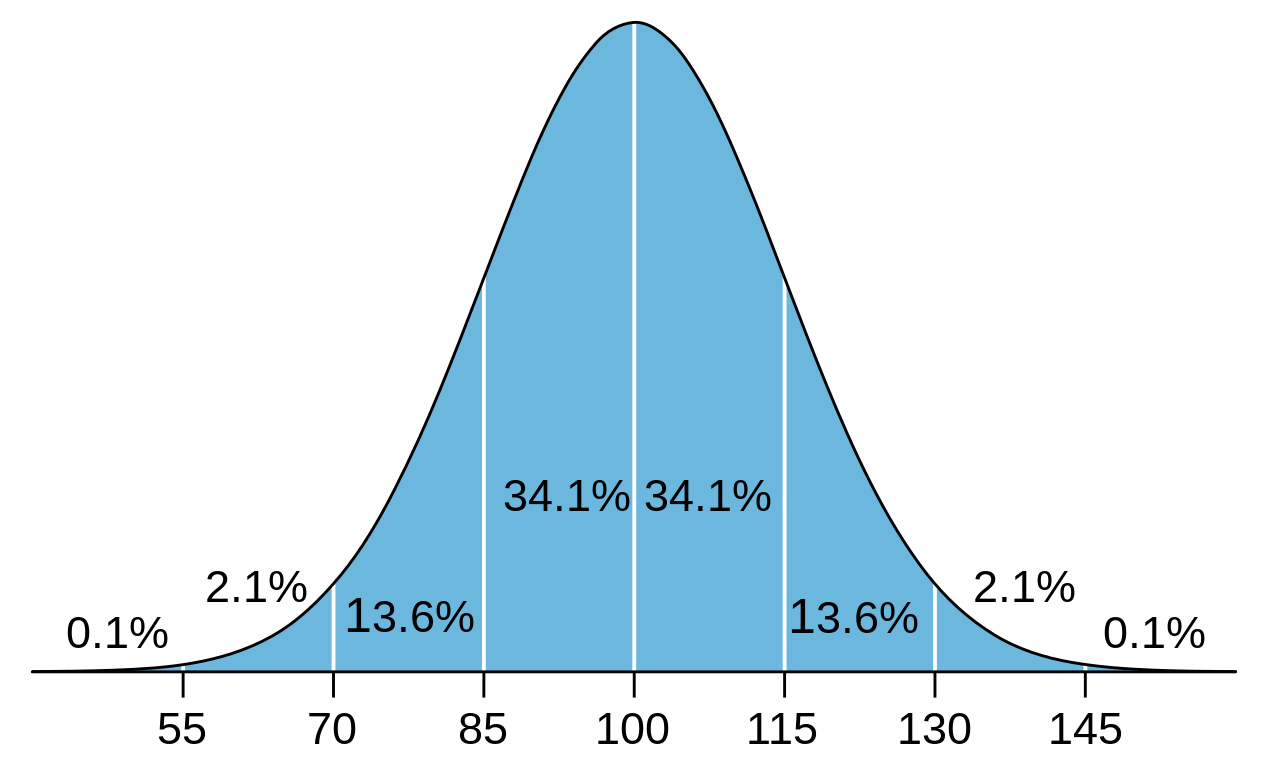
Let me start with some basic explanation of how an IQ test works. An IQ test is a set of ten or more different types of puzzles and questions that is scored by comparison to a sample designed to represent the population. It is set up so that an IQ score of 100 is the population average score; the higher you score the better you compare to the population. Most people score near to the average IQ, so the distribution is a bell curve – a distribution with fixed mathematical properties called a normal distribution. A normal distribution with a mean of 100 and a standard deviation (SD) of 15 points is used to create standard scores – IQ scores are calculated by using the raw score on the test comparing it to the norm group and then transposing that onto the standard distribution.

A properly validated IQ test shows IQ scores in terms of the number of standard deviations that person’s score is from the mean in a normal distribution of other people of their age in their country. As you can see from the graph below, the average IQ score is set at 100, and just over two thirds of people have an IQ score between 85 and 115. The further a score is from 100 the more unusual it is in the population. Only 2.28% of people score above and below 2 standard deviations from the mean. At the lower end, 2.28% of people have an IQ below 70 (considered a Learning Disability) and at the upper end of the range 2.28% have an IQ over 130 (considered “gifted” or “very superior”).

File:IQ distribution.svg - Wikipedia

So what about people who are super-bright? How accurately can we measure their ability?

Given that IQ tests are normed on only a few thousand people, the sample and thus the knowledge we have about the distribution of IQ in those ranges is pretty limited. By the time we look at the sample 3 SDs above the mean at 145+ we are studying 0.03% of the population (three people in every ten thousand) and that means that the normative sample will probably contain only two or three of those people at best. Of course most of the tests are normed in the USA, and the UK sample used to ensure it transfers to this country was only hundreds of people, so it probably didn’t contain any.

We then have the variable of error in measurement, which increases as you get to the edges of the distribution. You get a noise in the background during one item or a moment of misunderstanding and it can change the score by one or two points, and in these ranges that could make a huge difference. How valid can it be to stratify people in these extremes according to individual items of knowledge?

So, you would typically give either a confidence interval (the range at which the person is 95% likely to score if re-tested, according to the statistical properties of the test, usually the individual IQ score plus or minus 4-6 points) or a percentile. And the general practise is to say “the top 0.5%” for all scores above 140 and be no more specific than that. So the answer to my question is that we know fairly little about the distribution of IQ scores above 130 and the tests are not very good at reliably differentiating between scores in that range. That means I’d be sceptical about anyone claiming “genius” who cites a specific IQ score, as they clearly aren’t enough of a genius to understand the statistics or science of IQ measurement!

Does someone with a high IQ as a child keep getting higher?

No, cognitive assessments are designed to measure ability relative to your age peers, so that it is likely to remain a similar score as you get older. A child with an IQ of 130 is likely to become an adult with an IQ of 130, give or take the error of measurement, unless there is a significant head injury or some other explanation for the change. If someone under-performs on the test for some reason (for example because their attention is very poor) their score might improve if that reason is addressed (if their attention is improved by medication, change in their environment or practise at similar tasks). You can practise the specific tasks used in IQ tests and learn general knowledge and vocabulary deliberately to improve your score, and the score is not normally considered valid if the same test is used again within 24 months because of practise effects.

The norms for IQ tests are gathered for each language and country, so although they are meant to be “culture free” you also need to be mindful of cultural or language barriers to performance. And of course, in the end IQ scores measure how good you are at IQ tests, which may not reflect how “intelligent” you are in real life, where social skills, emotional intelligence, interests, ability to use executive functions to concentrate, self-monitor, learn from feedback and many other factors affect the degree to which you can succeed or appear exceptional. In fact it is often the people with the narrowest focus in their skill-set who are able to make the most impact in that area, and they may often not have the breadth of skills to appear that intelligent in other contexts. Of course there are some genuine polymaths, but it isn’t clear that IQ scores reflect functional skills beyond being reasonably predictive of academic attainments.

What about the IQ test I did online?

There are many online “IQ tests” that don’t have any proper norms and give meaningless results (in fact some of them like to give everybody high scores so that they will be more likely to share the link). In short, all of these “IQ tests” are done for entertainment and have little or no relationship with your actual IQ. There are also many assessments that are used in employment or education that have various levels of validation, and may be helpful to understand functional skills or predict attainments, but they don’t measure IQ. There was even a TV program linked with a “test the nation” survey a few years ago that used a simplified IQ-like survey to let people test themselves and see how they compared to other participants – but the sample collected is likely to be biased towards people who think they are clever and want to know their IQ, and to exclude people with learning disabilities.

For this reason a lot of people think they have done IQ tests, or know their IQ, when this isn’t really the case. In reality, if you want a properly validated IQ test then this is harder to come by. Only a practitioner psychologist is licensed to assess and interpret cognitive functioning with a validated IQ test. Because there is limited access to these tests in health and education settings, and the materials are restricted to certain professionals and expensive to use, IQ assessments are usually used to help identify areas of difficulty (eg for people with a learning disability or specific learning difficulties), or as part of an assessment for a particular condition (eg when looking at forms of neurodiversity like autism or ADHD).  Having a validated IQ assessment is also expensive in the private sector (approx £600-£1500). So, for all these reasons, they are not typically used for vanity testing for people who think they are clever.

So what about these scores cited in the media of IQs of 162? Are they cleverer than Stephen Hawking or Einstein?

Many high IQ societies don’t use the cognitive assessment tools that Clinical Psychologists use (like the Wechsler tests, or the Stanford Binet). Mensa for example use the Cattell which is not widely accepted as a valid test of IQ and has relatively low correlation with the standardised tests I mentioned. This test has a completely different scoring system, with a standard deviation of 24 points. This makes the highs look higher and the lows look lower, and it seems it is popular amongst high IQ societies because it is cheap to administer and pleasing to their members as it gives nice high numbers (you can also practise for it by doing the same kind of puzzles). It is also a good income generator for them. On this test a standard IQ score of 130 (achieved by that top 2.28% I mentioned earlier) would be a score of 148 – a higher number, but still designed to indicate the same level of ability (a score in the top 2.28%) – and a score of 145 on a standard test (achieved by the top 0.03% of the population) would be a score of 172.

So those published scores of 162 are high, but statistically we’d expect 3 in every ten thousand people to score over 170 on that scoring system – and simple multiplication tells us that across the population of the UK we’d expect there to be 18,000 people with that level of ability – whilst the error of measurement in that range must be enormous. In fact, we can say little about their IQ beyond “it is above 130 on a standardised test” due to the confidence intervals being very wide. To differentiate amongst super high ability people we would not only need a test that is able to be sufficiently granular at that ability range, we would have to norm it on representative samples of higher ability people studied in sufficient numbers to see what happens to the distribution as raw scores go up.

As to scores higher than Stephen Hawking or Einstein, that’s purely speculation. Neither of these two people have done comparable IQ tests, and the norms change year by year. Plus people can be brilliant at some things and less good at others, and there is not a perfect relationship between IQ and ‘intelligence’ let alone IQ predicting who will be a “genius” and increase the boundaries of current knowledge.

I’ll leave the last word to Stephen Hawking, when asked what his IQ was by the New York Times:

“I have no idea. People who boast about their I.Q. are losers”.

Bump!

Its been a while since I wrote a blog entry, so this is a catch-up to the little chain of events that took up my summer.

On 24th June I was driving from work to do an assessment in the community, when I gave way at a roundabout. Unfortunately the lorry behind me didn’t stop, and went into the back of me. I got jolted forward in my seatbelt, but walked out physically unscathed to find that you could hardly see the impact on the car either. Thankfully the lorry driver was lovely about it; concerned and apologetic and we exchanged details. I was right near the VW dealership where I bought the car, so I got them to check it was roadworthy and went on to my appointment about an hour late. The garage explained that cars are very well protected against straight on collisions, and the bumper would have absorbed most of the impact by crumpling inside, so it was later replaced by my insurance. Likewise I was fine on the outside, but things on the inside started to show the impact in unexpected ways, both physically and psychologically.

Physically I got a typical pattern of whiplash injury – pain in my neck and left shoulder, tightness in my left arm and a restricted range of movement, stiffness in my back, headaches and disrupted sleep. I also got dental pain, along with bruxism, the tendency to clench or grind your teeth, particularly during sleep. I’ve had similar physical symptoms from previous road traffic accidents (I’ve been hit several times before, 3 of which caused whiplash, but I’ve never had an at fault accident in 200,000+ miles since I bought my first car at age 20). But the psychological symptoms were new.

The first thing I noticed was that my concentration was completely shot. I couldn’t sequence tasks into the right order, sustain my attention or gather my thoughts enough to write coherently. I became more anxious, had an increased startle reaction to loud noises and weird scary dreams. I had to work hard to keep my mind on mundane tasks like driving, so I didn’t wander out of my lane on a quiet motorway and was attentive to the speed limit (although driving was limited anyway due to the pain in my shoulder and arm). I couldn’t draw together and reflect on the different information in my court reports, feel confident about my conclusions and present them effectively in a report, so I had to be signed off sick for a month – something I have never done before. However the weighty nature of doing expert witness work for the family court means that I had no other option, it wouldn’t have been ethical to have submitted poor work to inform the court’s decisions on such life-changing matters.

To compound things I started getting severe pain in my teeth and jaw. The dentist was initially unable to identify the source, but eventually found a crack in my wisdom tooth. He tried to fill this, but it caused me levels of pain that I have never experienced before (even in childbirth). A few days later they tried to remove the tooth but had to abort the attempt midway, due to an infection in my jaw. I spent the following week on antibiotics and analgesics, wavering between debilitating pain and a pleasant but unproductive codeine-induced haze. I was reminded how debilitating chronic pain can be, especially as I became more tolerant to codeine and had to alternate with ibuprofen to gain relief. I also found out that dental pain falls in the gaps between the out of hours services (the emergency dentist said “see your dentist on Monday, nothing we can do except let the antibiotics do their stuff, but see your GP if over the counter painkillers are not enough” whilst the walk in clinic said they couldn’t prescribe for dental pain). And to add insult to injury I got a speeding ticket for doing 36 mph on my way to the clinic. The tooth was removed the day before we flew to Scotland for our good friends’ wedding, and once there, I immediately started to feel somewhat better. On my return I was able to complete the delayed court reports and start to catch up with my email, albeit with limited intervals on the computer.

Now I feel like I’m getting back to normal. I’ve still got dental pain, and some physical restrictions (I can’t go weightlifting at the gym, my sleep isn’t 100% and I’m still very stiff on waking or if I do anything physical like playing with the kids or trying to pull a few weeds in the garden), but I feel like myself again psychologically. I can concentrate and plan to levels typical for me, and it has been an interesting experience to reflect upon. Taking time out of work was difficult for me, because it challenges both my expectations of myself as a perfectionist and workaholic, the level of input/control I’ve been able to have over my business, and my reputation as a reliable provider of services. The up side has been spending more time at home with the kids over the summer holidays, taking time to relax and being forced to think about self-care a bit more than usual. I am very lucky that my husband had just left his job and was able to postpone his freelance work and take on a lot of the domestic tasks, otherwise I don’t think that I’d have managed nearly as well.

As a self employed person, taking time off work also lost me a lot of money, but it was difficult to see this as a loss I had no control over (even though this is the case) rather than me being self-indulgent. Even though I was told that I could claim from the lorry driver’s insurance for lost earnings I was still loathe to make a claim. Plus it is hard to quantify losses when you don’t have a steady salary and payments come in months after I complete work. Of course I had to contact my insurer, as the car bumper was structurally compromised and needed replacement, and my insurance company in turn set other wheels in motion.

I genuinely loathe the personal injury claim industry from the speculative cold-calls and TV marketing to drum up trade to the impact on premiums and the motivation to malinger. I hate to be part of it. Yet I watch helplessly from the sidelines as the leaches of the insurance industry cream off maximum profit to take forward my claim, from the hire car whilst mine was in for repair (for more than twice the price of just walking into the local hire shop), to the paralegals at the ambulance-chasing law firm charging an obscene hourly rate for their cut-and-paste letters and calls. Yesterday I had my medical interview/examination with a very nice doctor who took 16 minutes to complete his assessment. Certainly an interesting contrast to the detailed day of interviews and assessments of each person I do for the family court!

So, its been an interesting summer. Despite the hiatus there is a lot I want to write about.

To the parent in the changing rooms this morning

It made me sad to hear you repeatedly criticise your child for minor things, and then conclude “you’ll go straight to bed when we get home”. When I came out the shower to see the child concerned was 12-18 months of age, and having to sit patiently on the counter whilst you did your hair and makeup, I wondered whether I should have said something. But being British, I bit my lip.

Here is what I’d have liked to have said:

Firstly: A child of that age won’t be able to sit still without making a noise for 20 minutes. It isn’t a realistic expectation, so you as a parent should bring along things to do or a snack for times like that. If the issue is that being up on the counter means they need supervision, use the playpen provided, or leave the child in the creche until you have got dressed. If you took the child swimming then make the whole outing fun, and recognise that after an energy-consuming activity a child might be more frazzled than usual, so prepare for this.

Second: A child of any age needs lots of praise and encouragement to learn how to behave, and to feel that they are a worthwhile person. You teach children best by showing them what you want them to do, not telling them what not to do, and praising any approximation of it whilst giving encouraging feedback until they get it right. Can you imagine teaching an adult to drive by saying what not to do? “Don’t hit the pedestrians… no, don’t mount the kerb… don’t hit that other car… don’t go so fast… don’t use that gear”. Would it work? Then why do you think a child can learn much more complex and subtle social and life skills based on what you don’t want them to do? Like a learner driver, they need to be told what to think about and prepare for, then given guidance how to do it, and feedback about how to improve their attempt next time, whilst making them feel okay about the fact that they are still learning and things are pretty hard until they become intuitive.

At this age, you also need to ensure your expectations are realistic – instructions for a child with a limited vocabulary are like trying to follow directions given a foreign language, whilst you are still learning how to use your body and interact with the world. Set simple clear rules and then be consistent in how you react to them. Hurting others or yourself, or breaking things on purpose are not okay, but the way you manage these has to be age appropriate. With a toddler, being told what they have done wrong and/or removed from the situation is the simplest response.

Third: Using sending to bed as a consequence for undesirable behaviour is a really bad choice for several reasons. Most obviously, it isn’t an immediate consequence. The child will not link the behaviour with the punishment if there is a gap of more than a few minutes until they are much older (even at 4-7 children will normally need an immediate consequence like a sticker to help them understand the longer term gain or loss is related to the behaviour). But it is also really silly to link going to bed with being punished. It sets up a negative reaction to being put to bed, which will increase arousal at exactly the time you should be helping a child to feel soothed and start winding down to sleep, and set up expectations of resisting going to bed or staying awake and active/noisy which are likely to lead to more negative feelings. If it is normally nap time just after lunch, make that a pleasant time, not a punishment. If it isn’t a nap time, then don’t use it at all.

Being put in isolation feels like being rejected and neglected and is a very serious consequence, even if only for a minute or two (which is why it works so powerfully in time out with older children). A preschool child being shut in their room for longer than a few minutes is abuse, and with an older child I’d still advocate for the shortest possible length of time. Consequences should last no more than the child’s age worth of minutes and be proportionate. Never deprive a child of food just because they have done something irritating – for most things your displeased facial expression and tone of voice are enough. With little ones you may have to physically intervene to make them safe or to take away something being used inappropriately (eg a crayon that is being drawn onto the table) but make sure to repair the relationship after you’ve given that consequence, and to praise the behaviours you want to see instead. Choose your battles wisely. Ignore the little stuff, it doesn’t matter compared to your child having a positive experience of themselves, others and the world. A positive relationship with their primary caregiver is the biggest gift you can give them and makes them resilient for the rest of their lives.

Finally, if you are stressed or unhappy, or lack parenting skills or support, do something about that. Your child sees you as the centre of their universe, and deserves to experience warmth, safety and love rather than recurrent criticism. If other stuff in your life or your mental health or experiences of being parented are a barrier to providing the kind of care you want to provide for your child, get some help. Ask your GP or speak to your health visitor. Lots of good parenting services exist, and it really is a sign of strength not of weakness to seek them out when it might benefit your child.

I hope I observed an unrepresentative sample of the relationship today, and that there was something the child did that merited the negative feedback, like trying to touch the hot hairdryer or the plug sockets. We all have bad hair days and moments when we aren’t the kind of parent we would like to be. But it made me realise how much of the maltreatment I see in the histories of people through work is the chronic, insidious, low-level kind, and how we all turn a blind eye to that every day. Maybe I should have spoken up to ask whether I could help, rather than being caught up in my own discomfort and feeling it would be difficult/inappropriate to criticise.

Sadly, I am sure there will be another time in another situation with another parent, so hopefully I can give that a try.

Siblings, friends and vampire bats: a story of reciprocity

I don’t remember that much of my undergraduate psychology degree. This may be because I wasn’t paying enough attention at the time, or because it was two decades ago, or because I have built so much later knowledge on top of it that the foundations are no longer visible, or some combination of the three. But I do recall that for the most part it didn’t feel that relevant to what I was most interested in – how I could help to alleviate human distress. I didn’t really care much for the mechanics, chemistry or geography of the brain. The seminal experiments that built our knowledge of human behaviour felt more about history than something I could apply in my daily life or future clinical practise. However, one course surprisingly caught my interest: behavioural ecology.

In this class, the text by Krebs and Davies, was a joy to read and full of fascinating insights into how human behaviour is very much just an extension of animal behaviour. Altruism in particular may feel like a sophisticated moral drive, but is in fact just a sensible survival strategy within a community of related individuals. I wrote essays that argued that religion and law were ways to formalise the reciprocity of altruistic behaviour. I particularly remember about vampire bats, and how donating blood to a peer who has not fed is a mutually beneficial strategy within the community. Such apparently selfless acts become a worthwhile investment when there is reciprocity, as one day you may need to be the recipient rather than the donor.

This came into my mind recently when I asked my brother if I could borrow some money. I was surprised that he hardly seemed to think about it before saying yes, until my parents pointed out that I had loaned him money and otherwise put myself out for him many times in the past. Similarly I asked old friends whether I could stay over with them when visiting a different part of the UK, and they were super accommodating to me. Both times it was interesting to have the experience of being the recipient of selfless kindness, as I very rarely make demands on others, despite constantly expecting myself to be a giver (perhaps because I feel that I am lucky enough to have plentiful resources myself both physically and emotionally most of the time). However, it felt very good to be the receiver for a change, and reminded me of the fact that there is pleasure on both sides of the relationship, and that reciprocity is the marker of the best relationships. Being helped is obviously a positive experience, but the act of helping a loved one is also rewarding in and of itself, and makes it more possible to ask for their help in the future.

In the bigger picture, my tendency to be a donor rather than a recipient is also one that I have been thinking about in a work context. I’ve clearly chosen a line of work in which I am acting to support those in need, and where I put some of my own emotional resources into my job. I’ve blogged in the past about times of feeling quite burnt out by my work (particularly my expert witness work for the family courts, as it contains so much grim content about child abuse) and the lack of nourishing and supportive experiences provided by certain employers or employment experiences (where good work doesn’t seem to be valued, and people are expected to live up to unrealistic expectations despite being sabotaged rather than supported to achieve them). I find myself wondering: where is the reciprocity? What do we get back when the positive feedback loops are absent? I read an excellent article about sick systems, and I found parts of it eerily familiar when I think back to my NHS days. I’m not in a sick system now, as I run my own company. Most of the time I can do work I enjoy and be rewarded for it (in terms of positive feedback, thanks and payment), but I do sometimes still feel somewhat exploited. I end up doing lots of committee work, policy documents, best practise papers and making contributions to the work of others (mostly unpaid and in my own time), and often those who promise input to these things, or to my work, don’t deliver. So why do I keep doing it? I wonder whether it is echoes of that culture that I carry with me, or my own unrelenting high standards and expectation I can always be a donor, or some combination of the two…

If the bigger picture is too depressing, look at the little picture

Today we learned that we will have a Conservative government for another five years, and I woke up feeling very pessimistic about the world. Clearly there are a lot of people who were swayed by the propaganda churned out by the billionaire owned newspapers, and the scaremongering about whether Scotland would steal English money. This is a sad day for the NHS, which will continue to be fragmented and put out to tender. It is a sad day for anyone dependent on benefits or health and social care services, who will continue to be blamed, stigmatised and treated like second class citizens. It is another five years in which wealth will be leached from the poorest and most vulnerable members of our society and given to the wealthiest and least deserving. So I could have stayed in bed and despaired for the state of the world. But I didn’t.

Today I made a difference person by person through my work. I also gave blood, and hopefully helped a stranger in their time of need. I was friendly to my neighbours and colleagues so that they could be a little happier as they went about their day. I donated to the DEC appeal for Nepal to help a displaced family have clean water. I gave advice to a person I don’t know on the internet to help them get their landlord to repair the hot water in their home. I spent time explaining things to my children and helped them to understand that the decisions that benefit us personally the most are not always the right ones to make when weighed up against the greater good. In other words, I made several small positive ripples go outwards into the world.

I’ve learnt that when problems on a global or political scale seem beyond my reach to influence I have two choices, to let despair immobilise me or to take it as an incentive to action. Today I was able to take the latter path, and I hope that many of you can too.

Getting organised

If you haven’t realised it by now, I’m the kind of person that keeps a lot of plates spinning in my professional life. I end up getting excited about things and find it hard to say no, even when I don’t have the capacity to give things the time they deserve. Perhaps because of this overload, and my avoidance of putting a financial value on my work, I have always struggling to get on top of the finances of the business, keep up with invoicing, respond to queries and book things in with enough time to complete everything before the deadline. However, I have relentless standards for my own work, so I try to do everything to the best of my ability, even if it eats into my time out of work (or even my sleep).

Having so much on the go requires a lot of organisational skills, and I know that I sometimes fall short in this regard, so I am very reliant on having a good team around me and particularly a good PA. Thus it was a disaster for me (although fab news for her) when my admin decided to leave Lifepsychol earlier this year and go and bake cakes instead. Worse still, it came at a time that I had two new Assistant Psychologists without prior experience starting in post, and a whole lot of deadlines. I had also concluded that delegating the book keeping to the accountants was not cost effective, as they did not understand the ins and outs of the business, or have access to our files or close enough communication with me to resolve queries. I was starting to panic that I wouldn’t be able to keep up with the demands and everything would fall apart.

Thus it is great news that I have recruited a new admin/operational manager, who is helping me to get everything organised, and has taken on the finances of the company, along with some of the personnel functions. This has been a lifeline as it has really taken the pressure off me, and allowed me to start chipping away at a to-do-list that has been growing much faster than I have been able to check items off it. It is helpful that there is a central point of contact for the company who is there on a full-time basis, and that is making all our lines of communication easier, especially as I seem to be all over the country at the moment!

Today we signed up for Google Apps for Work to set up shared cloud storage for the company, and a more professional company email, calendar and task-list system. We are gradually working through the state of the finances, and catching up with invoicing. We even sorted out the materials in the cupboards, and re-homed the five boxes of left over questionnaires from the diabetes study, some materials that were ordered in error, and a massive collection of used lever-arch files.

This really pleases my inner OCD, as I really dislike the feeling of disorganisation and clutter in my physical or psychological space. I have high hopes that once we are organised things can tick over in a much more satisfying way.

I’ve also been offered one of 10 UK places to be supported by ImpactHub to scale up one aspect of my business over the next year, so I’ll write more about that in my next blog!

Giving psychology away – the positive ripples of training

When I left the NHS I wondered whether I would have enough work to keep me busy, and felt like the expert witness work I do the family court would probably be the main strand of my income for the foreseeable future. However, perhaps because of my book, I have increasingly been asked to speak at conferences, provide training to various groups of professionals, and consult to organisations – particularly on the topic of working with attachment, trauma and the impact of maltreatment on children. This has become an enjoyable sideline where I can cascade psychological thinking to a wider audience, meet lots of new people, learn from others, and earn a good daily rate without the same emotional weight as doing court work.

I also like any work that involves improving the quality of services, particularly for complex or marginalised client groups. It was therefore very interesting to me when I was asked to meet up with some of the directors of a children’s home company, Keys Childcare, about offering training and consultation to a 20 placement project they were running about an hour away from my base. After some initial meetings, we decided that I would offer some staff training sessions (on attachment, trauma and the impact of maltreatment on children’s development) to all the staff, and then help them to implement a more systematic program of care planning and outcome measurement. The aim was to make decisions about which young people needed therapy and what form of therapy they received more evidence-based, as well as to ensure that all of the staff were involved in making the care for each young person as therapeutic as possible.

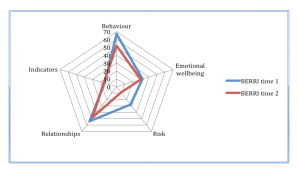
This fitted in really well with an outcome measurement system I had been developing for several years, using my ‘BERRI’ checklist of Behaviour, Emotional well-being, Relationships, Risk and Indicators of something requiring further assessment (such as markers of neuro-developmental conditions, or more usual behaviours, perception or thinking which would merit more specialised interventions). I had already developed a system whereby data could be entered into the BERRI online and produce a feedback report, and scores could be compared to track progress over time. This could produce a visual representation of a young person’s needs across the five dimensions, and allow us to be more holistic in our thinking about how to support them to make optimum progress.

radar

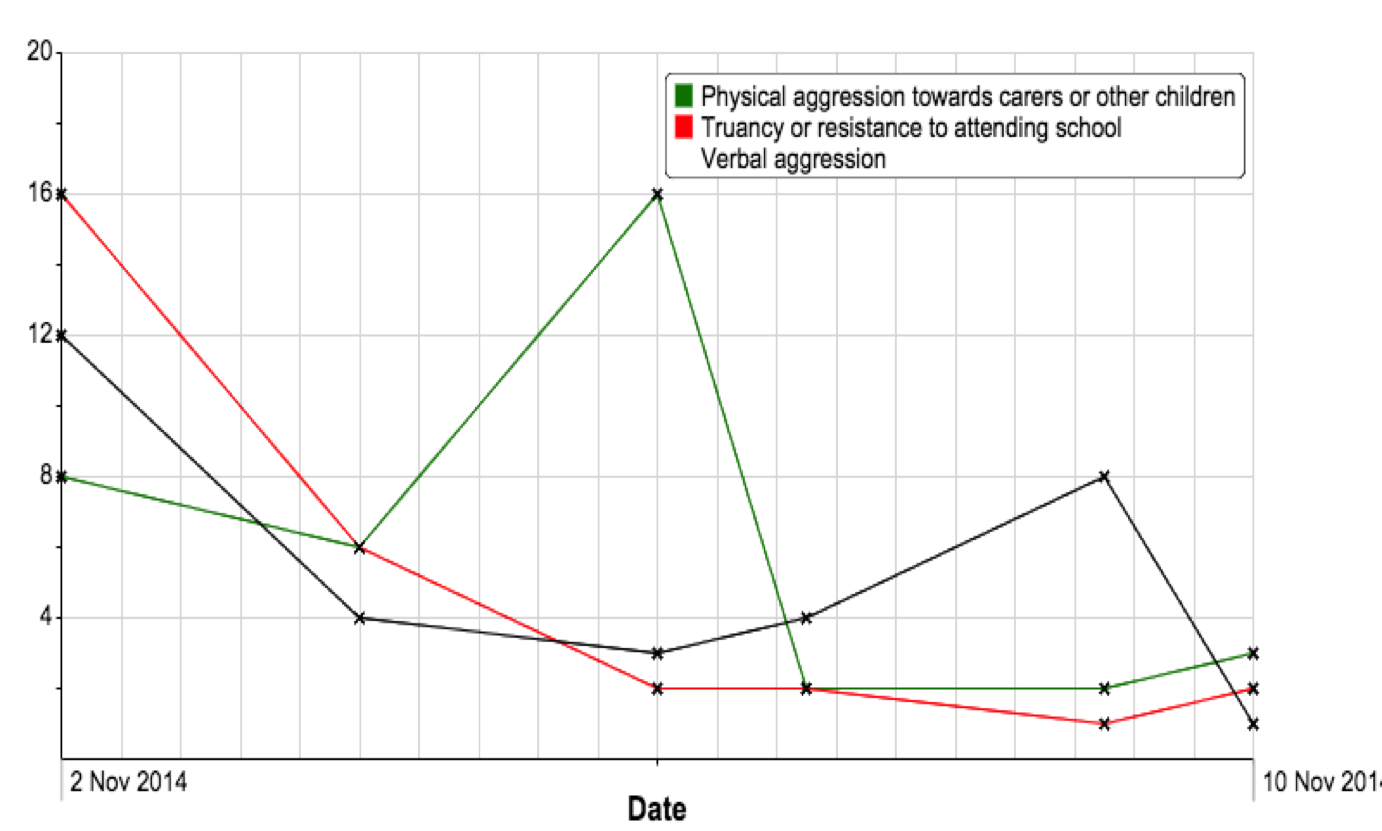
After discussion with friends and colleagues, I had started to develop a system for targeting particular concerns to address in the care plan. This involves identifying around three specific concerns from the BERRI and tracking them with greater frequency, typically daily, whilst giving the staff various strategies to try to address them. The target behaviours can be entered into the online system, which can then produce graphs to show progress and to identify any triggers. For example, in the chart below I’d hope that staff would instantly wonder what triggered the big green spike of aggressive behaviour.

tracking

I spent a couple of days each month with Keys, completing the staff training and improving the online system so that it would meet their needs. We also developed a pathway in which there would be a psychological screening assessment when young people arrive in placement, and their paperwork would be properly digested to ensure we had all relevant information from their history as well as an initial BERRI checklist, and we would bring this together in a meeting where the professionals around the child, their care team, the therapist linked to the home and myself would put together a therapeutic care plan document and identify the targets to work on over the coming months. The care plan could contain a summary of the history, a formulation section giving insight into the meaning of the behaviours and concerns the child was showing, then the targets we had agreed to track, and the strategies we had identified to help work on those concerns.

This was seen as a refinement to the existing therapeutic plan the homes in the project were already using, and embraced very positively. We called the approach Psychologically Informed Care-planning and Intervention, with the acronym PICI (which Jonathan Stanley, Chair of ICHA, said was an acronym that led naturally to a marketing slogan: “if you want the best for your child, get PICI”).

After a few months of seeing the changes within the local project, and gathering feedback from staff, social workers and commissioners, Keys decided to expand my remit. They asked me to do training for staff outside of my local project, and then to do some consulting to the wider organisation. They subsequently offered me a job as Clinical Director of Keys, with a remit to train all of their staff and implement the pathway across the whole organisation. This will take me three days per week for the next two years! They have also agreed to employ a psychology team to implement the project in each region, and this week we appointed the first qualified clinical psychologists. In time this team will grow to cover all of Keys services across the UK. We will also be taking on 3.5 assistant psychologists and more therapist time, so that we have a consistent level of consultation to each home in the company (with additional therapy time in the attachment homes where every child placed gets direct therapeutic input). This is super exciting, and I hope that we are able to evaluate the impact on both staff and the young people we look after.

Keys have embraced the new pathway and outcome measurement system as part of a wider push to improve staff training (which now also includes a modular training program that every staff member will work through) and to be able to evidence the effectiveness of their care. This includes a desire to be more evidence-based in how they make decisions about placements and interventions. The changes also coincided with the tenth anniversary of the company moving into childcare and buying the initial ten Keys homes from their previous owners, and also with a rebranding exercise. When they revealed the new branding a few weeks ago in Belfast I was delighted to see that Keys now describe themselves as providing “psychologically informed care for children and young people” and see this as a way to improve the quality of their placements (and through this to gain better Ofsted inspection grades, and become the placement of choice when commissioners seek to place complex young people).

It seems like a natural progression from the kind of consultation I was doing in a CAMHS LAC team, but on an organisation wide scale. My small amount of time has the power to influence more children by working indirectly. By “giving psychology away” I hope I am giving increased insight to those doing the day to day care, and slightly changing their way of working with the young people. Instead of a child getting one hour per week with me, they are getting 38 hours per week with a slightly more psychologically minded caregiver, and my influence can reach 320+ children and nearly 1000 staff.

The staff within Keys have been really enthusiastic about the new pathway and have given me positive feedback for the training days, so the although there is a lot of travelling and a very ambitious timetable for implementation I am really enjoying the work so far. I also get surprisingly positive feedback from training elsewhere, which is so lovely to receive. I think it really stands out for me given how few positive feedback loops there are in most clinical roles nowadays (beyond the occasional client or colleague sending a thank you card). I get a real buzz from positive tweets about my training or keynotes, gaining high scores on conference feedback forms, positive reviews of my book, or complimentary endorsements on LinkedIn.

I went up to Glasgow last week to train some staff to run my group program for parents and carers of maltreated children (Managing Behaviour with Attachment in Mind) and really enjoyed that also. Glaswegians really are the friendliest people in the world, and the group I trained were clearly hugely empathic to the children they work with so they were a delight to train. As I was leaving someone said to me that “training is a way to change the lives of thousands of children”. I think I had made some comment to brush this off (perhaps that it was the clinicians working directly with the families whose relationships were vital, rather than a day from a person like me), but she wasn’t having any of it. She said “no I mean it. I will interact different with the families I see tomorrow and in the future because I spent the day with you, and each person who came to the training will do likewise”. She explained emphatically that she had literally meant that in one day I had done something that would ripple out and change huge numbers of lives. That was pretty humbling to think about.

I’ve also had some exciting discussions about research, service evaluation and different kinds of therapeutic work (for example, working in partnership with collaborative lawyers). So I have decided to have a break from doing expert witness work over the summer and really have a think about what I most want to do. I need to weigh up all the choices in front of me, prioritise the things that make the most impact and/or give me the most satisfaction, and put some energy into finding allies with shared goals (including seeing whether I can recruit another clinical psychologist to LifePsychol in Milton Keynes to pick up some of the therapy and court work). I also want to reclaim my life outside of working hours, and to consider where in the country it makes most sense to be located. But it feels like all the effort I have invested in various projects to date is finally nearing fruition, and there are lots of interesting things on the horizon.

Long ago, I had a task list written on the whiteboard in my office, and Gilly had made me laugh by adding to the bottom of this “build secret volcano base, take over the world”, to reflect my ambitions to change practise on a wide scale. Maybe it isn’t such an unrealistic aim after all.