Falling through the cracks – the current state of NHS mental health services

Recently I spent sixteen hours trying to get an acute mental health assessment for a someone. The details of the case are not what matter here, but I want to talk about what I learnt from the process, and to do that I’ll need to give some context. It is necessarily vague and some information has also been changed to protect confidentiality.

However, as a pen picture it is fair to say that there was a combination of a severe deterioration in mental health with risk to others (the person had bizarre beliefs that led them to want to injure/kill people within particular demographics). The person did not want any mental health input, but I felt that the risk issues were so acute that it was necessary to override the lack of consent and request that an urgent mental health act assessment be undertaken. The other members of the household were keen for this to happen, as were various professionals who were already involved from the health, social care and criminal justice sectors. The person was open to a locality mental health service, but after the initial assessment identified various needs nobody had been allocated to undertake the work, so although it was an open case there had been no service for several months.

So, I rang the local service to ask for a psychiatric assessment. It wasn’t an area where I have worked before or a service that I had any prior experience with so I rang the number on their website. I explained I felt that there was acute risk coupled with obvious decline in mental health, but a lack of consent to treatment, so I enquired what kind of urgent services could be triggered, suggesting that the person involved would be difficult to approach and it would almost certainly be necessary to undertake a mental health act assessment and an admission against the person’s will might be necessary to safeguard others. And that is where I hit a brick wall.

The local service told me they were not commissioned to have a crisis service, and that unless the person involved had self-harmed they did not meet the urgent criteria. No amount of risk to others, or deterioration in mental health would qualify for their service, unless there was self-harm, or the person presented at A&E themselves, or we waited the timescales of their routine service (which had no capacity to allocate a worker). Pointing out the NICE guidance required a same-day response didn’t shift their position. Highlighting the risk to others or the individual likewise seemed to go unheard. The Approved Mental Health Professionals team said that the person met their criteria, but they could not get involved unless there was a psychiatrist from the locality team who had seen the person and would identify the bed if it was necessary to use a section. The psychiatrists said they were not resourced to go out and see people, and that they were not prepared to put themselves at risk by attending a person who presented a risk to others, even though I had arranged for the police to be present. They said the only way they would see the person was if the police used section 136 to bring them to the hospital as a place of safety, where they could then provide an assessment. They suggested that we call 999 to ask for ambulance and police assistance. The ambulance and police said they were not there to provide transport, and if the person was calm and inside the house, they did not present an imminent threat that required removing them using section 136.

Deadlock.

The next day I phoned the local mental health team again and asked to speak to someone senior to raise my concerns about the case. The duty clinician called me back several hours later. I got asked “what do you expect us to do on a Friday afternoon?” and “why is this our problem?” and then got talked over loudly again and again as I tried to explain the issues with risk and mental health. I asked politely four times for the person to stop talking over me, without effect and then asked her name. She refused to tell me and ultimately hung up on me. Her service wouldn’t tell me who I had spoken to, or give me any information about the complaints procedure beyond telling me to write a letter to their postal address. I asked to speak to a service manager. Unavailable. To a psychiatrist. Unavailable. I asked for someone to call me back. at 4.45 I got a return call with the same content as the previous conversations. No crisis service. Doesn’t meet their urgent criteria. A&E, the police bringing in under a 136 or nothing. I wrote a report giving all of my concerns to the whole network in writing.

In supervision I talked about my anxiety about a serious incident, and my fear that nothing would be done, and everyone would pass the buck. I was supported that my concerns were legitimate, and made the decision to try to take it up the chain of command. I called the department again. Then I called the directors of the trust involved, and the complaints department. I made calls all morning with no response, having already had no response for over a fortnight to concerns I felt were so acute they needed a same day response. So I called the CQC.

The CQC were very helpful, and made me feel that it was the right place to raise my concerns. I feel that the systemic issues will eventually be addressed because of the CQC having sufficient power to influence commissioning decisions, but that doesn’t help in the timescale of the individual. Likewise someone near the top of the trust concerned did get back to me the next day, and want to learn from the process (perhaps motivated by awareness of the CQC being involved). Hopefully we’ll look at the pathway, and address the various issues that my experience flagged up*. But again, that’s fixing the stable door after the horse has bolted. At the individual level, the outcome was disappointing. The person is moving to a different area within the next few weeks, and the service have decided that means that they don’t have to do anything, whilst the new area will only act if concerns are raised once the person arrives.

So the story doesn’t have an ending yet. There wasn’t a happily ever after, because the service I felt was required within a matter of hours hasn’t been provided, despite several weeks having passed. However, there hasn’t been a serious incident either. I’m keeping my fingers crossed the former happens before the latter.

But it was a pretty weird experience for me. Normally, if I raise a concern people take that pretty seriously. I’m a fairly senior clinician with the titles Dr and Consultant by my signature. I’ve been an expert witness in 200+ court cases. And I’ve had 20 years of experience against which to judge risk and after 16 years in the NHS I also think I have realistic expectations of services. I’ve never made a complaint about an NHS service before, and I hope I never have to again, but I didn’t feel like I had any other option. I was genuinely horrified to see defensive service specifications being used to deny a person with clear acute mental health needs a service. I felt like my concerns were ignored and dismissed because they were inconvenient and didn’t fit within existing pathways.

I’m not sure that my involvement did any good at all for the person in the end, despite spending hours and hours on the phone and writing emails and letters. But it made me wonder, what if I wasn’t there? What if there wasn’t someone with a title and qualifications and NICE guidelines to cite to try and agitate for the services to do the right thing? What if a family member or friend of the individual rather than a professional was trying to express their concerns? Why are the barriers so high when it comes to accessing mental health services? Why have services got specifications that exclude people in serious need? Why are the processes to raise concerns so opaque and so slow? Why don’t services join up better? Why are services always reactive and so rarely proactive? Are age, gender, race or other demographic characteristics a barrier to accessing treatment? Why are we still so far from parity between mental and physical health services? Why does mental health still not have the kind of services there are for acute physical health needs? Most of all, why does common sense and compassion get lost in pointless bureaucracy when it comes to referral pathways and criteria?

I used to be so proud to be part of the NHS. Now I wonder about what it has become. Is this just what is left after decades of cuts and reorganisations, or was I always a roll of the dice away from hitting a dead end?

*this was never followed up, so in retrospect it seems it was just platitudes to shut me up
Reflecting back

I’ve been archiving the files for a lot of my past court work this week. I moved office base and I don’t want to be cluttering up my new space with lots of old case information I don’t need any more, when it can be securely stored and eventually shredded. So far I’ve boxed up the files for 115 family court cases for which I completed an assessment and wrote a report, leaving only records that have been updated since the start of 2013 in my filing cabinet. As I check that each of the newer cases has been completed and invoiced, I will put those into storage too, and use my filing space for other things. It is another step in letting go of my role as an expert witness, and the huge weight of responsibility and emotional demand that entails.

As I put each case away, I added the family names to an index in order that I could locate them if it is ever required. I am supposed to keep files for seven years, or until the child is 21, so they stay with me a long time. As I record the names I realise I can remember the stories of many of the families, and I wondered how they were doing now. There were lots of traumas in those stories, that I heard and described in my reports, and felt in my bones. Many parents whose own childhoods meant that they couldn’t parent in a safe and nurturing way. Many of them dealt a hand full of adversity, who had no resources to cope with the stresses of their chaotic lives. Over and over again I saw children who were harmed by the care they were given, both in the children I had to assess, and in the histories of their parents and grandparents. Themes repeating across two or more generations.

It has always felt terribly sad that in order to give their children a chance at a better life, the courts have to intervene in ways that further wound the parents. But an expert’s job is to advise on what is best for the child, and sadly that is often contradictory with what is in the best interest of their parent. And I hope that I have always kept what would be best for the child paramount in my thinking, but whilst holding some compassion for the other family members. I think about the cases where I didn’t do the story justice, and the courts made decisions that I didn’t agree with. I worry about the cases where greater experience or new knowledge from the literature would have given me a slightly different perspective. I think about times I was threatened, or parents refused to talk to me, or I was cross-examined for five hours straight. Then I remember a time when a parent I assessed approaching me after I gave evidence, and feeling wary she was going to be angry that I recommended her child was removed. Instead she said thank you to me. “You were the only person I’ve met in all this that was always honest with me, and understood how I got here. I can see why you said what you did about me, and I think you are right that he will do better being adopted”. I’m still blown away by that. What an amazing gift to give me at a time that was so painful for her. I hope that she got the therapy she needed to put that reflection, empathy and kindness into practise in her life, and get out of the run of destructive relationships that had dominated her life.

I put the files into the box and lock them away. I am glad to let them go. It isn’t just physical space they take up, but mental space. Being an expert witness for the family court is a tough job. The hourly rates might seem high, but there are other ways to earn the same without the emotional burden. There have been pros and cons for me. I’m a different person now than I was when I began doing that work. I’m more observant and analytical, better able to ask the right questions, to deal with uncertainties, and to spot inconsistencies and triangulate sources. There have been rewarding moments too. I have had a lot of positive feedback about the quality of my assessments and evidence, and thanks for the impact of my work. But I’m also more cynical and I’ve seen a very dark side to the world. I’m more aware of the risks, and of how prevalent maltreatment and poor care are, even in our supposedly developed nation. I think I’m less trusting of people as a result of doing this type of work, and my norms for what levels of problems require professional help have shifted towards the more severe end of the spectrum, making me less sympathetic to people who feel very disadvantaged by more minor difficulties. I’ve also acquired the bad habits of work that has a strong pattern of boom-and-bust in demand – working through the night to make deadlines, putting in 80 hour weeks to meet demand, and generally taking on too much to leave enough of myself for other tasks and life outside work. It has also shown me that I can be a total control freak about the standards of work contributed by other members of my team, because my own standards are meticulous and I take this type of work – that can change the course of people’s lives – particularly seriously.

Letting go of court work is difficult, because it glitters. There is always demand, and it is nice to feel needed and held in high regard by other professionals. It feels as if you have genuine influence in the legal process (and I generally hold the UK justice system and public law professionals in high regard). The pay, although much reduced since legal aid cuts, still seems somehow more attractive as an hourly rate than the reality should be (given you can’t charge for much of the time these cases actually take, nor for administrative support such as typing or arranging appointments, nor for venues or materials it actually works out to be less than I make from other activities like therapy, training or consulting). It also has the kind of attraction of rubber-necking at a car-crash, as the cases each have their own grim story, are more complex than most clinical cases seen in secondary and tertiary tiers of service provision, and are often both acute and chronic in nature. I find it hard to say no when my skills are needed. But I must learn to delegate this work to others, or to decline, because I want to have my time and emotional energy back for other things.

And so it is good to archive my files, and to catch up with my invoicing, and to clear the decks of old ways of working to allow myself space for the new. It feels like putting down rocks I have been carrying for a long time….

Bedtime routine: The gift that keeps on giving

Of all the things I’ve done as a psychologist who is also a parent, the one I am probably most proud of is my bedtime routine. As I watch other people struggle to get their kids to sleep, or hear about the struggles of kids that keep getting out of bed or will only sleep with a parent present, I feel very grateful of the fact that mine always go down like magic.

The secret recipe started in infancy. After a difficult start with premature twins born before they had a suckle reflex, and six months of having to spend an hour feeding each of them every four hours (meaning we got a maximum of 2 hours sleep at a time), we turned a corner. At six months, we were told by our health visitor that they no longer needed milk in the night and could manage without a feed from the time we went to bed to 7am. So after a late feed at 11pm or midnight we got back our night. There were a few nights with some crying before the new routine was established. The first night pulled on all my emotional hooks, so I went to check and found they were fine and soon settled with me there, so the next night I was able to resist going for the ten minutes it took for the crying to peter out. Two nights later and it was quiet from midnight to seven am and we got back our unbroken sleep and our sanity. Soon after we saw that they were not taking much, if any, milk at the last feed and we were able to withdraw any room service from 7pm to 7am. By then, my night time routine was already in place.

Once baths are done, pyjamas are on and teeth are brushed, the kids get into bed and we make the room darker by closing the blackout curtains. I used to wish them goodnight using the same little rhyme every night, and then move straight to singing. Now they are older, when there is time, we normally have a little chat about the day and read a story – this is one of my favourite Mummy times, as we talk about all kinds of interesting things. Our conversations range from why some children are mean, to where petrol comes from, to why there is war in Gaza, to whether religious beliefs are true or just stories that some people believe and some people don’t, to how families have different configurations, why their second cousin had a brain tumour, or how flowers come back after the winter, or why some people are homeless. I’ve got a strong belief that if they are old enough to ask a question they are old enough to have an honest answer, no matter how difficult that answer is to articulate in simple terms for me as an adult. They have this insatiable thirst for knowledge, and often bring up what they have learnt at other times.

Whenever we have these discussions, my kids amaze me with their compassion and desire for fairness in the world. I still remember being told by a serious-faced four year old that we needed to “send a load of postcards to people in Israel and Palestine to tell them to look after and re-build schools, so that everybody can learn about how to be kind to others, no matter whether they believe in the Hanukkah God or the Eid God”. They were even younger when they explained how they want us to buy things that create employment in less developed countries, because most people have food and houses in England, but the people in other countries would want jobs that let them feed their families. And I remember how nonplussed they were to hear about gay marriage and how they couldn’t understand the examples of prejudice that kept coming up on the news because “its not right to be mean to people because of the colour of their skin or who they love”.

Then after our serious discussions and perhaps a bit of reading (Harry Potter and Rebel Girls seem to be favourites at the moment) it is time to wind down to sleep. Then quiet time begins. That signals that it is no longer the time to have a conversation and anything except the most urgent questions need to wait for the next day. I sing a few songs that they have chosen and a few old favourites, and within 15 minutes they are asleep. If we’ve had a busy day and we are out late, I can skip right to quiet time and go from active to asleep in the same time-frame. Friends and family members are often amazed, but I say its the best example of behavioural conditioning ever. I can even make the kids yawn by singing the same song in the middle of the day!

Of course it isn’t always perfect. If one of them is poorly, or I have been away too much in the week for work, they might stir and say “don’t go Mummy, sing an extra song” or they might wake in the night and come down for a cuddle or some medicine. But we always meet that need as quietly as possible and then return them to bed. Because when they sleep well, and we get quiet time as adults to wind down and catch up as a couple, the whole household is happier. We can flex the routine enough to stay up late for a special occasion or to give a little extra time on weekends or holidays, but we also flex the other way and start winding down earlier if they are tired and irritable. The kids even say “Mummy can we have an early night tonight as I’m feeling a bit tired and I want to have enough energy for swimming tomorrow?”

I know there is a lot of debate about ‘controlled crying’ but the few nights in which we ignored some crying at six months have reaped rewards ever since, and we have a happier family as a result. Of course, it won’t work for everyone. There are plenty of children who are more difficult to get to sleep than ours, but my advice would be to have a very clear routine, to start as young as possible, to be very calm as a parent throughout, and to persist through the difficult bit as quietly and calmly and consistently as possible. Because sleeping well helps all members of the family to regulate their emotional state better and have more positive experiences throughout the day as well as at night. I know I’m happier and more able to focus when I’ve had enough sleep, and the same is true for all members of the family.

If you build it they will come: The impact of making space in my professional life

When my personal development coach told me that the first steps towards having a happier working life and better work life balance were to a) figure out what I wanted to do most and b) clear out some space in my life for it to fit into, that seemed a bit back to front and almost too obvious.

Although I’ve always known that I want to apply clinical psychology to helping the most complex children and families, I felt a real lack of clarity about what I wanted to do. I think in retrospect this was because I’d originally envisaged nothing more creative than a career in CAMHS in the NHS. But even once I was outside the NHS I still felt this lack of vision for my ideal future, perhaps because I wanted to choose it from the options available to me, and I hadn’t explored what those might be very far beyond returning to the NHS or continuing what I was doing already (court expert witness work, with a side helping of trying to influence policy and practise by being involved with national committees, standards groups and supporting the next generation of CPs).

I had also internalised the idea that the right process was to build up my investment of time in what I wanted to do more, until that took off and allowed me to do less of the other stuff. I felt like clearing out space from my established work streams was of no value (or even a potential risk to my income) unless I had figured out what I wanted to do, or ideally created the alternative channels already. But slowly I realised that if all my time and energy was being consumed by my current workload, then there was no capacity to imagine anything better, to seek out any opportunities or plan any change, and I’d still be overloading myself and worrying about my work life balance in a year from now, or five, or ten.

So I decided to take a gamble and cut down my work commitments for a while and give myself thinking space to figure it out. Of course, being me, I took on the new part-time consulting role that was going to pay the bills whilst giving me time to think before I had managed to reduce my existing workload. So I had six months in which I had to overlap this new role with my all my ongoing court and committee work, before I was able to wind them down very much at all, and then a minor RTA to contend with (see previous blog). So I sure didn’t take the easy route to cutting down.

But the physical jolt was the final straw to help me to realise that I needed to change my work patterns and I have been able to spend more time with my family, and have now stepped down from almost all of my committee roles. This is an enormous change after 4 or 5 years on the BPS CYPF committee, nearly double that of being involved with CPLAAC, and more recently being part of the BPS/FJC standards group for psychology experts to the family court and the NICE guidance development group for attachment interventions, and a rep from the BPS to BAAF. I am now at the very tail end of the court work, with just three small pieces of work to complete (each an addendum to prior work or work that was delayed after I agreed to complete it) and a couple of single days in court.

Although my time is still very fraught for another couple of weeks and we will then segue into Christmas (meaning my winding down schedule will have taken me almost a year to achieve), I’ve managed to get onto some tasks I have been avoiding for a long time. I’ve started to work my way through the financial tangles that constantly stop things running smoothly – this is mainly the enormous pile of unpaid invoices where parties to court work have disputed their share, gone bust, or just not paid for years and years, but also includes the un-invoiced work that we have completed, expenses I have not claimed back from the company, and the administrative task of reconciling our records with the bank statements. My team have stepped up to help me and as I have made sense of it bit by bit it feels like that tangle is turning into a single logical thread I can follow and wind up as I go.

As I sort and put away the clutter that consumes my time and energy step by step, I am starting to feel less overwhelmed by running the business. As the volume of court work I undertake reduces, so does the emotional weight of the work. And as the burden I am carrying gets lighter, psychologically at least, some small gaps between the demands on my time and energy are already starting to appear. Into those gaps has come the beginnings of the vision I lacked of where I want to take my career in the future, and what kind of life I want.

I’m sure I’ll talk more about that next time. But for now I just wanted to share that it feels great to put down some of the load I have been carrying, to untangle the frustrating little issues that have been tying me up, and to create space for the stuff that I care about the most. With the help of a new business mentor I’ve been able to connect with the motivation that started me on this journey, and to finally work out where I want to go both personally and professionally. And that makes all the steps I have to take to get there much clearer.

I made the space, and sure enough, the goals of how I want to fill it have come to me.

Talking about depression and seeking help

Someone I know emailed me this week, saying he was feeling depressed. He was very self-critical about it because objectively his life was the best it had ever been (after a lot of difficult experiences in his childhood and early adult life he is now employed, in a relationship, with a nice home) and therefore it felt ungrateful to complain about anything (like social anxiety, work stress, sleep disturbance, niggles in the relationship, having to care for a dependent parent) as he should be happy. He felt perpetually exhausted and like therapy and medication was for people with ‘real problems’ and talked about wishing he didn’t exist. This was my answer:

There is no ‘should’ with feelings. They just are what they are. We can learn to challenge our thoughts or change our behaviours, which can have a positive knock on effect, but feelings we have little control over. So just be mindful of them, and try to deal with the stuff that underlies them when you are feeling well-resourced and supported.

I read a rather naff explanation on facebook today, but it has a germ of wisdom in it:

I held up an orange and asked a boy in the audience “If I were to squeeze this orange as hard as I could, what would come out?”

He looked at me like I was a little crazy and said, “Juice, of course.”

“Do you think apple juice could come out of it?”

“No!” he laughed.

“What about grapefruit juice?”

“No!”

“What would come out of it?”

“Orange juice, of course.”

“Why? Why when you squeeze an orange does orange juice come out?”

He may have been getting a little exasperated with me at this point.

“Well, it’s an orange and that’s what’s inside.”

I nodded. “Let’s assume that this orange isn’t an orange, but it’s you. And someone squeezes you, puts pressure on you, says something you don’t like, offends you. And out of you comes anger, hatred, bitterness, fear. Why? The answer, as our young friend has told us, is because that’s what’s inside.”

It’s one of the great lessons of life. What comes out when life squeezes you? When someone hurts or offends you? If anger, pain and fear come out of you, it’s because that’s what’s inside. It doesn’t matter who does the squeezing—your mother, your brother, your children, your boss, the government. If someone says something about you that you don’t like, what comes out of you is what’s inside. And what’s inside is up to you, it’s your choice.

When someone puts the pressure on you and out of you comes anything other than love, it’s because that’s what you’ve allowed to be inside. Once you take away all those negative things you don’t want in your life and replace them with love, you’ll find yourself living a highly functioning life.

Now, I’m not totally on board with filling yourself exclusively with love and light (because I think negative feelings are pretty normal and have their value too), and I’m not sure that anyone can ever respond only positively to life’s pressures, but he is right with one thing – your response under stress reflects what you have learnt and experienced in your life up to that point. If you are filled with the poison of being bullied at school or denigrated by your parents, with the wounds of failed relationships, with traumas and losses, then that becomes your norm. It will tarnish your view of yourself, the world and others, and it has the potential to leak out in unhelpful ways. When you carry that baggage and aren’t buoyed up by positive experiences and relationships it becomes much harder to be resilient to the day to day stressors of life. It becomes harder to feel you deserve a better life and to seek out positive experiences for yourself, and you can instead end up avoiding or sabotaging them.

Therapy is there to help you recognise that skew, and to separate the result of negative experiences from your innate worth as an individual. It can help you to challenge your thinking, to change your behaviour, to give yourself opportunities to test and refine your beliefs about yourself, the world and others. It can help you reflect on the patterns in your relationships, why you keep replaying the ones that are not helpful and how you can begin to change this. And sometimes when you are feeling so hopeless and worn out that even the idea of therapy is too much to manage, medication can help to give you the energy and optimism back to allow change to be possible.

The biggest problem of depression is that people can see it compassionately in others, but we are very critical of ourselves for feeling that way, and unable to recognise that the stuckness and self criticism is part of the depression and – importantly – eminently treatable. If you read back your email to me and imagine someone else made it, I think you’d be a lot more compassionate to that person than you are being to yourself. The problem is that you are trying to measure the objective situation with a subjective (and in fact distorted) tool – yourself. And that distortion increases when you are depressed. So be kind to yourself, and allow others to help you. You don’t have to be stuck with feeling sad just because you can’t pin a reason for it on something specific or because there are other people who have bigger problems in their lives.

You said that you sometimes wish you didn’t exist, but I am very glad you do, and I am sure that there are lots of other people who value you and would miss you if you weren’t around. When you are depressed it is hard (if not impossible) to imagine that life can get better. But it can get better. Not only that, but it does get better for most people with depression. Most people who are depressed or even suicidal go on to happier times and to be glad they didn’t act on those thoughts. So please, seek help and don’t give up. Call the Samaritans if you feel like you might harm yourself, and speak to your GP about medication and/or a referral for psychological therapy. After all, 90% of people who turn up to therapy start to feel better, and you can too.

Bump!

Its been a while since I wrote a blog entry, so this is a catch-up to the little chain of events that took up my summer.

On 24th June I was driving from work to do an assessment in the community, when I gave way at a roundabout. Unfortunately the lorry behind me didn’t stop, and went into the back of me. I got jolted forward in my seatbelt, but walked out physically unscathed to find that you could hardly see the impact on the car either. Thankfully the lorry driver was lovely about it; concerned and apologetic and we exchanged details. I was right near the VW dealership where I bought the car, so I got them to check it was roadworthy and went on to my appointment about an hour late. The garage explained that cars are very well protected against straight on collisions, and the bumper would have absorbed most of the impact by crumpling inside, so it was later replaced by my insurance. Likewise I was fine on the outside, but things on the inside started to show the impact in unexpected ways, both physically and psychologically.

Physically I got a typical pattern of whiplash injury – pain in my neck and left shoulder, tightness in my left arm and a restricted range of movement, stiffness in my back, headaches and disrupted sleep. I also got dental pain, along with bruxism, the tendency to clench or grind your teeth, particularly during sleep. I’ve had similar physical symptoms from previous road traffic accidents (I’ve been hit several times before, 3 of which caused whiplash, but I’ve never had an at fault accident in 200,000+ miles since I bought my first car at age 20). But the psychological symptoms were new.

The first thing I noticed was that my concentration was completely shot. I couldn’t sequence tasks into the right order, sustain my attention or gather my thoughts enough to write coherently. I became more anxious, had an increased startle reaction to loud noises and weird scary dreams. I had to work hard to keep my mind on mundane tasks like driving, so I didn’t wander out of my lane on a quiet motorway and was attentive to the speed limit (although driving was limited anyway due to the pain in my shoulder and arm). I couldn’t draw together and reflect on the different information in my court reports, feel confident about my conclusions and present them effectively in a report, so I had to be signed off sick for a month – something I have never done before. However the weighty nature of doing expert witness work for the family court means that I had no other option, it wouldn’t have been ethical to have submitted poor work to inform the court’s decisions on such life-changing matters.

To compound things I started getting severe pain in my teeth and jaw. The dentist was initially unable to identify the source, but eventually found a crack in my wisdom tooth. He tried to fill this, but it caused me levels of pain that I have never experienced before (even in childbirth). A few days later they tried to remove the tooth but had to abort the attempt midway, due to an infection in my jaw. I spent the following week on antibiotics and analgesics, wavering between debilitating pain and a pleasant but unproductive codeine-induced haze. I was reminded how debilitating chronic pain can be, especially as I became more tolerant to codeine and had to alternate with ibuprofen to gain relief. I also found out that dental pain falls in the gaps between the out of hours services (the emergency dentist said “see your dentist on Monday, nothing we can do except let the antibiotics do their stuff, but see your GP if over the counter painkillers are not enough” whilst the walk in clinic said they couldn’t prescribe for dental pain). And to add insult to injury I got a speeding ticket for doing 36 mph on my way to the clinic. The tooth was removed the day before we flew to Scotland for our good friends’ wedding, and once there, I immediately started to feel somewhat better. On my return I was able to complete the delayed court reports and start to catch up with my email, albeit with limited intervals on the computer.

Now I feel like I’m getting back to normal. I’ve still got dental pain, and some physical restrictions (I can’t go weightlifting at the gym, my sleep isn’t 100% and I’m still very stiff on waking or if I do anything physical like playing with the kids or trying to pull a few weeds in the garden), but I feel like myself again psychologically. I can concentrate and plan to levels typical for me, and it has been an interesting experience to reflect upon. Taking time out of work was difficult for me, because it challenges both my expectations of myself as a perfectionist and workaholic, the level of input/control I’ve been able to have over my business, and my reputation as a reliable provider of services. The up side has been spending more time at home with the kids over the summer holidays, taking time to relax and being forced to think about self-care a bit more than usual. I am very lucky that my husband had just left his job and was able to postpone his freelance work and take on a lot of the domestic tasks, otherwise I don’t think that I’d have managed nearly as well.

As a self employed person, taking time off work also lost me a lot of money, but it was difficult to see this as a loss I had no control over (even though this is the case) rather than me being self-indulgent. Even though I was told that I could claim from the lorry driver’s insurance for lost earnings I was still loathe to make a claim. Plus it is hard to quantify losses when you don’t have a steady salary and payments come in months after I complete work. Of course I had to contact my insurer, as the car bumper was structurally compromised and needed replacement, and my insurance company in turn set other wheels in motion.

I genuinely loathe the personal injury claim industry from the speculative cold-calls and TV marketing to drum up trade to the impact on premiums and the motivation to malinger. I hate to be part of it. Yet I watch helplessly from the sidelines as the leaches of the insurance industry cream off maximum profit to take forward my claim, from the hire car whilst mine was in for repair (for more than twice the price of just walking into the local hire shop), to the paralegals at the ambulance-chasing law firm charging an obscene hourly rate for their cut-and-paste letters and calls. Yesterday I had my medical interview/examination with a very nice doctor who took 16 minutes to complete his assessment. Certainly an interesting contrast to the detailed day of interviews and assessments of each person I do for the family court!

So, its been an interesting summer. Despite the hiatus there is a lot I want to write about.

To the parent in the changing rooms this morning

It made me sad to hear you repeatedly criticise your child for minor things, and then conclude “you’ll go straight to bed when we get home”. When I came out the shower to see the child concerned was 12-18 months of age, and having to sit patiently on the counter whilst you did your hair and makeup, I wondered whether I should have said something. But being British, I bit my lip.

Here is what I’d have liked to have said:

Firstly: A child of that age won’t be able to sit still without making a noise for 20 minutes. It isn’t a realistic expectation, so you as a parent should bring along things to do or a snack for times like that. If the issue is that being up on the counter means they need supervision, use the playpen provided, or leave the child in the creche until you have got dressed. If you took the child swimming then make the whole outing fun, and recognise that after an energy-consuming activity a child might be more frazzled than usual, so prepare for this.

Second: A child of any age needs lots of praise and encouragement to learn how to behave, and to feel that they are a worthwhile person. You teach children best by showing them what you want them to do, not telling them what not to do, and praising any approximation of it whilst giving encouraging feedback until they get it right. Can you imagine teaching an adult to drive by saying what not to do? “Don’t hit the pedestrians… no, don’t mount the kerb… don’t hit that other car… don’t go so fast… don’t use that gear”. Would it work? Then why do you think a child can learn much more complex and subtle social and life skills based on what you don’t want them to do? Like a learner driver, they need to be told what to think about and prepare for, then given guidance how to do it, and feedback about how to improve their attempt next time, whilst making them feel okay about the fact that they are still learning and things are pretty hard until they become intuitive.

At this age, you also need to ensure your expectations are realistic – instructions for a child with a limited vocabulary are like trying to follow directions given a foreign language, whilst you are still learning how to use your body and interact with the world. Set simple clear rules and then be consistent in how you react to them. Hurting others or yourself, or breaking things on purpose are not okay, but the way you manage these has to be age appropriate. With a toddler, being told what they have done wrong and/or removed from the situation is the simplest response.

Third: Using sending to bed as a consequence for undesirable behaviour is a really bad choice for several reasons. Most obviously, it isn’t an immediate consequence. The child will not link the behaviour with the punishment if there is a gap of more than a few minutes until they are much older (even at 4-7 children will normally need an immediate consequence like a sticker to help them understand the longer term gain or loss is related to the behaviour). But it is also really silly to link going to bed with being punished. It sets up a negative reaction to being put to bed, which will increase arousal at exactly the time you should be helping a child to feel soothed and start winding down to sleep, and set up expectations of resisting going to bed or staying awake and active/noisy which are likely to lead to more negative feelings. If it is normally nap time just after lunch, make that a pleasant time, not a punishment. If it isn’t a nap time, then don’t use it at all.

Being put in isolation feels like being rejected and neglected and is a very serious consequence, even if only for a minute or two (which is why it works so powerfully in time out with older children). A preschool child being shut in their room for longer than a few minutes is abuse, and with an older child I’d still advocate for the shortest possible length of time. Consequences should last no more than the child’s age worth of minutes and be proportionate. Never deprive a child of food just because they have done something irritating – for most things your displeased facial expression and tone of voice are enough. With little ones you may have to physically intervene to make them safe or to take away something being used inappropriately (eg a crayon that is being drawn onto the table) but make sure to repair the relationship after you’ve given that consequence, and to praise the behaviours you want to see instead. Choose your battles wisely. Ignore the little stuff, it doesn’t matter compared to your child having a positive experience of themselves, others and the world. A positive relationship with their primary caregiver is the biggest gift you can give them and makes them resilient for the rest of their lives.

Finally, if you are stressed or unhappy, or lack parenting skills or support, do something about that. Your child sees you as the centre of their universe, and deserves to experience warmth, safety and love rather than recurrent criticism. If other stuff in your life or your mental health or experiences of being parented are a barrier to providing the kind of care you want to provide for your child, get some help. Ask your GP or speak to your health visitor. Lots of good parenting services exist, and it really is a sign of strength not of weakness to seek them out when it might benefit your child.

I hope I observed an unrepresentative sample of the relationship today, and that there was something the child did that merited the negative feedback, like trying to touch the hot hairdryer or the plug sockets. We all have bad hair days and moments when we aren’t the kind of parent we would like to be. But it made me realise how much of the maltreatment I see in the histories of people through work is the chronic, insidious, low-level kind, and how we all turn a blind eye to that every day. Maybe I should have spoken up to ask whether I could help, rather than being caught up in my own discomfort and feeling it would be difficult/inappropriate to criticise.

Sadly, I am sure there will be another time in another situation with another parent, so hopefully I can give that a try.

Siblings, friends and vampire bats: a story of reciprocity

I don’t remember that much of my undergraduate psychology degree. This may be because I wasn’t paying enough attention at the time, or because it was two decades ago, or because I have built so much later knowledge on top of it that the foundations are no longer visible, or some combination of the three. But I do recall that for the most part it didn’t feel that relevant to what I was most interested in – how I could help to alleviate human distress. I didn’t really care much for the mechanics, chemistry or geography of the brain. The seminal experiments that built our knowledge of human behaviour felt more about history than something I could apply in my daily life or future clinical practise. However, one course surprisingly caught my interest: behavioural ecology.

In this class, the text by Krebs and Davies, was a joy to read and full of fascinating insights into how human behaviour is very much just an extension of animal behaviour. Altruism in particular may feel like a sophisticated moral drive, but is in fact just a sensible survival strategy within a community of related individuals. I wrote essays that argued that religion and law were ways to formalise the reciprocity of altruistic behaviour. I particularly remember about vampire bats, and how donating blood to a peer who has not fed is a mutually beneficial strategy within the community. Such apparently selfless acts become a worthwhile investment when there is reciprocity, as one day you may need to be the recipient rather than the donor.

This came into my mind recently when I asked my brother if I could borrow some money. I was surprised that he hardly seemed to think about it before saying yes, until my parents pointed out that I had loaned him money and otherwise put myself out for him many times in the past. Similarly I asked old friends whether I could stay over with them when visiting a different part of the UK, and they were super accommodating to me. Both times it was interesting to have the experience of being the recipient of selfless kindness, as I very rarely make demands on others, despite constantly expecting myself to be a giver (perhaps because I feel that I am lucky enough to have plentiful resources myself both physically and emotionally most of the time). However, it felt very good to be the receiver for a change, and reminded me of the fact that there is pleasure on both sides of the relationship, and that reciprocity is the marker of the best relationships. Being helped is obviously a positive experience, but the act of helping a loved one is also rewarding in and of itself, and makes it more possible to ask for their help in the future.

In the bigger picture, my tendency to be a donor rather than a recipient is also one that I have been thinking about in a work context. I’ve clearly chosen a line of work in which I am acting to support those in need, and where I put some of my own emotional resources into my job. I’ve blogged in the past about times of feeling quite burnt out by my work (particularly my expert witness work for the family courts, as it contains so much grim content about child abuse) and the lack of nourishing and supportive experiences provided by certain employers or employment experiences (where good work doesn’t seem to be valued, and people are expected to live up to unrealistic expectations despite being sabotaged rather than supported to achieve them). I find myself wondering: where is the reciprocity? What do we get back when the positive feedback loops are absent? I read an excellent article about sick systems, and I found parts of it eerily familiar when I think back to my NHS days. I’m not in a sick system now, as I run my own company. Most of the time I can do work I enjoy and be rewarded for it (in terms of positive feedback, thanks and payment), but I do sometimes still feel somewhat exploited. I end up doing lots of committee work, policy documents, best practise papers and making contributions to the work of others (mostly unpaid and in my own time), and often those who promise input to these things, or to my work, don’t deliver. So why do I keep doing it? I wonder whether it is echoes of that culture that I carry with me, or my own unrelenting high standards and expectation I can always be a donor, or some combination of the two…

Getting organised

If you haven’t realised it by now, I’m the kind of person that keeps a lot of plates spinning in my professional life. I end up getting excited about things and find it hard to say no, even when I don’t have the capacity to give things the time they deserve. Perhaps because of this overload, and my avoidance of putting a financial value on my work, I have always struggling to get on top of the finances of the business, keep up with invoicing, respond to queries and book things in with enough time to complete everything before the deadline. However, I have relentless standards for my own work, so I try to do everything to the best of my ability, even if it eats into my time out of work (or even my sleep).

Having so much on the go requires a lot of organisational skills, and I know that I sometimes fall short in this regard, so I am very reliant on having a good team around me and particularly a good PA. Thus it was a disaster for me (although fab news for her) when my admin decided to leave Lifepsychol earlier this year and go and bake cakes instead. Worse still, it came at a time that I had two new Assistant Psychologists without prior experience starting in post, and a whole lot of deadlines. I had also concluded that delegating the book keeping to the accountants was not cost effective, as they did not understand the ins and outs of the business, or have access to our files or close enough communication with me to resolve queries. I was starting to panic that I wouldn’t be able to keep up with the demands and everything would fall apart.

Thus it is great news that I have recruited a new admin/operational manager, who is helping me to get everything organised, and has taken on the finances of the company, along with some of the personnel functions. This has been a lifeline as it has really taken the pressure off me, and allowed me to start chipping away at a to-do-list that has been growing much faster than I have been able to check items off it. It is helpful that there is a central point of contact for the company who is there on a full-time basis, and that is making all our lines of communication easier, especially as I seem to be all over the country at the moment!

Today we signed up for Google Apps for Work to set up shared cloud storage for the company, and a more professional company email, calendar and task-list system. We are gradually working through the state of the finances, and catching up with invoicing. We even sorted out the materials in the cupboards, and re-homed the five boxes of left over questionnaires from the diabetes study, some materials that were ordered in error, and a massive collection of used lever-arch files.

This really pleases my inner OCD, as I really dislike the feeling of disorganisation and clutter in my physical or psychological space. I have high hopes that once we are organised things can tick over in a much more satisfying way.

I’ve also been offered one of 10 UK places to be supported by ImpactHub to scale up one aspect of my business over the next year, so I’ll write more about that in my next blog!

Giving psychology away – the positive ripples of training

When I left the NHS I wondered whether I would have enough work to keep me busy, and felt like the expert witness work I do the family court would probably be the main strand of my income for the foreseeable future. However, perhaps because of my book, I have increasingly been asked to speak at conferences, provide training to various groups of professionals, and consult to organisations – particularly on the topic of working with attachment, trauma and the impact of maltreatment on children. This has become an enjoyable sideline where I can cascade psychological thinking to a wider audience, meet lots of new people, learn from others, and earn a good daily rate without the same emotional weight as doing court work.

I also like any work that involves improving the quality of services, particularly for complex or marginalised client groups. It was therefore very interesting to me when I was asked to meet up with some of the directors of a children’s home company, Keys Childcare, about offering training and consultation to a 20 placement project they were running about an hour away from my base. After some initial meetings, we decided that I would offer some staff training sessions (on attachment, trauma and the impact of maltreatment on children’s development) to all the staff, and then help them to implement a more systematic program of care planning and outcome measurement. The aim was to make decisions about which young people needed therapy and what form of therapy they received more evidence-based, as well as to ensure that all of the staff were involved in making the care for each young person as therapeutic as possible.

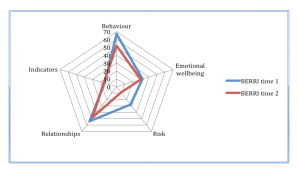
This fitted in really well with an outcome measurement system I had been developing for several years, using my ‘BERRI’ checklist of Behaviour, Emotional well-being, Relationships, Risk and Indicators of something requiring further assessment (such as markers of neuro-developmental conditions, or more usual behaviours, perception or thinking which would merit more specialised interventions). I had already developed a system whereby data could be entered into the BERRI online and produce a feedback report, and scores could be compared to track progress over time. This could produce a visual representation of a young person’s needs across the five dimensions, and allow us to be more holistic in our thinking about how to support them to make optimum progress.

radar

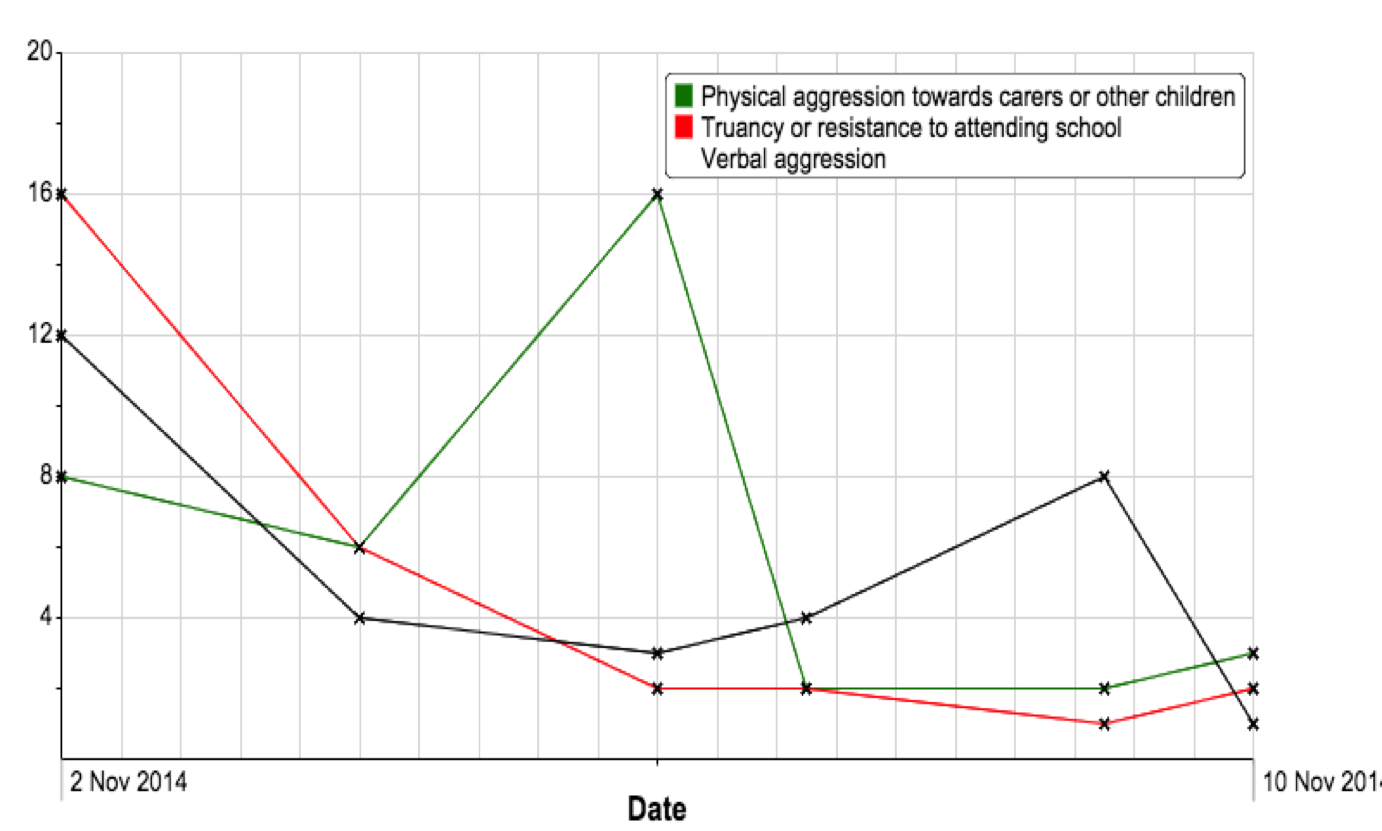
After discussion with friends and colleagues, I had started to develop a system for targeting particular concerns to address in the care plan. This involves identifying around three specific concerns from the BERRI and tracking them with greater frequency, typically daily, whilst giving the staff various strategies to try to address them. The target behaviours can be entered into the online system, which can then produce graphs to show progress and to identify any triggers. For example, in the chart below I’d hope that staff would instantly wonder what triggered the big green spike of aggressive behaviour.

tracking

I spent a couple of days each month with Keys, completing the staff training and improving the online system so that it would meet their needs. We also developed a pathway in which there would be a psychological screening assessment when young people arrive in placement, and their paperwork would be properly digested to ensure we had all relevant information from their history as well as an initial BERRI checklist, and we would bring this together in a meeting where the professionals around the child, their care team, the therapist linked to the home and myself would put together a therapeutic care plan document and identify the targets to work on over the coming months. The care plan could contain a summary of the history, a formulation section giving insight into the meaning of the behaviours and concerns the child was showing, then the targets we had agreed to track, and the strategies we had identified to help work on those concerns.

This was seen as a refinement to the existing therapeutic plan the homes in the project were already using, and embraced very positively. We called the approach Psychologically Informed Care-planning and Intervention, with the acronym PICI (which Jonathan Stanley, Chair of ICHA, said was an acronym that led naturally to a marketing slogan: “if you want the best for your child, get PICI”).

After a few months of seeing the changes within the local project, and gathering feedback from staff, social workers and commissioners, Keys decided to expand my remit. They asked me to do training for staff outside of my local project, and then to do some consulting to the wider organisation. They subsequently offered me a job as Clinical Director of Keys, with a remit to train all of their staff and implement the pathway across the whole organisation. This will take me three days per week for the next two years! They have also agreed to employ a psychology team to implement the project in each region, and this week we appointed the first qualified clinical psychologists. In time this team will grow to cover all of Keys services across the UK. We will also be taking on 3.5 assistant psychologists and more therapist time, so that we have a consistent level of consultation to each home in the company (with additional therapy time in the attachment homes where every child placed gets direct therapeutic input). This is super exciting, and I hope that we are able to evaluate the impact on both staff and the young people we look after.

Keys have embraced the new pathway and outcome measurement system as part of a wider push to improve staff training (which now also includes a modular training program that every staff member will work through) and to be able to evidence the effectiveness of their care. This includes a desire to be more evidence-based in how they make decisions about placements and interventions. The changes also coincided with the tenth anniversary of the company moving into childcare and buying the initial ten Keys homes from their previous owners, and also with a rebranding exercise. When they revealed the new branding a few weeks ago in Belfast I was delighted to see that Keys now describe themselves as providing “psychologically informed care for children and young people” and see this as a way to improve the quality of their placements (and through this to gain better Ofsted inspection grades, and become the placement of choice when commissioners seek to place complex young people).

It seems like a natural progression from the kind of consultation I was doing in a CAMHS LAC team, but on an organisation wide scale. My small amount of time has the power to influence more children by working indirectly. By “giving psychology away” I hope I am giving increased insight to those doing the day to day care, and slightly changing their way of working with the young people. Instead of a child getting one hour per week with me, they are getting 38 hours per week with a slightly more psychologically minded caregiver, and my influence can reach 320+ children and nearly 1000 staff.

The staff within Keys have been really enthusiastic about the new pathway and have given me positive feedback for the training days, so the although there is a lot of travelling and a very ambitious timetable for implementation I am really enjoying the work so far. I also get surprisingly positive feedback from training elsewhere, which is so lovely to receive. I think it really stands out for me given how few positive feedback loops there are in most clinical roles nowadays (beyond the occasional client or colleague sending a thank you card). I get a real buzz from positive tweets about my training or keynotes, gaining high scores on conference feedback forms, positive reviews of my book, or complimentary endorsements on LinkedIn.

I went up to Glasgow last week to train some staff to run my group program for parents and carers of maltreated children (Managing Behaviour with Attachment in Mind) and really enjoyed that also. Glaswegians really are the friendliest people in the world, and the group I trained were clearly hugely empathic to the children they work with so they were a delight to train. As I was leaving someone said to me that “training is a way to change the lives of thousands of children”. I think I had made some comment to brush this off (perhaps that it was the clinicians working directly with the families whose relationships were vital, rather than a day from a person like me), but she wasn’t having any of it. She said “no I mean it. I will interact different with the families I see tomorrow and in the future because I spent the day with you, and each person who came to the training will do likewise”. She explained emphatically that she had literally meant that in one day I had done something that would ripple out and change huge numbers of lives. That was pretty humbling to think about.

I’ve also had some exciting discussions about research, service evaluation and different kinds of therapeutic work (for example, working in partnership with collaborative lawyers). So I have decided to have a break from doing expert witness work over the summer and really have a think about what I most want to do. I need to weigh up all the choices in front of me, prioritise the things that make the most impact and/or give me the most satisfaction, and put some energy into finding allies with shared goals (including seeing whether I can recruit another clinical psychologist to LifePsychol in Milton Keynes to pick up some of the therapy and court work). I also want to reclaim my life outside of working hours, and to consider where in the country it makes most sense to be located. But it feels like all the effort I have invested in various projects to date is finally nearing fruition, and there are lots of interesting things on the horizon.

Long ago, I had a task list written on the whiteboard in my office, and Gilly had made me laugh by adding to the bottom of this “build secret volcano base, take over the world”, to reflect my ambitions to change practise on a wide scale. Maybe it isn’t such an unrealistic aim after all.