Getting organised

If you haven’t realised it by now, I’m the kind of person that keeps a lot of plates spinning in my professional life. I end up getting excited about things and find it hard to say no, even when I don’t have the capacity to give things the time they deserve. Perhaps because of this overload, and my avoidance of putting a financial value on my work, I have always struggling to get on top of the finances of the business, keep up with invoicing, respond to queries and book things in with enough time to complete everything before the deadline. However, I have relentless standards for my own work, so I try to do everything to the best of my ability, even if it eats into my time out of work (or even my sleep).

Having so much on the go requires a lot of organisational skills, and I know that I sometimes fall short in this regard, so I am very reliant on having a good team around me and particularly a good PA. Thus it was a disaster for me (although fab news for her) when my admin decided to leave Lifepsychol earlier this year and go and bake cakes instead. Worse still, it came at a time that I had two new Assistant Psychologists without prior experience starting in post, and a whole lot of deadlines. I had also concluded that delegating the book keeping to the accountants was not cost effective, as they did not understand the ins and outs of the business, or have access to our files or close enough communication with me to resolve queries. I was starting to panic that I wouldn’t be able to keep up with the demands and everything would fall apart.

Thus it is great news that I have recruited a new admin/operational manager, who is helping me to get everything organised, and has taken on the finances of the company, along with some of the personnel functions. This has been a lifeline as it has really taken the pressure off me, and allowed me to start chipping away at a to-do-list that has been growing much faster than I have been able to check items off it. It is helpful that there is a central point of contact for the company who is there on a full-time basis, and that is making all our lines of communication easier, especially as I seem to be all over the country at the moment!

Today we signed up for Google Apps for Work to set up shared cloud storage for the company, and a more professional company email, calendar and task-list system. We are gradually working through the state of the finances, and catching up with invoicing. We even sorted out the materials in the cupboards, and re-homed the five boxes of left over questionnaires from the diabetes study, some materials that were ordered in error, and a massive collection of used lever-arch files.

This really pleases my inner OCD, as I really dislike the feeling of disorganisation and clutter in my physical or psychological space. I have high hopes that once we are organised things can tick over in a much more satisfying way.

I’ve also been offered one of 10 UK places to be supported by ImpactHub to scale up one aspect of my business over the next year, so I’ll write more about that in my next blog!

Giving psychology away – the positive ripples of training

When I left the NHS I wondered whether I would have enough work to keep me busy, and felt like the expert witness work I do the family court would probably be the main strand of my income for the foreseeable future. However, perhaps because of my book, I have increasingly been asked to speak at conferences, provide training to various groups of professionals, and consult to organisations – particularly on the topic of working with attachment, trauma and the impact of maltreatment on children. This has become an enjoyable sideline where I can cascade psychological thinking to a wider audience, meet lots of new people, learn from others, and earn a good daily rate without the same emotional weight as doing court work.

I also like any work that involves improving the quality of services, particularly for complex or marginalised client groups. It was therefore very interesting to me when I was asked to meet up with some of the directors of a children’s home company, Keys Childcare, about offering training and consultation to a 20 placement project they were running about an hour away from my base. After some initial meetings, we decided that I would offer some staff training sessions (on attachment, trauma and the impact of maltreatment on children’s development) to all the staff, and then help them to implement a more systematic program of care planning and outcome measurement. The aim was to make decisions about which young people needed therapy and what form of therapy they received more evidence-based, as well as to ensure that all of the staff were involved in making the care for each young person as therapeutic as possible.

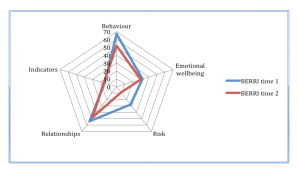
This fitted in really well with an outcome measurement system I had been developing for several years, using my ‘BERRI’ checklist of Behaviour, Emotional well-being, Relationships, Risk and Indicators of something requiring further assessment (such as markers of neuro-developmental conditions, or more usual behaviours, perception or thinking which would merit more specialised interventions). I had already developed a system whereby data could be entered into the BERRI online and produce a feedback report, and scores could be compared to track progress over time. This could produce a visual representation of a young person’s needs across the five dimensions, and allow us to be more holistic in our thinking about how to support them to make optimum progress.

radar

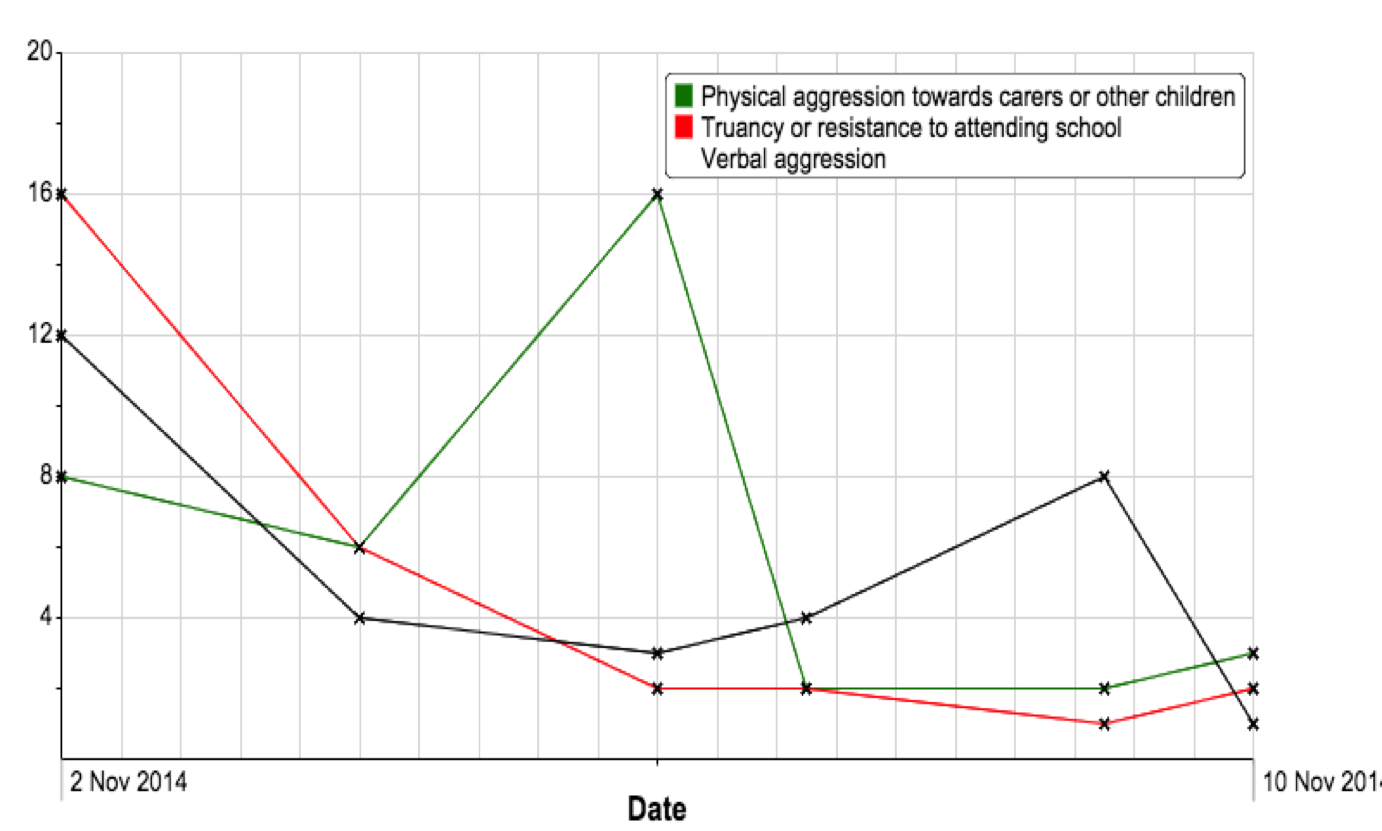
After discussion with friends and colleagues, I had started to develop a system for targeting particular concerns to address in the care plan. This involves identifying around three specific concerns from the BERRI and tracking them with greater frequency, typically daily, whilst giving the staff various strategies to try to address them. The target behaviours can be entered into the online system, which can then produce graphs to show progress and to identify any triggers. For example, in the chart below I’d hope that staff would instantly wonder what triggered the big green spike of aggressive behaviour.

tracking

I spent a couple of days each month with Keys, completing the staff training and improving the online system so that it would meet their needs. We also developed a pathway in which there would be a psychological screening assessment when young people arrive in placement, and their paperwork would be properly digested to ensure we had all relevant information from their history as well as an initial BERRI checklist, and we would bring this together in a meeting where the professionals around the child, their care team, the therapist linked to the home and myself would put together a therapeutic care plan document and identify the targets to work on over the coming months. The care plan could contain a summary of the history, a formulation section giving insight into the meaning of the behaviours and concerns the child was showing, then the targets we had agreed to track, and the strategies we had identified to help work on those concerns.

This was seen as a refinement to the existing therapeutic plan the homes in the project were already using, and embraced very positively. We called the approach Psychologically Informed Care-planning and Intervention, with the acronym PICI (which Jonathan Stanley, Chair of ICHA, said was an acronym that led naturally to a marketing slogan: “if you want the best for your child, get PICI”).

After a few months of seeing the changes within the local project, and gathering feedback from staff, social workers and commissioners, Keys decided to expand my remit. They asked me to do training for staff outside of my local project, and then to do some consulting to the wider organisation. They subsequently offered me a job as Clinical Director of Keys, with a remit to train all of their staff and implement the pathway across the whole organisation. This will take me three days per week for the next two years! They have also agreed to employ a psychology team to implement the project in each region, and this week we appointed the first qualified clinical psychologists. In time this team will grow to cover all of Keys services across the UK. We will also be taking on 3.5 assistant psychologists and more therapist time, so that we have a consistent level of consultation to each home in the company (with additional therapy time in the attachment homes where every child placed gets direct therapeutic input). This is super exciting, and I hope that we are able to evaluate the impact on both staff and the young people we look after.

Keys have embraced the new pathway and outcome measurement system as part of a wider push to improve staff training (which now also includes a modular training program that every staff member will work through) and to be able to evidence the effectiveness of their care. This includes a desire to be more evidence-based in how they make decisions about placements and interventions. The changes also coincided with the tenth anniversary of the company moving into childcare and buying the initial ten Keys homes from their previous owners, and also with a rebranding exercise. When they revealed the new branding a few weeks ago in Belfast I was delighted to see that Keys now describe themselves as providing “psychologically informed care for children and young people” and see this as a way to improve the quality of their placements (and through this to gain better Ofsted inspection grades, and become the placement of choice when commissioners seek to place complex young people).

It seems like a natural progression from the kind of consultation I was doing in a CAMHS LAC team, but on an organisation wide scale. My small amount of time has the power to influence more children by working indirectly. By “giving psychology away” I hope I am giving increased insight to those doing the day to day care, and slightly changing their way of working with the young people. Instead of a child getting one hour per week with me, they are getting 38 hours per week with a slightly more psychologically minded caregiver, and my influence can reach 320+ children and nearly 1000 staff.

The staff within Keys have been really enthusiastic about the new pathway and have given me positive feedback for the training days, so the although there is a lot of travelling and a very ambitious timetable for implementation I am really enjoying the work so far. I also get surprisingly positive feedback from training elsewhere, which is so lovely to receive. I think it really stands out for me given how few positive feedback loops there are in most clinical roles nowadays (beyond the occasional client or colleague sending a thank you card). I get a real buzz from positive tweets about my training or keynotes, gaining high scores on conference feedback forms, positive reviews of my book, or complimentary endorsements on LinkedIn.

I went up to Glasgow last week to train some staff to run my group program for parents and carers of maltreated children (Managing Behaviour with Attachment in Mind) and really enjoyed that also. Glaswegians really are the friendliest people in the world, and the group I trained were clearly hugely empathic to the children they work with so they were a delight to train. As I was leaving someone said to me that “training is a way to change the lives of thousands of children”. I think I had made some comment to brush this off (perhaps that it was the clinicians working directly with the families whose relationships were vital, rather than a day from a person like me), but she wasn’t having any of it. She said “no I mean it. I will interact different with the families I see tomorrow and in the future because I spent the day with you, and each person who came to the training will do likewise”. She explained emphatically that she had literally meant that in one day I had done something that would ripple out and change huge numbers of lives. That was pretty humbling to think about.

I’ve also had some exciting discussions about research, service evaluation and different kinds of therapeutic work (for example, working in partnership with collaborative lawyers). So I have decided to have a break from doing expert witness work over the summer and really have a think about what I most want to do. I need to weigh up all the choices in front of me, prioritise the things that make the most impact and/or give me the most satisfaction, and put some energy into finding allies with shared goals (including seeing whether I can recruit another clinical psychologist to LifePsychol in Milton Keynes to pick up some of the therapy and court work). I also want to reclaim my life outside of working hours, and to consider where in the country it makes most sense to be located. But it feels like all the effort I have invested in various projects to date is finally nearing fruition, and there are lots of interesting things on the horizon.

Long ago, I had a task list written on the whiteboard in my office, and Gilly had made me laugh by adding to the bottom of this “build secret volcano base, take over the world”, to reflect my ambitions to change practise on a wide scale. Maybe it isn’t such an unrealistic aim after all.

All change!

Someone once said to me that, if you can manage the stress, change can be an opportunity. They argued that a time of confusion is a good time to put forward ideas that could be seen as potential solutions, as nothing is set in stone yet. Derren Brown (the skilled TV hypnotist, cold-reader, sleight of hand maestro and showman) said something similar when he talked about how confused and stressed people are at their most suggestible. I think he said it whilst persuading bookies at the races that he had won on losing tickets, which was not something I felt was ethical to replicate (even if I had his skill-set) but I do have some anecdotal experiences of this being true. I remember a few years ago going shopping in early December and queuing up to pay in a very busy clothes store. I had a loyalty card which gave a discount for the event at the store, but when I got to the till I couldn’t find it. The poor cashier was on hold to the accounts department to see if they could find my details when, whilst making small-talk, I asked if the discount was the same as the student discount. The cashier then decided it would be easier to put my purchase through as a student discount (which did not require a card number), so that she could deal with me more quickly. Thus I got the discount without the card, and she was able to move on to the next customer. I could see that my comment had unintentionally introduced the potential for an easy win into her mind. Of course as soon as I left the crowded store I was able to find the card, but it made me think about the attractiveness of offering an easy option when the demands are overwhelming. I find this a reassuring concept to think about when the public sector organisations seem to be constantly in a state of organisational change, demands that exceed resources to meet the need, and a pervasive level of uncertainty and confusion! This idea that sometimes a suggestion with serendipitous timing could influence change in a positive direction offered an interesting alternative perspective to my pessimism about how difficult it can be to get even solid, evidence-based, cost-saving ideas accepted into practise (see previous blogs).

I’ve also been talking about the need for change in how I work in my personal development coaching sessions. I’ve previously blogged about feeling a bit burnt out by the emotionally harrowing content of some of my work, the need for me to get better at prioritising and how I am trying to get a better work-life balance. One of my motivations to start the coaching was my sense that I have so many plates spinning I have almost lost track of why I am spinning them and what my goal is. I wanted to re-evaluate what my goals were, and to find the joy in my work again. As I have begun to clear space in my life to reflect on this, I have recognised that my beliefs about what my career would look like have not really kept pace with changes in the public sector and in my own interests and ways of working.

At some level, my template for a good career in psychology was based on my Mum. She worked in child psychology and CAMHS, and was Head of Child Psychology for a county at the point she retired a couple of years ago. I had always assumed that was pretty much how my professional life would pan out. I had qualified in 2000, worked my way up the bands to make Consultant Grade and be part of the CAMHS management team in 2008, and expected to end up as Head of a Child Psychology service somewhere. In metaphorical terms, that was the train journey I bought a ticket for. But something changed when I had kids and went through a lot of stress related to the organisational changes when the CAMHS contract was won by a competing trust and we were TUPEd over. In the end I left the NHS and did something different. In the metaphor, I got off the train. My early plans for my company were very much based on wanting to replicate what I was doing within the NHS, but without the systemic problems I experienced in the NHS trust that I left. So in the metaphor I caught the bus, but I was still headed for the same destination. At various points I meandered, detoured to explore things I had heard about, joined groups to see the local sights, even hiked across country with my own compass, but underneath it all my destination was still the same.

Of course once you are going off the beaten track, sightseeing, hiking and choosing your own route, the journey becomes a bit more scary but much more interesting. In turn, the destination becomes less fixed and also less important, because it can continue to change and there may be steps beyond each destination to another. You can also grow in confidence and tackle bigger challenges and find new things inspiring, so you end up setting goals you had not considered at the beginning of the journey. Once I was off the train, I didn’t need to follow the tracks, or try to make my way by other means to where they led. I didn’t need to replicate CAMHS or to try to set up a LAC service outside the NHS, and I didn’t need to be Head of a Child Psychology service. Indeed I was offered an NHS post with this title last year, which was my expected destination, but I declined the offer. I learnt things about the post that made me concerned that I’d be jumping back into a train on a route where everything was running late and all the passengers were unhappy, whilst I was no longer afraid of being off the rail network and doing my own thing – in fact I had remembered how much I could enjoy the journey if my focus was in the here and now and not about trying to get to the destination ASAP. I started to think of myself as being a much more adventurous person and put my skills to use in much more flexible ways.

Sadly, the kind of NHS I envisaged spending the next 25 years in isn’t there any more, and the jobs at 8C and above bear a lot of the brunt of the change by having to take on the new political and financial pressures, whilst the lower banded staff continue to do much the same work (albeit with increased pressures of throughput and whilst hot-desking). There are good services remaining, and some people will still think that is the best career option for them, and I’m glad about that as I love the NHS and want to see it survive and hopefully thrive in the future with more investment. But for me it isn’t the only option any more. There are other opportunities for adventures outside of the NHS that hang on to my core ethics and values, and put my clinical psychology skills and experiences to good use, but without some of the constraints of the NHS. I can write my own job description, choose my own working pattern and be paid for what I do, rather than on a fixed set of salary points for a set number of hours. Perhaps surprisingly to me, I’ve learnt I’ve got competencies and ideas that are useful and marketable in lots of places. Despite the austerity in the NHS, I continue to have more opportunities and offers of work than I can accept, and some of these are quite well paid. In short, I have learnt that I can actually think much more creatively about what options for my professional life will make me happy if I let go of the template of how I expected my career to be.

With that insight, I’ve got a growing desire to start afresh and do the things that have most impact and bring me most joy. That means I need to look hard at all the options in front of me, and all the plates I have been spinning, and figure out which of those I want to focus on, and which I want to pass on to other people or drop. There may also be entirely new projects that I can develop because they are interesting to me, but I can recognise a future market or source of funding for.

There is big change ahead. But my business is small and agile, I’ve got an entrepreneurial attitude, and I’m lucky enough to have some interesting offers on the horizon. I’m in a position where I can embrace the change, so I am seeing it as an opportunity.

Slow burn: Reflecting on the emotional impact of working with chronic trauma*

*This post contains vignettes of harrowing material which may upset some readers. Case examples are all anonymised.

When I decided to do work in child protection, people warned me it was the fast road to burnout. Twenty years later I think they are right about the direction, if not about the speed.

Burnout is an insidious thing. It sneaks up on you as a chronic accumulation of many tiny things, rather than having an obvious trigger, like a single life threatening event that causes PTSD. A thousand small examples of vicarious traumatisation. Experiences that I shouldn’t complain about as I’ve chosen a career that inevitably brings exposure to distress and tragedy. It feels like I’ve chosen to wade through the grottiest parts of life, until I’m normed on that 1% of stories that cause the most concern. It saturates me. Pollutes my perceptions of life. It has been building up for a long time.

Fifteen years ago my two specialist placements included post abuse work with survivors of sexual abuse, a group for non-abusing parents of children who had been sexually abused and work with “complex” children and families, such as those on the child protection register. I knew it was emotionally harrowing work then. I talked about it with a good friend, and concluded that my drive was to go where I was most needed, to grapple with the most complex cases, and that I’d worry about burnout when I got there. I graduated onto a clinic for children who were “failing to thrive” and most of my clinical time being with children in care and therapeutic work with those who had experienced trauma or maltreatment. Right from the start, it was an induction of fire, salved only by the fact that it was important work that needed to be done.

It started with individual stories.

The sad silent child who ate 7 digestive biscuits and carefully stowed extras in his pockets during clinic, but whose parents claimed he had a digestive disorder that meant he wasn’t gaining weight despite eating plenty.

The young woman with learning disabilities who repeatedly played out how the daddy bear lay on top of the baby bear and thrust, but said baby bear was a liar and nobody believed her when she told.

The adult relatives who revealed at the last moment the sadistic physical and sexual abuse that their step-father inflicted, after he had charmed the professionals enough to get residence of his grand children, when their mother was unable to cope and had reverted to chronic drug use.

The maps of children’s bodies in medical notes, used for annotating injuries, including one for babies. The paediatricians sharing photographs of torn orifices, injuries, malnourishment and legs with rickets. “This one has burns on their hands up to a straight line on their arms, showing they were held in boiling water as a punishment”. No, I don’t want to see, thanks.

The little girl in a religious cult who couldn’t disclose her abuser as she had been taught it was as bad to think or speak badly of others as what they had done, and shown pictures of people rotting in the ground or burning in hell for their sins.

The boy who was conceived through rape, whose mother couldn’t look at him, and whose grandmother thought any challenging behaviour showed he was “living up to his genes”.

A girl asking how she got the zigzag scar on her stomach. The family didn’t want to tell her about how her mother tried to cut her open to let the devil out during a puerperal psychosis. They don’t want to spoil the relationship as she goes to Mum for alternate weekends. When I meet Mum she talks incoherently about spirits and auras, telling me she likes climbing on the roof to be nearer to God. She has no need of adult mental health services, thanks.

The young woman who always claims to be pregnant by her current partner. He is less likely to harm her that way. She is couch surfing at the moment, which is the new name for homeless. Her only possession is a photograph of her son who was removed at birth and adopted. After physical and sexual abuse at home, and attempts to stay with numerous relatives, she grew up in care. She had a sexual relationship with her male carer at 14 which she views as consensual.

Since 2000 I have done expert witness work for the family courts. That means reading bundles of documents about trauma, child abuse, neglect, loss, violence, family breakdowns and mental health problems. It means speaking to parents who have been maltreated in their own lives, lack coping resources and instead of being able to create healthy relationships and flourish have limped from one bad experience to another. It involves speaking to children who have seen too much, had to cope with awful things and missed out on the love and nurture that you’d want every child to take for granted. I read about and sometimes see the state of the home, with rubbish heaped up and rotting, flies circling, dirty nappies on the floor, no clean clothing, nowhere to store possessions and no space that isn’t filled with clutter. I hear about broken bones, bruises, burns, rapes and assaults. Sometimes there are x-rays, photographs or medical records. I see sadness and anger accumulated over many years of getting a raw deal. I measure problems with learning, attention, behaviour, life skills, self-esteem and mental health. I observe who denies the problems, who spills over with them, and who recognises themselves doing as they were done by despite all their best intentions otherwise.

I read, and I listen. I measure and observe. I pull the pieces together to see what fits and what conflicts. It is an active process, trying to understand what happened, how and why. Evaluating insight and future risks. A computer couldn’t be programmed to do this. It takes empathy, curiosity, critical thinking and detective skills. I am the barometer of relationships, of what would feel okay, of what is causing harm. If I felt nothing, I couldn’t do the job. But there is so much pain to feel. So many sad stories.

A little girl with curly dark blond hair who the foster carer told me “shook with excitement to get her own dolly for the first time and promised to keep it pristine so that when mummy gives it to her little sister she will still think it is new”. I nod politely. Take verbatim notes. I have to stop the car on the way home for a cry.

A teenage boy tells me how his father often pinned him up against the wall by his neck or beat him with a belt. He wonders why he dissociates when he perceives threat or criticism now and worries that he is going mad. I try to explain his brain learnt to protect him when nothing else could.

I observe the baby that was rescued from the fire. Her scars are healing slowly, and the medical treatments are painful. She can’t bear to be touched. There is too much pain for someone so young.

A mother tells me how it hurts her watching the foster carer do a better job than she was able to at caring for her children. “I always swore I’d be different to my mum, make better choices of partner than she did, keep my kids safe from harm. I look at where we are now and see it has happened all over again and I can’t bear it”. And neither can I.

A teenage girl tells me she took the overdose because her step-dad broke the door down and overturned the bed to reach where she and her mother were hiding, and hit her mother repeatedly with the broken bed leg. She shrugs and smiles, and says “its just how it is, you know”. I don’t know. But trying to imagine it makes my guts curl and my eyes leak involuntarily.

A mother tells me about the culture she grew up in, and how grateful she is to be here, even though the whole family live in a single room in slum conditions, and it is hard to find work as an illegal immigrant. If her son is hungry, developmentally delayed, and being beaten for misbehaviour at least he is safe. I think that isn’t safe. It is all relative.

A father tells me that his uncle sexually abused him as a young boy, but there was too much stigma to tell anyone and he was afraid to lose this special relationship. He still spends time with his uncle now, and trusts him implicitly with his own children. A few sentences later he says he is baffled why the children are showing sexualised behaviour. I am baffled that other people can’t see how obviously the pieces fit together.

I assess a couple that smell so bad I struggle not to gag. I open the windows but it is not enough. I go out for air every hour. A social worker sprays perfume on my sleeve so I can raise it to my face to mask the smell. I learn the phrase “body odour to an extent causing discomfort to anyone in the proximity”. They don’t own toothbrushes and show me teeth rotting in swollen gums.

A woman tells me she has put on 9 stone as she needs to have fat deeper than the knife blade is long, since she was stabbed by her ex-partner. She wheezes for a long time after climbing the stairs at the contact centre, and she struggles to get down on the floor to play with the baby. I worry when she is slower than expected to return from the toilet, do I need to check if she is okay?

The child was born with HIV. His mother died of it. He lives with his grandmother. She doubts the diagnosis. “He doesn’t look ill, the English doctors don’t know about us”, she says when I ask why his prescriptions have not been collected.

A lady tells me that she must have had post natal depression. If she wasn’t ill she would keep the house clean, but when she is ill she can hardly get out of bed, and gets ideas that the world is very unsafe. That is why she kept the children in her bed with her, rather than sending them to school, until they were no longer able to walk. She’s on antidepressants now, and saw a counsellor for six sessions, so everything will be fine. The social workers are making a fuss about nothing.

A man tells me he has exercised to pass the time whilst in prison. He is proud that he is bigger and tougher than his father now. He says the robbery was the fault of the friends who bought him the beer and suggested the idea, and much exaggerated by the victim. I am glad I brought with a student to observe, as the room is quite isolated and his body language makes me tense.

This couple have managed to sustain the acrimony of their separation for five years. She says he was controlling, violent and obsessive about having every last penny accounted for. She tolerated his promiscuity for far too long. He says she was moody and manipulative, and it is probably her mental health that’s the problem, and her jealousy that he moved onto another relationship. It makes me cross that both of them seem to have forgotten the kids in the middle of their conflict.

A little boy tells me what it felt like to be buggered. I try not to think about it that night in bed. I play tetris on my phone until I fall asleep at 4am.

A woman tells me that all of her relationships have been with men who present a sexual risk with children. They are all so different, she says, that whenever she learns what to avoid the next one is nothing like it. And why wouldn’t you move in with someone you’ve just met? How else do you get somewhere to live after the last relationship has turned sour?

The story stems of a girl of eight show the family repeatedly pushing the girl off a cliff and laughing at her. For variation they poison her and laugh as she vomits. She repeats the loop for 90 minutes, then returns to lying foetal under the table as I leave, just as she was when I arrived.

“I had a cold, mum caught it, and it made her sick so she fell down the stairs” says the boy with autism. “That is why she had to go to hospital”. It wasn’t the head injuries her partner caused, it was his fault. But later in the conversation “Daddy gets out of prison soon. When he finds us he will kill us this time”. It is deadpan. An emotionless fact of life.

The girl in the children’s ward tells me “I didn’t want to go home. I jumped off the bridge because it would be better to be dead. They say I will need to be in hospital at least six weeks whilst my leg heals”. She smiles showing me the metal cage and all the pins reassembling her bones, and counts the pieces in the x-ray. She won’t say what is wrong at home.

“He spat right in my face and pushed me over. I was so angry then. I hit him with the lamp until it broke, then I whipped him with the cable. I could see the shape of the switch in the bruises when I was done. They might have seen it, but that’s not the same. I’d never hurt the children.”

A boy tells me what is different in foster care. “It was the best day ever. We went to the garden centre. I got to look at the fish, and we had a drink and a slice of cake at the cafe. We eat at the table with the grown ups here. I got my own coat too, nobody wore it before me! And my skin is better”. The carers tell me that they had to wash the grime off the bath after he arrived, replace all his clothes and do twice daily treatments of his infected eczema. They had to get a court order to shave off his matted hair as his parents would not give consent.

A five year old girl tells me about the day she came into care. “I could hear they had fish and chips in the front room. I could smell it. I tried to walk there, but my legs weren’t working and I kept falling over”. The medical records show that a visitor called an ambulance when they saw her unconscious and malnourished. Her blood test results are marked with blue biro. Haemoglobin is captioned “how is she alive?”. She dances when she shows me the foster carers have a rabbit run in the garden.

In each family I hear many of these stories from each individual, and I see several families each month for assessment. I’ve been doing this for over a decade now. I have banked hundreds of such narratives, maybe a thousand. All involve a child or children being harmed. The stories are each unique, but the themes recur. James blurs into Joshua and Jared and Jacob. Samira merges with Samantha and Saskia and Sasha. Depression and anxiety, broken bones and bruises, filth and mayhem, conflict and violence, cancer, obesity and sensory impairment, neglect and abuse heap up in my repertoire of human experience and leak out into my life. I see those stories lurking at the edge of my vision, in the arguments partially overheard in the shops, or behind the headlines in the news. I see their echoes amongst people that I know; my neighbours and colleagues and friends.

I set myself impossible standards. I worry if my child has messy hair when she gets back from school, or I notice mud under her fingernails. Will people think we aren’t taking proper care of them? Are we not taking proper care of them? We go to A&E after my daughter burns her hand. I ask her to tell the story before I speak and she says “it was your fault mummy, it was your drink that tipped over”. I feel like a failure and a hypocrite. My cat has a jaw infection and needs teeth removed and antibiotics. I should have known. He smells like the couple I assessed at the social work centre last year.

I say we need to leave the restaurant. I can hear a mother saying “ungrateful brat, I should never have had you” to her son. Outside the school a mother pushing a baby in a pram says to her friend “look at him giving me evils, he’s going to be just like his father”. I walk away. The couple outside the pub argue incoherently and their voices get louder and shriller as we walk back to our car after a night out. The child in the park approaches me and asks me to push him on the swings. People on the internet disclose abuse. In the supermarket I hear a slap and the child is crying. The woman walks past on the street with a fading black eye. They are anonymous and legion. The scale of the problem is overwhelming. I can do nothing.

Friends of friends ask for advice as they have heard I am a psychologist. Its important to try to point people in the right direction, but I am depleted. Another 2 lever arch files arrive at work. Its an incest case and mother is terminally ill. Surely there can be no more stories this bad, but there is a queue awaiting my attention. The next one has police transcripts of the interviews of all of Dad’s victims. He might be a paedophile but his daughter wants to see him anyway. The one after that they want me to see Dad whilst he is in prison for abducting the children to a different country. He believes it is his right; fathers own children in his culture. Then back to the bread and butter of court work, another family where neglect and maltreatment has been the norm through many generations. One of the children is the same age and gender as one of mine. Don’t make comparisons. Don’t go there. Change the subject.

A letter from a solicitor tells me that my invoice has been reduced by the Legal Aid Agency on appraisal. I will get £400 less than the total billed, despite not billing for 6 hours work already because of the fee caps. The hours were “not proportionate”. Do I explain again that it takes longer to do assessments via a translator? I don’t have the energy. Another one is querying the hourly rate. I should work for £7 less if I only see the adults as I won’t be a child psychologist. I ask if a psychiatrist gets paid the rate for a psychotherapist if they don’t diagnose or prescribe. The solicitor is sympathetic but says there is nothing they can do. A father doesn’t attend an appointment that is booked to fill a whole day. I have driven 2 hours to get here, and I wait for an hour whilst phone calls are made, then drive 2 hours home, exhausted. I can do nothing else with my day. Legal Aid say a psychologist can fill their time productively with other activities and refuse to pay anything over travel costs, even though the contract says that they will pay for any appointment cancelled with less than 72 hours notice. I can’t bill for materials, venues or typing. The questionnaires cost an average of £5.31 each. I used 6 per child and there were 7 children in the family. Does it add enough to my report to justify £220 of lost income? The LAA ask what ‘capacity’ is and why it took me 4 hours to assess it. Is it not embarrassing to work for the family court system and not to know this or to have the sense to Google? The self-funding father who was supposed to have lodged the cost of the report with his solicitor hasn’t. He now wants to pay in monthly instalments, but my staff get paid next week. I have to turn away two cases a day after reading about the plight of the children, because I am booked up too far ahead. The wealthy mother from abroad hasn’t paid her share of the bill from 4 months ago, but the court wants me to do more work for her case. There are 16 follow-up questions from the report I filed last week. Why do I do this again?

Tomorrow is the appointment to assess the teenage mother in the mother and baby unit. Yesterday her boyfriend told me about how they met online, and gave me their usernames. Google shows me his dating site entries seeking single mothers, Facebook posts about the violence in their relationship and a video of the baby’s “sexy dance”. A solicitor phones. Can I squeeze in one extra case this month? Mother has been evicted. She doesn’t want to see her child and is too anxious to talk to her lawyers. Could I fit the capacity assessment in this week? I get an email to my personal account. My builder’s sister’s son is feeling suicidal. I reply with the phone numbers for the Samaritans and the local crisis service. I watch the news story about the children in the refugee camp and am horrified to find I feel nothing. I have reached compassion fatigue. I turn off my phone and computer and go back to bed.

I am empty. My emotional resources have run out. Is this constant aching tiredness what they call burnout? I run on clockwork. I am a robot Mum and a robot wife. I fall asleep on the sofa. I am exhausted. At night when I finally fall to sleep I dream about children with their eyes sewn shut. I can’t save them all. When I wake I go to work and do it all over again. I’m good at this. It is important. It is needed. It is never ending.

Then I pause and take a few weeks off for a family holiday. Soon after we arrive the bubble of numbness bursts. I cry watching a video on Youtube. It segues into crying for all the children I’ve met, and all the children someone like me never met or didn’t reach in time, including the parents I speak to so often. I cry with frustration at my own limited reach. I cry for the selfishness of politicians, the broken systems and missing safety nets. I despair at how you increasingly need money to buy justice, and how hopeless and disengaged wide tranches of society are becoming. I click to sign petitions. I donate to campaigns. I counsel compassion in online debates. But I am tired. Achingly tired. Tired in my bones and my guts and my heart. I know how much this needs to be done. And I don’t know what else I can do. But I can’t do this any more.