Giving psychology away – the positive ripples of training

When I left the NHS I wondered whether I would have enough work to keep me busy, and felt like the expert witness work I do the family court would probably be the main strand of my income for the foreseeable future. However, perhaps because of my book, I have increasingly been asked to speak at conferences, provide training to various groups of professionals, and consult to organisations – particularly on the topic of working with attachment, trauma and the impact of maltreatment on children. This has become an enjoyable sideline where I can cascade psychological thinking to a wider audience, meet lots of new people, learn from others, and earn a good daily rate without the same emotional weight as doing court work.

I also like any work that involves improving the quality of services, particularly for complex or marginalised client groups. It was therefore very interesting to me when I was asked to meet up with some of the directors of a children’s home company, Keys Childcare, about offering training and consultation to a 20 placement project they were running about an hour away from my base. After some initial meetings, we decided that I would offer some staff training sessions (on attachment, trauma and the impact of maltreatment on children’s development) to all the staff, and then help them to implement a more systematic program of care planning and outcome measurement. The aim was to make decisions about which young people needed therapy and what form of therapy they received more evidence-based, as well as to ensure that all of the staff were involved in making the care for each young person as therapeutic as possible.

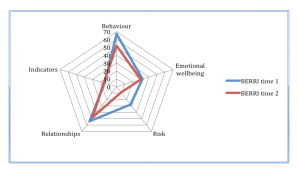
This fitted in really well with an outcome measurement system I had been developing for several years, using my ‘BERRI’ checklist of Behaviour, Emotional well-being, Relationships, Risk and Indicators of something requiring further assessment (such as markers of neuro-developmental conditions, or more usual behaviours, perception or thinking which would merit more specialised interventions). I had already developed a system whereby data could be entered into the BERRI online and produce a feedback report, and scores could be compared to track progress over time. This could produce a visual representation of a young person’s needs across the five dimensions, and allow us to be more holistic in our thinking about how to support them to make optimum progress.
radar

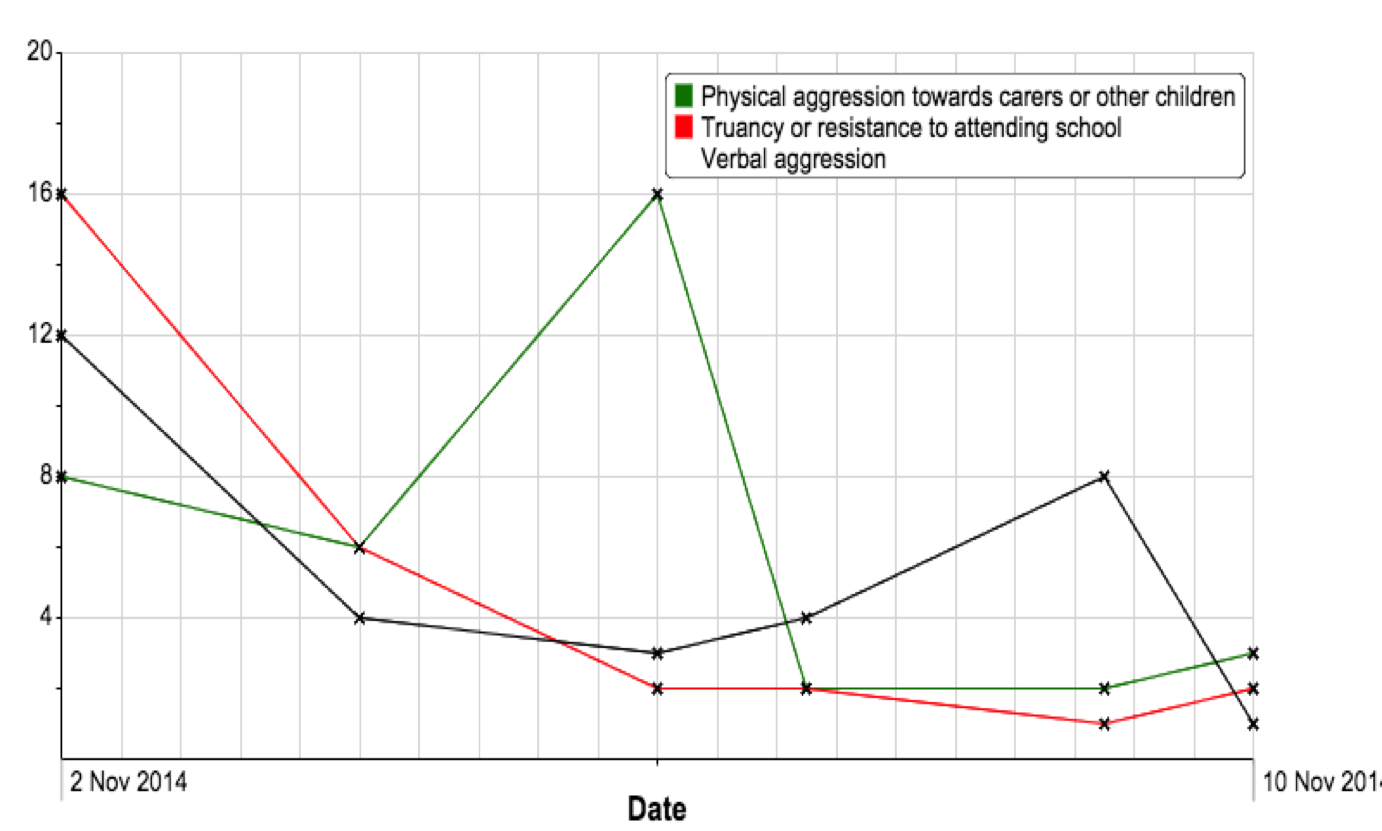
After discussion with friends and colleagues, I had started to develop a system for targeting particular concerns to address in the care plan. This involves identifying around three specific concerns from the BERRI and tracking them with greater frequency, typically daily, whilst giving the staff various strategies to try to address them. The target behaviours can be entered into the online system, which can then produce graphs to show progress and to identify any triggers. For example, in the chart below I’d hope that staff would instantly wonder what triggered the big green spike of aggressive behaviour.
tracking

I spent a couple of days each month with Keys, completing the staff training and improving the online system so that it would meet their needs. We also developed a pathway in which there would be a psychological screening assessment when young people arrive in placement, and their paperwork would be properly digested to ensure we had all relevant information from their history as well as an initial BERRI checklist, and we would bring this together in a meeting where the professionals around the child, their care team, the therapist linked to the home and myself would put together a therapeutic care plan document and identify the targets to work on over the coming months. The care plan could contain a summary of the history, a formulation section giving insight into the meaning of the behaviours and concerns the child was showing, then the targets we had agreed to track, and the strategies we had identified to help work on those concerns.

This was seen as a refinement to the existing therapeutic plan the homes in the project were already using, and embraced very positively. We called the approach Psychologically Informed Care-planning and Intervention, with the acronym PICI (which Jonathan Stanley, Chair of ICHA, said was an acronym that led naturally to a marketing slogan: “if you want the best for your child, get PICI”).

After a few months of seeing the changes within the local project, and gathering feedback from staff, social workers and commissioners, Keys decided to expand my remit. They asked me to do training for staff outside of my local project, and then to do some consulting to the wider organisation. They subsequently offered me a job as Clinical Director of Keys, with a remit to train all of their staff and implement the pathway across the whole organisation. This will take me three days per week for the next two years! They have also agreed to employ a psychology team to implement the project in each region, and this week we appointed the first qualified clinical psychologists. In time this team will grow to cover all of Keys services across the UK. We will also be taking on 3.5 assistant psychologists and more therapist time, so that we have a consistent level of consultation to each home in the company (with additional therapy time in the attachment homes where every child placed gets direct therapeutic input). This is super exciting, and I hope that we are able to evaluate the impact on both staff and the young people we look after.

Keys have embraced the new pathway and outcome measurement system as part of a wider push to improve staff training (which now also includes a modular training program that every staff member will work through) and to be able to evidence the effectiveness of their care. This includes a desire to be more evidence-based in how they make decisions about placements and interventions. The changes also coincided with the tenth anniversary of the company moving into childcare and buying the initial ten Keys homes from their previous owners, and also with a rebranding exercise. When they revealed the new branding a few weeks ago in Belfast I was delighted to see that Keys now describe themselves as providing “psychologically informed care for children and young people” and see this as a way to improve the quality of their placements (and through this to gain better Ofsted inspection grades, and become the placement of choice when commissioners seek to place complex young people).

It seems like a natural progression from the kind of consultation I was doing in a CAMHS LAC team, but on an organisation wide scale. My small amount of time has the power to influence more children by working indirectly. By “giving psychology away” I hope I am giving increased insight to those doing the day to day care, and slightly changing their way of working with the young people. Instead of a child getting one hour per week with me, they are getting 38 hours per week with a slightly more psychologically minded caregiver, and my influence can reach 320+ children and nearly 1000 staff.

The staff within Keys have been really enthusiastic about the new pathway and have given me positive feedback for the training days, so the although there is a lot of travelling and a very ambitious timetable for implementation I am really enjoying the work so far. I also get surprisingly positive feedback from training elsewhere, which is so lovely to receive. I think it really stands out for me given how few positive feedback loops there are in most clinical roles nowadays (beyond the occasional client or colleague sending a thank you card). I get a real buzz from positive tweets about my training or keynotes, gaining high scores on conference feedback forms, positive reviews of my book, or complimentary endorsements on LinkedIn.

I went up to Glasgow last week to train some staff to run my group program for parents and carers of maltreated children (Managing Behaviour with Attachment in Mind) and really enjoyed that also. Glaswegians really are the friendliest people in the world, and the group I trained were clearly hugely empathic to the children they work with so they were a delight to train. As I was leaving someone said to me that “training is a way to change the lives of thousands of children”. I think I had made some comment to brush this off (perhaps that it was the clinicians working directly with the families whose relationships were vital, rather than a day from a person like me), but she wasn’t having any of it. She said “no I mean it. I will interact different with the families I see tomorrow and in the future because I spent the day with you, and each person who came to the training will do likewise”. She explained emphatically that she had literally meant that in one day I had done something that would ripple out and change huge numbers of lives. That was pretty humbling to think about.

I’ve also had some exciting discussions about research, service evaluation and different kinds of therapeutic work (for example, working in partnership with collaborative lawyers). So I have decided to have a break from doing expert witness work over the summer and really have a think about what I most want to do. I need to weigh up all the choices in front of me, prioritise the things that make the most impact and/or give me the most satisfaction, and put some energy into finding allies with shared goals (including seeing whether I can recruit another clinical psychologist to LifePsychol in Milton Keynes to pick up some of the therapy and court work). I also want to reclaim my life outside of working hours, and to consider where in the country it makes most sense to be located. But it feels like all the effort I have invested in various projects to date is finally nearing fruition, and there are lots of interesting things on the horizon.

Long ago, I had a task list written on the whiteboard in my office, and Gilly had made me laugh by adding to the bottom of this “build secret volcano base, take over the world”, to reflect my ambitions to change practise on a wide scale. Maybe it isn’t such an unrealistic aim after all.

Wisdom and reflection

Every now and again I stumble across something that makes me think “yep, that’s true, that explains something really profound”. I want to record that bit of wisdom, and hang on to it, and pass it on to others. So this blog is partly to fulfil that desire, as well as to meander through some of my own experiences and ideas, which are less well-formed and still open to the process of being improved through constructive challenge. There is a certain vulnerability when expressing ideas that are not yet thought through from every perspective, but I think that reflection and feedback is an important component of personal growth. I believe that beliefs can and do change according to your knowledge and experiences. If you look at life as a journey towards wisdom, then each interaction and experience is an opportunity for reflection and learning.

One example of a simple piece of wisdom I like comes courtesy of Michael Specter’s TED talk about the danger of science denial. He says “everyone is entitled to their own opinion, but they are not entitled to their own facts”. It is a helpful thing to remember, because people believe all kinds of disagreeable things that make them prejudiced, intolerant, selfish and lead them to act against their own best interests. As therapists, we are taught to give our clients unconditional positive regard, but what do we do when people have harmful behaviour and offensive beliefs? Do we just ignore them and try to work as normal? Do we pass the client on to another therapist? Do we try to find (or fake) respect for them despite the parts that are uncomfortable? Or do we challenge their beliefs? And what if we as therapists have our own prejudices, or see them in colleagues?

The first step is to recognise and acknowledge the underlying beliefs that are at play. We can then formulate to understand where such beliefs might come from. That will increase our empathy for the individual, but it isn’t an excuse. It doesn’t make the beliefs or behaviours acceptable, just as we can understand why a person might learn to use violence or abuse substances, without endorsing that choice. Sometimes our job as a psychologist is to go back to the facts, and then explore how they fit with the opinion, and what the costs and benefits of maintaining that opinion are. This can true be from the typical inward-facing cognitive distortions of depression or anxiety, to the outward facing generalisations behind racism, misogyny or homophobia, or the poor choices that lead to substance misuse, offending or aggression.

When a colleague of mine declared some of the narrative techniques I was using with a child to be “one step away from tarot cards and the work of the devil” and a non-judgemental discussion about a young person’s self-identified sexuality and gender to be “encouraging an abomination”, it was somewhat mind-boggling to try to understand where those beliefs came from and whether or how to challenge them. Had I known Specter’s quote then, I think it would have given me some guidance. She was entitled to her beliefs, but the service needed to operate on the basis of facts. The facts were that the therapeutic technique I was using had been used thousands of times before causing outcomes ranging from neutral to positive, and had published studies of efficacy. And it is evident that large numbers of people identify as LGBTQ, and that this occurs across the animal kingdom, suggesting it is an innate drive (although the evidence suggests that early experiences do have some influence). It is not a choice. There are enormous risk factors in not accepting that and responding with empathy and compassion (including appalling levels of self-harm and suicide where such identities are rejected/devalued, or there is pressure to act like they are heterosexual and cis-gendered).

I found the beliefs that colleague expressed repugnant, whilst I was also trying to respect her culture and choices, which included the right to participate in a charismatic Christian church that held these beliefs (and no doubt many others) as doctrine. Thankfully I had a wiser supervisor I could take the issue to. Fifteen years down the line, it might be that I would be the person who had to address such a concern about an employee in my company or line management. I think that where beliefs get in the way of facts sufficiently that they interfere with your work, this raises issues about competency to fulfil the role. This should be dealt with much the same as if the person was failing to do their paperwork, or wasn’t dressing appropriately for the job – with feedback about the requirements of the role, an offer of support to develop new skills, and a timescale in which change is required. This might lead to recognition by either or both parties that the person is not suited to the role.

A past supervisor once told me another wise thing: “It is easier to grow the things you like than it is to shrink the things you don’t like”. Whether that is in terms of the balance of fun and frustration in your job, or the way your children behave, a focus on growing the good can lead to more positivity, progress and creativity.

Another piece of wisdom that I have found helpful is the serenity prayer: “Grant me the serenity to accept the things I cannot change, the courage to change the things I can, and the wisdom to know the difference”. This is helpful as we lose a lot of energy trying to change things that are immutable (or at least moaning about them), when we would often make more progress by focusing on the things we can do, even if they seem much smaller. We only have finite time and emotional/physical resources, so we have to prioritise. As Dave Allen said, “you can do anything, but not everything”.

On the other hand, Emma Watson’s powerful questions “if not you, who? If not now, when?”, Ghandi’s instruction to “be the change you want to see in the world” and Nelson Mandela’s observation that “it always seems impossible until it is done” are reminders that we each have responsibility for progress and the power to make change. We shouldn’t be overwhelmed by big challenges and can’t rely on other people to get things done, so we need to stop procrastinating and take action to step up to the plate for things that we care about.

I’ve ended up making a website and forum that get 10 million page views per year because it seemed like a good idea and I was in the right place at the right time for that to be a possibility. I am active with my professional body and contributing feedback to national policy, because someone needs to do it and I can just about eke out the capacity. I’ve supervised Assistants and Trainees, and done personal and professional development coaching for early career stage psychologists for many years, because it feels like a helpful thing for me to do. I’ve left the NHS and set up a company and a social enterprise that have survived through a recession. I sometimes get to hear how little things I have done have rippled out and influenced people or events in ways I didn’t expect, and there are people who cite me as influential on their lives personally or professionally. Yet when people ask how I manage to do all these things, it seems like a strange question, as I feel like they are all things any of my peers could equally have done.

Duncan Law, a Clinical Psychologist who has been instrumental in setting up CYP IAPT, said recently (in the context of successful bids for service development) that it is only looking backward that things look like a straight line, because when you are doing them it seems like you are just trying lots of options in the hope of finding a path forward. I feel that about my career. Looking backwards it seems that every component of my experience has culminated to prepare me for the things I am doing now, as if I planned my career methodically. However, at the time I was just taking the most interesting available option, in ways that often seemed to deviate from what I really wanted.

I’ll give the last word to Steve Jobs, who said “the only way to do great work is to love what you do. If you haven’t found it yet, keep looking. Don’t settle. As with all matters of the heart, you’ll know when you find it”. For all its periodic frustrations, I feel very privileged to be able to earn my living doing something that is interesting, worthwhile and rewarding. I wish that everybody had the same experience in their working lives.

All change!

Someone once said to me that, if you can manage the stress, change can be an opportunity. They argued that a time of confusion is a good time to put forward ideas that could be seen as potential solutions, as nothing is set in stone yet. Derren Brown (the skilled TV hypnotist, cold-reader, sleight of hand maestro and showman) said something similar when he talked about how confused and stressed people are at their most suggestible. I think he said it whilst persuading bookies at the races that he had won on losing tickets, which was not something I felt was ethical to replicate (even if I had his skill-set) but I do have some anecdotal experiences of this being true. I remember a few years ago going shopping in early December and queuing up to pay in a very busy clothes store. I had a loyalty card which gave a discount for the event at the store, but when I got to the till I couldn’t find it. The poor cashier was on hold to the accounts department to see if they could find my details when, whilst making small-talk, I asked if the discount was the same as the student discount. The cashier then decided it would be easier to put my purchase through as a student discount (which did not require a card number), so that she could deal with me more quickly. Thus I got the discount without the card, and she was able to move on to the next customer. I could see that my comment had unintentionally introduced the potential for an easy win into her mind. Of course as soon as I left the crowded store I was able to find the card, but it made me think about the attractiveness of offering an easy option when the demands are overwhelming. I find this a reassuring concept to think about when the public sector organisations seem to be constantly in a state of organisational change, demands that exceed resources to meet the need, and a pervasive level of uncertainty and confusion! This idea that sometimes a suggestion with serendipitous timing could influence change in a positive direction offered an interesting alternative perspective to my pessimism about how difficult it can be to get even solid, evidence-based, cost-saving ideas accepted into practise (see previous blogs).

I’ve also been talking about the need for change in how I work in my personal development coaching sessions. I’ve previously blogged about feeling a bit burnt out by the emotionally harrowing content of some of my work, the need for me to get better at prioritising and how I am trying to get a better work-life balance. One of my motivations to start the coaching was my sense that I have so many plates spinning I have almost lost track of why I am spinning them and what my goal is. I wanted to re-evaluate what my goals were, and to find the joy in my work again. As I have begun to clear space in my life to reflect on this, I have recognised that my beliefs about what my career would look like have not really kept pace with changes in the public sector and in my own interests and ways of working.

At some level, my template for a good career in psychology was based on my Mum. She worked in child psychology and CAMHS, and was Head of Child Psychology for a county at the point she retired a couple of years ago. I had always assumed that was pretty much how my professional life would pan out. I had qualified in 2000, worked my way up the bands to make Consultant Grade and be part of the CAMHS management team in 2008, and expected to end up as Head of a Child Psychology service somewhere. In metaphorical terms, that was the train journey I bought a ticket for. But something changed when I had kids and went through a lot of stress related to the organisational changes when the CAMHS contract was won by a competing trust and we were TUPEd over. In the end I left the NHS and did something different. In the metaphor, I got off the train. My early plans for my company were very much based on wanting to replicate what I was doing within the NHS, but without the systemic problems I experienced in the NHS trust that I left. So in the metaphor I caught the bus, but I was still headed for the same destination. At various points I meandered, detoured to explore things I had heard about, joined groups to see the local sights, even hiked across country with my own compass, but underneath it all my destination was still the same.

Of course once you are going off the beaten track, sightseeing, hiking and choosing your own route, the journey becomes a bit more scary but much more interesting. In turn, the destination becomes less fixed and also less important, because it can continue to change and there may be steps beyond each destination to another. You can also grow in confidence and tackle bigger challenges and find new things inspiring, so you end up setting goals you had not considered at the beginning of the journey. Once I was off the train, I didn’t need to follow the tracks, or try to make my way by other means to where they led. I didn’t need to replicate CAMHS or to try to set up a LAC service outside the NHS, and I didn’t need to be Head of a Child Psychology service. Indeed I was offered an NHS post with this title last year, which was my expected destination, but I declined the offer. I learnt things about the post that made me concerned that I’d be jumping back into a train on a route where everything was running late and all the passengers were unhappy, whilst I was no longer afraid of being off the rail network and doing my own thing – in fact I had remembered how much I could enjoy the journey if my focus was in the here and now and not about trying to get to the destination ASAP. I started to think of myself as being a much more adventurous person and put my skills to use in much more flexible ways.

Sadly, the kind of NHS I envisaged spending the next 25 years in isn’t there any more, and the jobs at 8C and above bear a lot of the brunt of the change by having to take on the new political and financial pressures, whilst the lower banded staff continue to do much the same work (albeit with increased pressures of throughput and whilst hot-desking). There are good services remaining, and some people will still think that is the best career option for them, and I’m glad about that as I love the NHS and want to see it survive and hopefully thrive in the future with more investment. But for me it isn’t the only option any more. There are other opportunities for adventures outside of the NHS that hang on to my core ethics and values, and put my clinical psychology skills and experiences to good use, but without some of the constraints of the NHS. I can write my own job description, choose my own working pattern and be paid for what I do, rather than on a fixed set of salary points for a set number of hours. Perhaps surprisingly to me, I’ve learnt I’ve got competencies and ideas that are useful and marketable in lots of places. Despite the austerity in the NHS, I continue to have more opportunities and offers of work than I can accept, and some of these are quite well paid. In short, I have learnt that I can actually think much more creatively about what options for my professional life will make me happy if I let go of the template of how I expected my career to be.

With that insight, I’ve got a growing desire to start afresh and do the things that have most impact and bring me most joy. That means I need to look hard at all the options in front of me, and all the plates I have been spinning, and figure out which of those I want to focus on, and which I want to pass on to other people or drop. There may also be entirely new projects that I can develop because they are interesting to me, but I can recognise a future market or source of funding for.

There is big change ahead. But my business is small and agile, I’ve got an entrepreneurial attitude, and I’m lucky enough to have some interesting offers on the horizon. I’m in a position where I can embrace the change, so I am seeing it as an opportunity.

Confessions of a workaholic

Hi, I’m Miriam. I’m a workaholic.

I face that fact with insight that it is somewhat akin to an addiction. But there is no 12 step program for this (and I’m an atheist so it probably wouldn’t suit me if there was) and total abstinence is not an option. There is little around in terms of evidence-based intervention either. This might be due to the lack of stigma involved in working too much, and the way that having a job at all is a mark of relative success. In fact society somehow endorses overwork, and there is almost a culture of humble-bragging about how much we let work take over our lives. Our phones and computers bring us calls, emails and texts 24/7 and it is hard to know where work ends and our lives outside of work begin.

So let me start by describing the problem: I have too many plates to keep spinning. I take on much too much at work. On top of all the psychology work I am struggling to get on top of the invoicing and the finances of the business (I don’t really enjoy doing that side of things, but I haven’t found a successful way to delegate it yet). I bring work home. I work as if its a hobby by running a website, a blog, several twitter accounts and now a patreon service in which I offer personal development support to early career stage psychologists. I am making an app, developing an online outcome tracking system and writing a book. Plus I talk at conferences and do training. And I do court work. I provide supervision and personal development support. I sit on numerous committees and working groups. I fill my diary chock full of commitments and let the admin spill outside working hours. And I am writing grant applications (I’ve got one, part-written, on my screen at this very moment). But it is not just in work that my workaholism shows. I create little work-like activities to populate my life. We have some investments that I manage. I used to trade on eBay and at sci-fi fairs. Even giving stuff away to charities and freecycle takes time to organise. I do little fundraising activities for good causes. I’ve done up a series of houses (and even helped friends to do up theirs when I have spare time).I grow vegetables. Even the way I shop is influenced by my business brain, so I’m very conscious of relative prices in different supermarkets and I like to get reductions and offers.  There is a half-written novel too (but everyone has one of those, right?).

Since I’ve left the NHS to set up my business I’ve worked many more hours than I did before that. But even in the NHS I’d often stay late to finish admin, and I took on court work outside of my NHS hours. I’d guess I worked 40-45 hours per week then if I averaged it out. Last year I would work from waking up until the kids needed putting to bed, when I’d stop for an hour to chat and then sing to them, then I’d make a meal and eat with my husband before resuming work again until I couldn’t stay awake any longer. I’d fit in bits of work (and catching up on sleep) at the weekend. There were many weeks I probably clocked up over 70 hours of work. And that leaves very little time for anything else.

I’ve come to think of the space that work takes in my life being like that expanding foam filler you can use to fill the gaps where pipes enter your home. At its worst, every minute of my time that isn’t taken up with something else gets filled with work, or work-like activities. The only spaces that are protected are for the things that I value more than work and have defined really clearly – the hour in which I put the kids to bed is sacrosanct. As is an evening meal with my husband. If I have made arrangements with friends or family then work has to fit around. On the times when we go out for meals or do things as a family, I try to make sure work does not impinge. I’ve also tried to carve out time to get to the gym three times a week, and only miss this when working away from base or where there is an immediate deadline. Some things that waste a lot of time for other people, I have simply chosen not to do (for example, I haven’t watched any live TV in over five years now). But many things that should be prioritised are not. I stay up late and sacrifice my sleep pattern far too often. I work through meals. I miss out on relaxation time. I haven’t found time for my hobbies in years. I don’t take a full quota of leave. Nor do I have as many holidays as I would like. Plus I’m embarrassed to say I’ve taken reports to finish with on several UK short breaks with my family. Once we went somewhere without wi-fi and I ended up driving around and using the BT hotspots from domestic customers to work in my car for 3 hours to get a report in, because a colleague had sent me their contribution 2 days later than planned and it didn’t meet my standards without substantial editing.

So, given there was no risk of getting fired or not being able to pay the mortgage, why would I give work such precedence against everything else in my life?

I keep asking myself that, and its a tough question to answer. I am not hugely motivated to maximise my income and I’m not competing against someone else. I’ve never had ambitions to drive a porsche or own a huge house with a swimming pool or any form of status symbols – in fact I hate ostentatiousness. I don’t have a goal for turnover, or numbers of employees, to win a particular contract, or to take over the NHS. I just want to do worthwhile work that improves life for people who have been dealt a bad hand, in a way that is delivered to them for free and according to need. I want to spend my working time with people I like around me, and to have shared goals and achievements.

I think the things that motivate me to work hard are complex and interwoven. Part of it is my heritage, and the stories about the importance of work that have carried through the generations in my family. My dad rebelled against expectations to be a doctor, and has always been creative, which is a much harder niche in which to find success (he has written many children’s books and has latterly become a skilled photographer). He spent much of his working life as a house husband, dealing in antiques or doing jobs he didn’t like, and had a lot of time off with ME like symptoms when I was a kid. My mum has always been a hard worker and the main provider in my family. My maternal grandmother was a hard working single mother in an era and cultural group where there were not really single mothers, and remarried unhappily but wished she hadn’t (and probably impressed upon my mum at some level the value of supporting yourself and marrying for love). Plus my heritage is as an immigrant squared – my great grandparents/grandparents were persecuted Jews who earned their way up from nothing when they fled from Russia to South Africa, and then my parents came to the UK and built a new life here from scratch. There is a high value placed on taking advantage of the opportunity for a good education that people take for granted in the UK, and there are many examples of the value of hard work. The family is very well educated (my dad is the only one who didn’t finish his doctorate) and has implicit ethical rules about the kind of work that we do. I’d think about these as stepping up to the challenge, and seeking to advance knowledge or make people happier, rather than maximising profit or power. There is a definite drive to achieve, though no-one would explicitly want to pass this on to me and I know they would want me to prioritise happiness.

Another part is my moral values, approach to life and personality. Being a psychologist is core to my identity, but so is a sort of entrepreneurial view of the world. I approach everything with curiosity and a desire to problem solve. When it comes to issues that lead people to be less happy or achieve less than optimal outcomes, I genuinely love the process of formulating what is going on, designing innovative solutions that might be effective, evaluating whether they work and disseminating the results. I gain satisfaction from the intellectual challenge, being able to influence practise. I like getting positive feedback for good work, feeling that I have been helpful to others or had a positive impact on systems or decisions. I like the fact my reputation means I am constantly in demand – interestingly in the public sector a waiting list feels like a sign of failure, of not keeping pace with demand, whilst in the private sector it is a marker of success as people are prepared to wait to see you, and the demand for your services exceeds your capacity to supply them. I also feel that people who are gifted with the resources of resilience, intellect, empathy and knowledge should put them to good use, and that the value of my life and the legacy I leave behind will be the impact I have had upon the happiness of others. I’m not a perfectionist, but I do set myself high standards. Finally, it is hard to turn down work that is so badly needed or that you feel might be done poorly in your absence. I know that sounds grandiose, but I’ve seen really bad examples of court reports that led to ill-informed decisions, and it adds to my sense of responsibility to do things well.

I also think that the nature of being self-employed, and of feeling responsible for employees has added to my pressure to work. I feel like I need to put the effort in to establish the business, to ensure we have enough cash flow to pay everyone, and to feel I am pulling my weight. I also feel there is something difficult about turning down work that pays amounts of money that seem almost obscene when compared with what some of the population have to live on. Doing this kind of work is such a privilege compared to having to work in a factory or doing hard physical labour or monotonous office work, or having to do voluntary work experience to claim their benefits. I compare myself to someone trying to eke out £150 of job seeker’s allowance to pay for a fortnight of food and fuel and think how bizarre it would seem to them that I had turned down work that would earn that in just a couple of hours. Or I compare what I earn now to myself as a graduate psychologist earning £9500/year and self-funding an MSc from it. I think about how that extra money could keep on the assistant who really needs the work, or pay for us to have a holiday, or a cleaner, or how far it would go if donated to a charity.  It just seems so ungrateful and lazy not to be willing to do the extra work in that context.

It is also to do with how I think about my own work. I always try to help others and say yes to requests unless I have a reason to say no. I’m dreadful at thinking “oh it will just take me a couple of hours” and taking on new responsibilities without being realistic about my existing commitments. I don’t put sufficient value on my time. And I hide the amount of work I do from others (and myself) by flexing my working pattern. I’m a night owl. I can work until I get things done, into the small hours of the morning taking advantage of the quiet solitude that gives me, and being self-employed and having a sympathetic partner I can often work a late start into my week or lie in at the weekend to catch up. But it makes me tired/hungry/cold (which are all very connected for me) and sabotages my daytime activities if I do it too much. From lying in rather than being up with the kids in the morning, to being grumpy and half-focused during interactions later in the day, there is always a price to pay on those nights that I’ve worked too late. But my tendency to put things in to this quiet time, or to need it to catch up with things I have taken on means that I don’t stop at bedtime, and I certainly don’t stop in time to wind down for bedtime. I don’t think it makes me a very good role model. My kids ask why I am up late at night, or sleep in during the morning, and I feel embarrassed that I haven’t organised my time better. My colleagues are used to me taking work home and end up adding things to my calendar to fill up all the gaps, reinforcing the pattern that the 10 hours it takes to write a court report is outside of my working hours, and that no admin time is scheduled for writing bids, contributing to committee work outside of meetings, catching up with email or making calls.

Ironically perhaps, my internal sense of myself is of a lazy and disorganised person. It has been interesting to me to have friends, colleagues and online folks reflect how they perceive me as hardworking, organised and successful. The contrast between my sense of self as never doing enough, and the external perceptions that I do more than is necessary is something I have been increasingly reflecting on. I recognise that my pattern of work is quite masochistic at times. I’m also aware that my expectations of myself are unrealistic and can’t be sustained. Overworking means I end up feeling like I end up with no down time, or at least very little that is entirely disconnected from my professional role or being a mum. I sometimes hit a kind of gridlock where there are so many demands I don’t know where to begin and end up doing none of them! And, like the emotional burnout I wrote about in an earlier blog, this has to stop.

A previous supervisor once talked to me about needing balance between multiple roles as a professional, a parent, a partner and a person. I’m trying to take stock and to chase work back into working hours so that I can focus on the other roles. I think they get more and more neglected as I go down the list. But kids grow up fast, and time with loved ones is precious and shouldn’t be put on hold for some imaginary future point at which there is more time. And I need to also find better ways to care for myself, so that I am happier and have more emotional resources to share with those around me. No more postponing going to the optician or physio. No more working through lunch, and no more super-late nights. I need to set aside time in my diary for all of my work commitments, including those that are currently invisible, and to prioritise better amongst what I take on. Instead of being pulled in all directions I need to work out where my highest point of contribution and greatest enjoyment are, and concentrate more of my efforts in a single direction. I need to have firmer boundaries and say no more often.

I read an article recently about a man who was diagnosed with cancer and given a very poor prognosis who then made a very positive response to treatment. When his cancer was treated and doctors said he had returned to a normal life expectancy he said that the experience had given him an unexpected gift – the insight that time is a precious and finite resource. He recommends that everyone thinks about what they would do if they had only a week to live, or only a month, or only a year, or only five years and identifies their priorities for this time. He points that at best we only have the remainder of our lifetime to live (in my case, probably another 50 years) and that now is the time to do the things that are the most important. So many people on their deathbed look back wish that they had recognised what was really important while they still had time, but we have this time ahead of us, and the option to choose to use it wisely. So whilst I have time, I am going to work out how I want to spend it. And that doesn’t involve work filling up all the gaps in my life. I suspect it involves more cuddles, more singing, more making things and cooking. More time socialising. More walks in the countryside. More holidays and travel. Regular exercise. Relaxation. Going to watch gigs, films, comedy and shows. Finishing my Adventure Diver certification. Making a mosaic. Laughing.

Work isn’t really so important. It doesn’t have the right to crowd out all the fun.

Sifting through the hoard

Over the years I have watched “a life of grime”, “my hoarder mum”, “life laundry” and “how clean is your house?” and saw hoarders on TV whose homes were filled from top to bottom with the detritus of their lives. The homes were unhygienic and bursting at the seams. Some were infested with insects, mice or rats. It was obviously problematic. I’ve read http://inheritingthehoard.wordpress.com/ and been curious about how some people reach the point they just can’t throw anything away.

I’ve done assessments with families who live in dirty cluttered spaces, filled with what is perceived as rubbish by outsiders but to them are mementos of loved ones who have died, have some intrinsic financial worth, or are imbued with sentimental value (or in the case of one or two people with more unusual thinking, with feelings that would be hurt if they were discarded). I’ve wondered why they can’t see the risks this is causing for them and their children, and realised how habituated we become to our own environment.

And each time I empathise because I can see some of those traits in myself. I collect things like art deco pottery and art nouveau metal or glasswork. My husband collects vintage Star Wars toys and retro video games (along with containers overflowing with consoles, cables and controllers). I have boxes and jars filled with ribbons, buttons, shells, stones. I have various hobbies that accumulate future materials (from pyrography to mosaics, silk painting to silver polymer clay, to making glass jewellery and other small items in a miniature kiln). More than that, I don’t like to throw things away if they could potentially be of use to someone.

I justify some of it with intellectual rationale. I loathe wastefulness, and the disposable consumerism that characterises the modern age. I can’t bear that everything has become disposable, is burning up the planets resources in manufacture and then going into landfill at an ever greater rate. I’d much rather reuse, repair and recycle whenever possible. I want to teach my children about being frugal, and about finding enjoyment in creative activities rather than consumption. The dress that tore has such pretty fabric that could be used for another project. Last year’s Christmas cards can be clipped with pinking shears into this year’s gift tags. The pretty wrappers from these chocolates could go in the making box to use in craft projects. The trousers you’ve grown out of should go to the charity shop.

I was also an early fan of eBay and Freecycle, and realised that almost everything has value to someone else. So I would sell items worth more than the hassle of posting them out to the buyer, and freecycle everything else. From the extra items of pottery I picked up at car boot sales, to clothes we grow out of, to the wood flooring that came up after we had insurance work done in the house it would find new homes. We’ve sold books, toys, video games, collectables, antiques, electronic items, pushchairs, car seats, cots, jewellery and furniture. We’ve given away spare fence panels, a lawnmower, a microwave, two TV’s, a hi-fi system, bags of used jiffy bags, metal car ramps, two sofas, carpets, even 56 baby fish from our pond. We take clothes and toys to the charity shop every 4-6 months. And the amount that went into the bin reduced. I also changed my shopping patterns to include reduced items to prevent them ending up going to waste, and to try to reduce the packaging used. We also try to recycle as much as possible of our rubbish (our council collects paper, card, plastic containers, metal, glass and garden waste and we compost food waste in a “hot bin” to fertilise our home grown vegetables).

The problem is that my heap of clothes for taking up, taking in, letting out or repairing outpaces the time available for me to sew. The collecting of the hobby items exceeds the time I give myself for creative projects. The piles for eBay and Freecycle grow when I don’t have enough time to spend on that kind of internet busy work, and we haven’t quite got the hot bin working optimally (by which I mean that in the year we have owned it we are yet to produce any viable compost, perhaps because we have not added enough shredded paper and chipped bark to keep it aerated). And I end up keeping things I love even when they are pretty much worn out and we can afford to replace them, from a favourite top where a hasty encounter with a door handle punctured the sleeve to comfy but scruffy shoes. My disposal threshold has become too high.

Steadily over time the amount of stuff we aren’t using in the house has increased. But we are lucky to have a fairly big space to live in, and plenty of hidey holes for storage, so this hoarding has not been so obvious. We also have high standards of hygiene and the wealth to supplement our own tidying up with weekly professional cleaning, so this doesn’t feel like the kind of hoarding that I’ve seen on TV. We just have places in the house that are filled with stuff. There is a heap of slightly or un-used hotel toiletries in the upstairs bathroom because I don’t like the idea that they would be binned by hotel staff if I didn’t take them home. I have various repositories of lovely smellies and candles that seem to accumulate whilst we use more pragmatic alternatives. There is a chest in my bedroom of fabric, and boxes of threads, buttons, ribbons and beads. There is a filing cabinet in the garage filled with art glass, and an old sideboard filled with items for my future mosaic project, along with the tools and junk that garages usually accumulate. The extra bedroom has become a den filled to the brim with video gaming stuff. There are boxes in the loft with art deco pottery item that don’t quite fit the collection I display in a cabinet in the front room. There is a collection of StarWars toys in what used to be the airing cupboard. I have a box of my old school work in the loft, and boxes of the art work the kids have made. We have seven bookcases full of books, plus half a cupboard of activity books and magazines that haven’t been completed. The dining room holds piles of items we are planning to sell on eBay or Amazon, or give away on Freecycle, along with craft materials and books we haven’t found a place to put away. And in the lounge there are heaps of paperwork that need filing and things that need taking to work, or returning to the place we bought them.

Its too much. And it is beginning to feel contrary to the logic that made it accumulate: Things need to be useful, not kept for the sake of it. So, starting this weekend, we are going to go through the whole house top to bottom and clear out the clutter. This time, to make sure we do it properly, all the contents of each room are getting heaped in the middle and then put away. Each item can only stay if we use it or love it and it has a place to go. Things that we love but that need fixing can only stay if they will be repaired before Xmas. Everything else needs to go in the bin, or on freecycle, or to the charity shop ASAP.

Its another reminder of how the dividing line between pathological and functional is blurry, and often a matter of socio-economic status and which side of the table you sit. In a tiny home without the help of a cleaner this would be a problem level of hoarding, in my lifestyle it isn’t, just as the hedge fund trader can fund a drug habit without the pitfalls so common amongst users of the same substance in poverty. It seems to me that hoarding is a basic human survival instinct (to store what might be useful if next season is not so abundant) that doesn’t translate well to the modern context, where supplies are available 24/7. Perhaps some people have stronger triggers to hoard, like not wanting to let go of a loved one who has died by dealing with their possessions, or have different perceptions of the standards that are normative in terms of clutter and cleanliness in the living environment. But it is clearly another trait that exists along a spectrum, with a somewhat arbitrary threshold at which is is considered a problem or symptom of poor mental health. And it reminds me once again, that there but for fortune I could be receiving rather than providing mental health services.

So here I sit, overwhelmed by the chaos that is normally hidden in the storage holes of my life. I’m already embarrassed by the sheer volume of stuff involved. Crates of excess coat hangers, hundreds of elastic bands, pens and mouse-mats promoting medication, heaps of recyclable packaging from parcels, toys related to developmental stages the kids have long since passed. But its a therapeutic process to sort it out, and I think it will be a psychological as well as physical weight lifted when it is all gone.