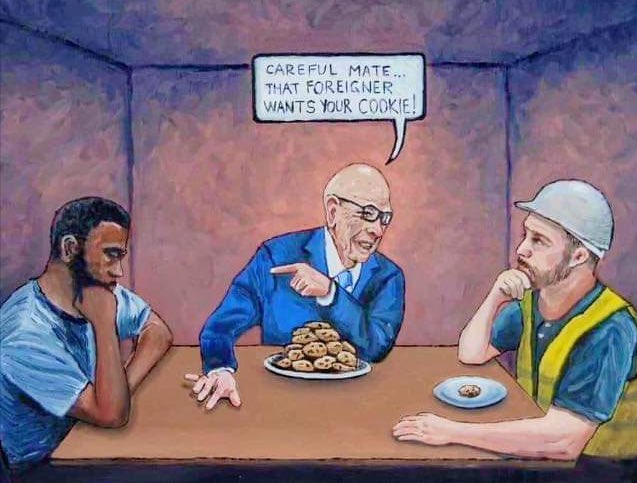
How we talk about things influences how we think about things. Whether you believe the people arriving in small boats after perilous journeys are “illegal immigrants” (who have come here to exploit the system and harm us) or “asylum seekers” (desperate people who are seeking better/safer lives for themselves and their families) frames how you treat them. If you believe people who have complex offshore tax arrangements are “legitimate successful business people” or “tax dodgers” frames how you treat them. If you believe that trans people are “men in a dress (who present a threat to women)” or vulnerable people who desire to live in a way that is aligned to their deepest sense of self frames how you treat them. Words matter because they set the Overton window – the range of discourse that is considered acceptable in a society – which frames the prevalent perception and accepted understanding of key issues.
That is why the “culture wars” in politics and social media is so dangerous. People are being swept up into bubbles where if you believe one misleading thing (eg that the difficulties young white men now face are not being recognised because all the focus is on uplifting women and people from the global south, or that immigrants get preference for housing or benefits or are taking away job opportunities from your community) you are suddenly exposed to more and more hideous things – from the incel mindset to vaccine misinformation, transphobia, racism, islamaphobia, antisemitism, sexism, and regressive views about reproductive rights or the value of people who don’t have children – until your understanding of the world can completely detatch from the reality. Once swept into a bubble like that people end up dividing the world into allies (who think like themselves) and enemies (who think differently). To align with the allies who defended you when you faced one area of legitimate criticism is to align with all their beliefs. So otherwise sensible and progressive people can end up defending the indefensible and entrenching into deeper and deeper prejudice and antagonism. Once it becomes about alliances and identity, it seems our ability to apply any critical thinking to evaluate claims is undermined.
Yet progress has made huge strides over the decades before this recent setback. The public are broadly supportive of gay marriage, of women’s rights, of a health service funded from taxes, of a social care safety net, of the need to take better care of the environment and avoid climate change. These have been positive changes over time. There is also less tolerance of prejudice. You can see it when you watch old TV shows, and hear their casual jokes that have a sexist, racist, homophobic or transphobic edge to them, and realise that such content wouldn’t be commissioned now (and rightly so) – although portrayal of people with disabilities by actors without them persists. Problems are most obvious when we look back 50 years or more, where the issue was overt in shows like the Black and White Mistrel Show and sitcoms contained overtly racist content. Disney have had to add content warnings to some of their old films and cartoons. However, shows that were not seen as problematic in my youth have also been reviewed. Episodes of Little Britain, League of Gentlemen and the Mighty Boosh have been withdrawn for blackface. But even relatively recent content can age badly. If you rewatch episodes of Scrubs or Psych (both still highly rated and available to stream) there is content that feels really uncomfortable now. The former has had three episodes pulled for blackface. Psych remains up in full, but has repeated caricatures of people of different nationalities, and lots of casual sexism, racism and transphobia, despite being made from 2006-2014. Times have changed for the better in this regard. The acceptable discourse changing is a sign that progress is being made to reduce inequalities. Frustratingly, as I wrote in my last blog post, the last government and various figures on the right have managed to reverse some of that progress, with inflamatory discourse about immigrants, islam and trans people. Thankfully there are signs that is being addressed by the new government and that the majority of people don’t share such toxic views.
Language also matters when it comes to the terminology people use about their skills and professional status. It might sound boring and pedantic, but it is super-important to use the right words to describe yourself – especially when it comes to the terms that identify your professional status or qualifications. When I go to my GP it matters whether I get seen by a qualified doctor with five or more years of training with signficant breadth and/or depth, or another form of clinician who may only have a year or two of training and a much lower level or narrower area of expertise. If I have stress and worries, it makes a difference if I see a “wellbeing worker” who only has administrative experience or a qualified mental health professional. At the hospital it matters if it is a or “physician’s assistant” or a doctor that examines you – it can be life or death.
So when I read a CV in which someone claims to be a “Chartered member of the BPS” when they only have GBC – the graduate basis that is the first step towards gaining a qualification that could lead to later Chartered Status* – that is a problem. Yet this mistake was made by more than one applicant for one of our recent vacancies. If I read that someone is a “clinical psychologist” but they are not on the HCPC register as a practitioner psychologist, that is misleading and unlawful – yet I’ve seen three examples this month alone (in applications, and on LinkedIn profiles). I suspect that people in the psychological career paths are being impacted by the lack of clarity in the legislation and professional bodies, just as the public are, because there is no clear single source of this information. It is particularly confusing for people entering the UK from countries with different training paths, terminology and regulatory frameworks. Someone who is legitimately a “clinical psychologist” in another country can’t continue to use that title when living or working here unless they gain HCPC registration. Yet it is interesting that it isn’t as obvious as someone not being allowed to practise as a medial doctor or dentist or social worker without the right regulatory status – perhaps because the regulatory framework for psychology is so weak that if they drop the word “clinical” they are free to claim to be a psychologist with impugnity**.
It also bugs me when people self-adopt the term “consultant” because this is not protected by law and they think it will make them sound more impressive, when that title should reflect external validation of the level of responsibility of your role and expertise. I had to earn that title through a process involving a panel interview for a job with national assessors appointed by our professional body. I gained my consultant grading after many years of service gaining specialist skills with a particular client group, only when I gained a post with responsibility for a multidisciplinary team in a multi-agency context, working with highly complex presentations. Whilst the professional bodies haven’t yet resolved the issue of defining use of the consultant grade outside the NHS or large employing organisations, there are some professional recommendations and correspondence. Consultant is a term designed to mirror our medical colleagues in the NHS and is used to designate an individual who has been assessed as having attained a high level of specialist skill, doing a job with a high level of responsibility for leading a service and managing others, as well as having a deep expertise in a particular model of psychology and/or population. It isn’t obtained by time served or by specialist knowledge alone, it is a reflection of holding a post that scores above a particular threshold on the KSF – normally leading a substantial area of service delivery and being accountable for the outcomes and the team that deliver that service. For that reason, it makes me bristle to see self-employed sole practitioners who have claimed the title “consultant” either because they offer consultations or because they think they have earned it through time served or depth of knowledge of a model of therapy. That isn’t how it works. Not only was I judged to be the strongest candidate for the post and to have the required competencies to work at that level, my NHS role was judged to require consultant banding because of its level of responsibility. I have retained the title “consultant clinical psychologist” after leaving the NHS because I have continued to work in complex multi-agency contexts, leading teams and being accountable for their performance. But if individuals within my profession don’t understand and respect this differentiation, how can we expect the public (or the courts, or private service managers, or colleagues in social care or education) to understand what the terms mean, which of them are regulated and how to recognise when people are using them inappropriately and what to do about it?
I still hope that the government will grasp this nettle and regulate the title “psychologist”, require professional indemnity insurance for anyone offering therapy or mental health services to the public, and give the public much clearer information about how to find a suitably qualified practitioner who can meet their needs. I hope that this will then bring clarity for the terminology that people can use, and for public understanding of that terminology. But we are a long way from this happening. For now, I can only try to share clear information on the clinpsy forum, which continues to get millions of page views and to be one of the most accessible sources of information about the career path for clinical psychology in the UK.
*The BPS have lowered all the standards for what it takes to be a member, and how you can become chartered, so this is less and less meaningful, and they have encouraged members (even student and graduate members) to use letters after their name that I believe the public and non-psychologists would find misleading, so they are at least partly to blame.
**The issue of regulation of titles in psychology is something I feel passionately about and consider an important issue of public protection. The UK is the only country in the developed world not to regulate the term “psychologist” so this is a necessary first step. But I believe that absolutely everybody offering any form of wellbeing service to the public requires professional indemnity insurance and to be within the scope of a regulator. Otherwise people will continue to be preyed upon by unscrupulous, abusive and incompetent practitioners when they are at their most vulnerable.

 ClinPsyEye