I wanted to write something about recent events. They’ve had a powerful emotional effect on me, and lots of people that I know. People who are muslim, asian or black have been particularly affected, but I think many people will have been a bit more wary of unrest or concerned about what was going on and what it means about us as a nation. I also wanted to express solidarity to those who have felt fearful over recent times, and to think a bit about what we can do going forward.
There will be those who say that commentary on recent events isn’t professional or think it doesn’t relate to psychology, and more generally claim that politics shouldn’t enter professional settings. But, as you’ll have gathered from my past posts on here, I don’t shy away from politics. I think all human behaviour is worth trying to understand, and everything is ultimately influenced by wider political issues and decisions. Mental health does not happen in a vacuum. It is related to physical health, and to our ability to meet our basic needs for safety, shelter, food and relationships. There are also numerous socio-political issues underpinning the wellbeing of individuals and the trauma that many experience, from poverty to employment stress, polarisation (“culture wars”) to waiting lists.
As anyone who has read any of my blog will know, I’m politically progressive. I’d like to think I’ve always been very active in naming the racism/islamophobia on show in person and on social media, supporting my team to think about and deal with the repercussions (and I’ve been a long-time supporter of Hope Not Hate, Stop Funding Hate and various social justice organisations). I’m also have some skin in the game. I’ve previously talked about being a second-generation immigrant myself*, but never experiencing the same prejudices as friends who are black or asian or muslim because I am white, middle class and non-religious (although I was recently rightly reminded of the way white eastern european immigrants were treated around Brexit). I also believe in the golden rule to treat others as we’d hope to be treated. If there was a massive disaster in the UK, we’d hope that another nation would let us take our family to safety there, and give us the opportunity to work and contribute and become part of the community. We can’t resent the people who move here wanting the same thing.
So where do I stand on the recent riots? As I see it, they were the inevitable consequences, not of “reasonable concerns about immigration” or the tragic events in Southport, but of ignorance and hate stoked by the far right boiling over into acts of terrorism, vandalism and aggression. What happened over the weekend was the fruition of a long process of politicians, media and hatemongers shifting the window of acceptable discourse to include racism and islamophobia, with a thin veneer of patriotism to give it cover. It is a story that began before Brexit or the Trump presidency, and is tied into the growth of social media (see my prior blog here). The riots were the symptoms of a sickness that has been intentionally cultivated and allowed to fester for too long. I have watched it grow with revulsion and a sense of powerlessness. I can only hope that the people who instigated the violence face consequences as easily as the saps who enacted it, who have already started appearing in court and await prison sentences.
On the flip-side, as always, where bad things happen, we see good people stepping up. In this case we saw people coming out in force to clear up their neighbourhoods, repair damage and guard mosques. And today we saw thousands of people turn out to face down fascism in every city there was expected to be a far right protest, donating to fundraisers to cover repair costs for vandalised libraries, shops and cars, and expressing abhorence for the rioting. I also got some joy from watching how far right figureheads were throwing each other under the bus to try to seem less personally culpable, further protests failed to materialise and the media that had stoked hate for so many years was suddenly changing its tune. It was a relief to see that the majority of the population believe in a diverse and inclusive society, not in mob rule, and that those promoting or participating in violence will face consequences.
So where do we go from here? I think the government will need to act to prevent the spread of hate and instigation of violence, by considering how they regulate it on social media and in the press. The move towards rapid and visible justice was something we need to see applied to all violent crime, as the current court system isn’t able to keep up with demand**. We need to see changes to the immigration system too – moving people who are entitled to stay rapidly into work and allowing them to integrate in communities, rather than cooping them up in hotels at the tax-payer’s expense. And we need to address poverty, health and quality of life, so people don’t feel they have missed out on progress. It is much easier to whip up hatred against foreigners when people are struggling in their own lives. If we can offer a functional health service, a benefits safety net of minimum income that means people can afford to pay their rent and bills and feed their families. If we can offer hope for the future, educate people to recognise fake news, and show the value of diversity to our society, it will be harder to whip up hatred again.
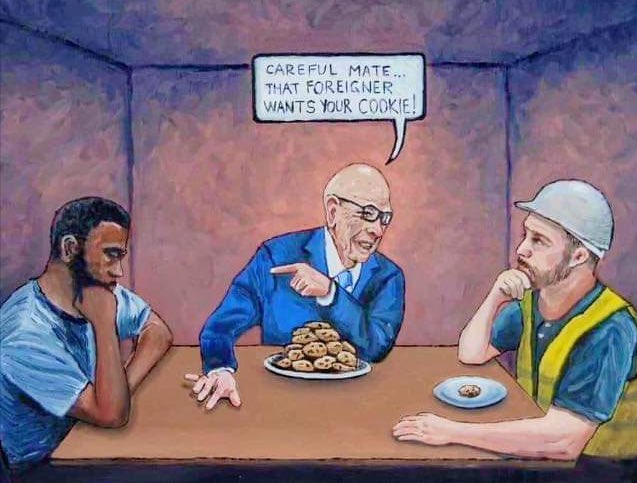
There is an illustration of three men sitting at a table that I often retweet. One man has a pile of cookies on his plate, one has a single cookie and one has none. Sometimes the man with many cookies is drawn to look like a banker or a press baron or a billionaire, and the man without as an immigrant. The man with plenty of cookies tells the man with one “careful mate, that foreigner wants your cookie”. It is an apt metaphor for how the those with the greatest wealth and power have always targeted resentment towards those with least, so that they can maintain the unfairness of their privilege. It is no coincidence that the peddlers of hate are often selfish and narcissistic millionaires and billionaires, wanting the majority of the population to focus their anger on disadvantaged groups like single mothers, immigrants or people who claim benefits, rather than looking at who is really hoarding a disproportionate share of the world’s wealth and resources***.
*My great grandparents fled religious persecution in the USSR, my parents moved continent again to avoid complicity with a regime that was racist and to take up educational opportunities, and arrived in the UK in 1969. My mum returned 40 years of service in the NHS, my dad over a decade in education/care/justice. And they had me and my brother who haven’t been too bad for the UK either – I’m an award-winning CP and social innovator working in health and care, and he’s a world-leading AI researcher. Accepting a fair proportion of people fleeing persecution is the morally right thing to do. But it also makes economic sense. Without immigration, the UK would miss out on amazing people, and essential health and care staff.
**I also think that the draconian laws about peaceful protest, especially when applied to issues like climate change, need to be reconsidered. I don’t have an issue with prosecuting those who cause disruption or damage, but I think preventing them being able to explain their reasons for doing so in court is a concerning precedent, and some of the sentences have been disproportionate when compared to other crimes.
***The scale of wealth held by the richest few is mindblowing. This illustration starts with a single pixel to represent a dollar. Remember that a billion people in the world live on less than a dollar a day. A tiny square represents the household median income in the USA of £69,000 dollars (this seems higher than UK salaries, but they have to pay for health insurance and various other costs, and get minimal paid leave, and employers don’t have to contribute to employee pension schemes). A small square is a million dollars (a level of wealth that would place you in the top 3% of the world). Elon Musk’s wealth is a block so big it seems endless.
 ClinPsyEye