Diagnosis vs difference

I read a recent editorial on LinkedIn about the way that the diagnostic criteria for neurodiversity require “impairment” in functioning for a person to reach the diagnostic threshold. It was an interesting topic for a paper, and raised a set of broader interlinked questions in my mind about whether diagnosis is a recognition of difference-from-the-norm in the way some people’s brain or body functions, or whether it is about recognising something that is harmful (like a disease), or whether it causes distress or impairment / difficulties in functioning (like a disability or mental health condition). In particular it is interesting to think about how neurodiversity fits into that framework, compared to mental health conditions or physical health conditions. It opens questions about the purpose of diagnosis and whether that is about recognition of difference and understanding ourselves, or for gatekeeping access to certain types of support. It also raises questions about terminology – whether we acknowledge that many patterns of need or difference fall on a spectrum, and what we call a disorder or condition.

As it stands, in the current diagnostic rules (DSM 5 or ICD 11) each diagnosis has a minimum set of symptoms described. For example, in the DSM for a diagnosis of autism the individual must have “persistent deficits in social communication and social interaction across multiple contexts” and two or more areas in which they show “restricted, repetitive patterns of behavior, interests, or activities”. These difficulties must have emerged early in development, and not be “better explained by intellectual disability or global developmental delay”. However, to be diagnosed, the person doesn’t just need to have the neurotype of autism or ADHD but to struggle significantly with work, life, mental health or relationships because of it. Symptoms must cause “clinically significant impairment in social, occupational, or other important areas of current functioning”.

On first glance it seems a pretty clear description that could be consistently applied, but the more I’ve thought about it the more problems I see. First of all, the impairment criteria mean that people could waver in and out of the diagnostic category according to how well they are doing in their lives at that point, how well their environment and network support their needs, or their developmental stage. For example, a person could be autistic as a child, but then find a lifestyle, job, community or other niche in which they are happy and successful, and therefore fall below the diagnostic threshold – until a change or stressful life event means that they become distressed, when they would be diagnosable once again. Or they could have very subtle challenges that would not meet the criteria in primary school, but increasingly struggle during secondary school and meet the criteria for diagnosis, but then escape the sensory overload and/or social demands of that setting and no longer meet the criteria again.

That doesn’t make much sense given that autism, ADHD and other forms of neurodiversity are currently conceptualised as lifelong, inate differences in how people process information and interact with the world, rather than conditions that come and go. Neurodiversity isn’t a disease that temporarily disrupts a person’s normal functioning and can be treated to return them to normal. Neurodiversity is normal for that person; it is intrinsic to the way they experience and interact with the world for the whole of their lifespan. A neurodiverse brain is set up with a much wider focus of attention, or more attention to detail, or more propensity for sensory overload than a neurotypical one. A person doesn’t stop being autistic or having ADHD or a learning disability even if they learn strategies to fit in better with other people’s expectations or cope better cope at school or in the workplace any more than a person who is colourblind stops being colourblind if someone provides glasses that increase the red-green contrast.

For that reason, neurodiversity doesn’t fit into the medical model of diagnosis in the same way as mental health problems that may come and go, where a diagnosis may be helpful during the period when a person is experiencing depression or anxiety or psychosis, but may cease to be relevant at a later point – as for many people the symptoms will entirely resolve (spontaneously or with treatment) and no longer impact them. In the case of a mental health condition it wouldn’t be relevant to continue to use the diagnostic label after their symptoms resolve, as the individual may return to population-normative ways of experiencing the world. If we retained the diagnosis it would lose all meaning, as about half the population would end up with it, but most of those would have no symptoms that differentiate them from those without the diagnosis.

I also wondered how the idea of impairment fits with masking. In some cases a diagnosis could be withheld from a person who subjectively feels like they are struggling enormously if they were able to mask their difficulties enough for them to not impair their ability to function in their workplace or relationships during the assessment period. Or could it be considered a signficant impairment that it is exhausting to mask difficulties? Or that the effort of masking or coping with sensory overload all day at school or work means the person then struggles to function at home, withdrawing or becoming dysregulated in a way that might on first inspection suggest the difficulty is located within the home.

However, despite all the reservations I have raised, it is possible to think about diagnosis as only being meaningful when it applies to functioning, and a label for a degree of symptoms that is outside of the normative range. Many conditions are not binary variables that are either present or absent. Illness is quite often a matter of degree rather than the presence or absence of a condition. For example, a person’s glucose metabolism can indicate that they are becoming insulin resistant, but it is only above a certain threshold that the diagnostic label of diabetes would be applied, and certain treatments would be considered. Likewise our blood pressure or weight can be in the healthy range, or below or above that, but a diagnosis is only given if it is sufficiently high to cause significant health risks. There are numerous variables where we can be tested to see whether we fall into the typical range, or whether further investigation or treatment would be benficial – from our levels of white and red blood cells, iron, vitamin D, cholesterol, hormones, to the functioning of our liver and kidneys, markers of inflammation, infection or tumours. The threshold at which doctors diagnose conditions is typically the point at which symptoms start interfering with functioning and/or the pattern identified is known to cause harm, risk or distress to the individual.

Sometimes medics have to determine appropriate treatment without a diagnostic test being available, or where there is not a direct relationship between symptoms and the scores from blood tests or scans. For example, calcific tendonitis can affect the shoulder joint causing pain, reduced movement or even functional paralysis. However, sometimes people with scans that show a lot of calcification don’t report any symptoms, and sometimes people with very little visible in the scans have a lot of functional impairment. Physiotherapy and/or steroid injections seem equally effective at treating symptoms regardless of what shows in the scans. So treatment is typically determined by impairment alone. Likewise, a woman might have lower levels of oestrogen during or after menopause, and this might be associated with certain symptoms like brain fog, anxiety, hot sweats or disrupted sleep. But there is a degree of variation in what level of oestrogen the woman’s body is used to, and the effect she will experience from it dropping that means some women glide though menopause naturally without much ill-effect, whilst others (myself included) would find it entirely disabling without HRT – and this doesn’t map directly onto the level of oestrogen detected in blood tests. For this reason, it is the pattern of symptoms rather than the blood test results that should guide treatment.

Likewise, depression is something that ocurs along a spectrum from very mild to totally disabling symptoms. As is anxiety. There are even levels of the unusual beliefs or sensory experiences that occur in psychosis that would be considered normative – such as thinking you’ve seen a person who has recently died, hearing an internal voice giving you advice, or having strange or intrusive thoughts that you are able to quickly dismiss. In the same way, arguably we are all neurodiverse to some degree – we each have different patterns of cognitive strengths and weaknesses, different ways of processing sensory information, and subjective experiences of the world. But some of us are able to function in the world more successfully than others, with some people constantly feeling discomfort, distress or having to put in huge amounts of effort to do things that others find effortless. It therefore seems logical that it is the level of impairment rather than the neurotype that determines whether a diagnostic label is appropriate – even though this brings both a level of subjectivity to the judgement of whether the label is appropriate and an acknowlegement that the degree of impairment reflects not just the qualities of the individual, but also the qualities of the environment and network that they function within.

It might be that like height or hair colour, sexuality or personality traits, our strengths and weaknesses, there are ways in which we all vary that are not “conditions” that need to be diagnosed but simply differences between individuals. If we conceptualise neurodiversity as this kind of difference, then recognising it can still be a helpful way to understand ourselves, and how we differ from others. It can also help us find our tribe – the people that share our struggles or our interests and talents.

However, all this theoretical debate misses the elephant in the room of how widening the diagnostic range helps people with more subtle impairment recognise their neurotype, at the cost of negating the experience of those with more profound impairment who had historically been able to convey their needs with a label that now gives most people a false impression of much subtler difficulties. What terminology do parents or carers of people with the “autism” described by Kanner (or at the more impaired end of the spectrum described by Wing and Gould) use to describe their pattern of needs? These individuals may be non-verbal, with significant developmental delay, very atypical ways of interacting with others, and obvious stims/stereotypies that instantly mark them out as different to members of the public. This group includes people with autism who are profoundly disabled to the point that they will need signficant financial and practical support across their lifespan – attending special schools, not being able to communicate their needs except through their behaviour, unable to reach independent living, or have the capacity to make decisions about their lives. Having an appropriate diagnostic label functions as a gatekeeper to accessing this kind of financial and practical support.

The problem being that whilst this group have used the label “autism” to describe their needs for eight decades, this is not the same population as now use the word “autism” to describe themselves on social media, to friends or in the workplace. As the diagnostic threshold has lowered to recognise more subtle impairments the label of autism has been claimed by many quite “high functioning” people to self-describe their struggles in a neurotypical world, and – because this group is more articulate and able to speak for themselves – they have come to dominate the discourse about autism, overshadowing the smaller numbers of people with more profound disabilities who had previously been described by this label. The larger number of people who are now included in the same diagnostic category but were previously given the diagnosis of Asperger Syndrome or High Functioning Autism, or seen as having difficulties that were below the diagnostic threshold, typically don’t have the moderate to profound learning disabilities, or need for support in their daily living skills as those who were diagnosed with Autism a few decades earlier. This population group might be independent, articulate, intellectually able, employed, and/or involved in interpersonal relationships including friendships and romantic/intimate relationships. Whilst it is evident that they do find some elements of life harder than neurotypical people, and it is a very helpful and affirming label that lets many people understand why they have felt different to the norm and have struggled with elements of their life, the level of support they require is not equivalent – despite the diagnosis on paper now being the same. A parallel process of widening the diagnosis has happened with ADHD and other elements of neurodiversity, to the point that 10-15% of people now identify with at least one element of neurodiversity, when historically only 1-2% of people were given these diagnostic labels.

This mismatch has therefore become the grain of truth that underlies some very toxic discussions about the growing rate of diagnosis, and the expanding numbers of people claiming disability benefits and adjustments or support within education and the workplace. With larger, more articulate and more powerful groups of voices advocating for the needs of the able end of the spectrum (who often object to any implication of there being a spectrum or such a thing as high vs low functioning or find such labels pejorative), it is hard for the voices of those representing more disabled individuals to be heard. I can understand that we need to respect the voices of lived experience about what terminology they are comfortable with. But some people don’t have voices in this conversation. And it wouldn’t be honest or fair to pretend that the needs of everyone with autism are equal.

The changing use of the diagnostic label doesn’t necessarily relate to the type or degree of support people require, and therefore it may no longer be able to function as a gatekeeper of services. That might still have to rely on an understanding of impairment – the areas in which we are struggling or require more support than the rest of the population. We can’t support everyone equally, that just isn’t viable. We also can’t allow resource rationing to lead the decisions about terminology or diagnosis. But it will have to be consideration of impairment that helps systems to differentiate what levels of support are appropriate – even if that involves subjective judgements, of functional states that are impacted by the environment, and will need to be regularly reviewed over time. Because without us evolving the right language to accurately reflect levels of need, the most disadvantaged will struggle to get their needs met at all – with tragic consequences for them, their caregivers, and the public purse. And, as Mahatma Gandhi is believed to have said, “the true measure of any society can be found in how it treats its most vulnerable members.”

Why I dislike the concept of resilience

The way people talk about increasing the resilience of children who have experienced trauma makes me deeply uncomfortable. Likewise the way we talk about people who have lived through traumatic experiences in their work, bullying or coercively controlling relationships needing to “toughen up” or learn skills to “shake it off”. Worse still, the idea of attributing better outcomes to people with a “positive mental attitude”, “determination” or “grit”. It seems to suggest that there is some inner strength that allows some people to weather trauma better than others in a way that implies that anyone who doesn’t manage to do so is somehow weaker or missing skills we need to equip them with, rather than acknowledging that how our brains and bodies respond to trauma is largely out of our control. None of us know how we will cope under adversity, or how it will affect us later down the line.

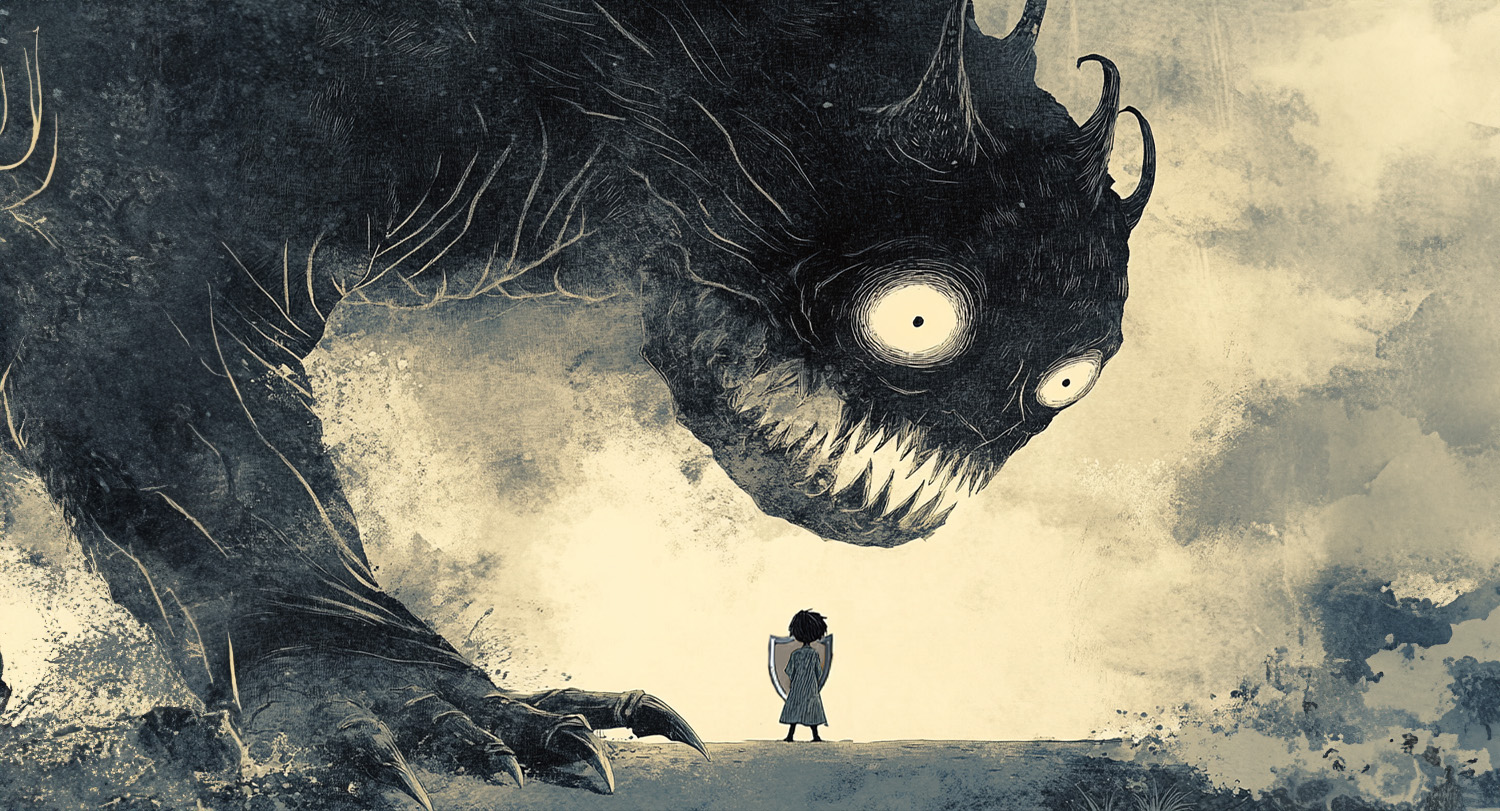
It feels like saying the outcome from the scenario in the picture above is defined by how well the character can use his shield, not by the size or temperament of the monster, the landscape, the weather, or even the character’s age, size, speed, intelligence or strength.

Resilience is defined as “the capacity to withstand or to recover quickly from difficulties; toughness” (Oxford English Dictionary) or within psychology as “the process and outcome of successfully adapting to difficult or challenging life experiences, especially through mental, emotional, and behavioral flexibility” (APA) and they tell us that “the resources and skills associated with resilience can be cultivated and practiced”.

I’ve got a number of problems with this.

First and foremost, I don’t think it is a helpful way to conceptualise the issue. The responsibility for the impact of trauma should sit with those who perpetrate harm*, not on victims. If you think about other forms of adversity like cancer, car accidents or crime, we work on prevention and recovery; we don’t expect people to be resilient to these things. We broadly understand that the extent of their injuries, the treatment required, the impact on their life, and the time it will take to recover, are largely out of their control. In the same way, we need to understand that there are many types of trauma, with different qualities like duration, severity, numbers of perpetrators and the degree to which it undermines trust. Each trauma is set in a different context, and impacts on different individuals, with different resources and sources of support. But even if we map the type and severity of trauma there is no direct relationship between the nature of the trauma experienced and the symptoms the individual will experience.

Secondly, the individual factors in outcomes from trauma seem to be outside of the person’s control. They are determined by chance (eg being in the wrong place at the wrong time), or our biology and epigenetic factors (eg the length of our telomeres, the protective caps at the end of DNA strands that shorten with each cell division, are impacted by our genes but also shortened by trauma), or related to the quality of our relationships (eg having any one reliable attuned relationship is protective), and our socioeconomic status (eg ability to eat a healthy diet and avoid stress) rather than to do with an individual’s mindset. Research that purports to measure individual differences often appears to measure elements that are impacted by experience. For example, one pop psychology article explains “instead of falling into despair or hiding from issues by using unhealthy coping strategies, resilient people face life’s difficulties head-on. People with resilience do not experience less distress, grief, or anxiety than other people do. Instead, they use healthy coping skills to handle such difficulties in ways that foster strength and growth, often emerging stronger than they were before”. But it seems to me that the ability to use these coping strategies depends on intelligence, relationships and past experience.

In the same way, survivor stories are often framed in terms of perseverence, bravery and determination rather than factors outside their control. I’m not denigrating the value of people with lived experience telling their stories – they are important for other people to hear to understand the nature of problems in society, and important role models that life after trauma is possible for people earlier in that journey. But we need to be careful not to extrapolate that the admirable qualities they now demonstrate were the reason they now seem to be unscathed by their experience (or part of post-traumatic growth). Actually it might have taken immense work to get to the point that their lives are going well and they are able to talk about their experiences. Just like the way the people we see most in the gym are the fittest people, the people able to talk about their experiences of trauma may be those who have the intelligence, reflective capacity, time and support to process their experiences and talk about them in a way that appeals to the audience.

Thirdly, we all tend to attribute too much of many outcomes to individual factors, and too little to external factors that come down to luck. Rich people frequently attribute their success to hard work, without realising that many people who work harder fail to reap the same rewards. Top athletes attribute their success to talent and hard work, but fail to recognise that month of birth and access to facilities play a significant part in their success (people born earlier in the school year tend to be larger and better coordinated, and therefore get more practise and experience of success that leads to greater confidence and opportunity). And it is the success stories that get told to larger audiences and seep into the culture. Was the key factor in the story of a six year old who saved his mother by alerting a delivery driver to her seizure his bravery or was it the stroke of luck that someone was around at the right moment? We like the story with internal locus of control as it gives us hope and makes us feel less powerless in the face of overwhelming or unpredictable threats.

That isn’t to say that there aren’t things that can be done to aid recovery from trauma. Of course learning to be compassionate to yourself, being able to talk about your experiences and having ongoing supportive relationships that help you recognise that what happened was not your fault are all important in aiding recovery. However, these aids to recovery should be focused on how the individual feels, rather than to what degree their distress is visible from the outside. We have learnt from social skills training in neurodiversity that looking normal to others can be performative, and something done at high personal cost to wellbeing. I think there is a risk that in some cases perceived resilience might be just how well a person can mask the impact of trauma.

*and anyone who knows about abuse and has the power to prevent or report it, but fails to do so (from politicians, heads of the church, and powerful figures in each industry through to relatives, colleagues and bystanders).

Words Matter: Prejudice, progress and professional terminology

How we talk about things influences how we think about things. Whether you believe the people arriving in small boats after perilous journeys are “illegal immigrants” (who have come here to exploit the system and harm us) or “asylum seekers” (desperate people who are seeking better/safer lives for themselves and their families) frames how you treat them. If you believe people who have complex offshore tax arrangements are “legitimate successful business people” or “tax dodgers” frames how you treat them. If you believe that trans people are “men in a dress (who present a threat to women)” or vulnerable people who desire to live in a way that is aligned to their deepest sense of self frames how you treat them. Words matter because they set the Overton window – the range of discourse that is considered acceptable in a society – which frames the prevalent perception and accepted understanding of key issues.

That is why the “culture wars” in politics and social media is so dangerous. People are being swept up into bubbles where if you believe one misleading thing (eg that the difficulties young white men now face are not being recognised because all the focus is on uplifting women and people from the global south, or that immigrants get preference for housing or benefits or are taking away job opportunities from your community) you are suddenly exposed to more and more hideous things – from the incel mindset to vaccine misinformation, transphobia, racism, islamaphobia, antisemitism, sexism, and regressive views about reproductive rights or the value of people who don’t have children – until your understanding of the world can completely detatch from the reality. Once swept into a bubble like that people end up dividing the world into allies (who think like themselves) and enemies (who think differently). To align with the allies who defended you when you faced one area of legitimate criticism is to align with all their beliefs. So otherwise sensible and progressive people can end up defending the indefensible and entrenching into deeper and deeper prejudice and antagonism. Once it becomes about alliances and identity, it seems our ability to apply any critical thinking to evaluate claims is undermined.

Yet progress has made huge strides over the decades before this recent setback. The public are broadly supportive of gay marriage, of women’s rights, of a health service funded from taxes, of a social care safety net, of the need to take better care of the environment and avoid climate change. These have been positive changes over time. There is also less tolerance of prejudice. You can see it when you watch old TV shows, and hear their casual jokes that have a sexist, racist, homophobic or transphobic edge to them, and realise that such content wouldn’t be commissioned now (and rightly so) – although portrayal of people with disabilities by actors without them persists. Problems are most obvious when we look back 50 years or more, where the issue was overt in shows like the Black and White Mistrel Show and sitcoms contained overtly racist content. Disney have had to add content warnings to some of their old films and cartoons. However, shows that were not seen as problematic in my youth have also been reviewed. Episodes of Little Britain, League of Gentlemen and the Mighty Boosh have been withdrawn for blackface. But even relatively recent content can age badly. If you rewatch episodes of Scrubs or Psych (both still highly rated and available to stream) there is content that feels really uncomfortable now. The former has had three episodes pulled for blackface. Psych remains up in full, but has repeated caricatures of people of different nationalities, and lots of casual sexism, racism and transphobia, despite being made from 2006-2014. Times have changed for the better in this regard. The acceptable discourse changing is a sign that progress is being made to reduce inequalities. Frustratingly, as I wrote in my last blog post, the last government and various figures on the right have managed to reverse some of that progress, with inflamatory discourse about immigrants, islam and trans people. Thankfully there are signs that is being addressed by the new government and that the majority of people don’t share such toxic views.

Language also matters when it comes to the terminology people use about their skills and professional status. It might sound boring and pedantic, but it is super-important to use the right words to describe yourself – especially when it comes to the terms that identify your professional status or qualifications. When I go to my GP it matters whether I get seen by a qualified doctor with five or more years of training with signficant breadth and/or depth, or another form of clinician who may only have a year or two of training and a much lower level or narrower area of expertise. If I have stress and worries, it makes a difference if I see a “wellbeing worker” who only has administrative experience or a qualified mental health professional. At the hospital it matters if it is a or “physician’s assistant” or a doctor that examines you – it can be life or death.

So when I read a CV in which someone claims to be a “Chartered member of the BPS” when they only have GBC – the graduate basis that is the first step towards gaining a qualification that could lead to later Chartered Status* – that is a problem. Yet this mistake was made by more than one applicant for one of our recent vacancies. If I read that someone is a “clinical psychologist” but they are not on the HCPC register as a practitioner psychologist, that is misleading and unlawful – yet I’ve seen three examples this month alone (in applications, and on LinkedIn profiles). I suspect that people in the psychological career paths are being impacted by the lack of clarity in the legislation and professional bodies, just as the public are, because there is no clear single source of this information. It is particularly confusing for people entering the UK from countries with different training paths, terminology and regulatory frameworks. Someone who is legitimately a “clinical psychologist” in another country can’t continue to use that title when living or working here unless they gain HCPC registration. Yet it is interesting that it isn’t as obvious as someone not being allowed to practise as a medial doctor or dentist or social worker without the right regulatory status – perhaps because the regulatory framework for psychology is so weak that if they drop the word “clinical” they are free to claim to be a psychologist with impugnity**.

It also bugs me when people self-adopt the term “consultant” because this is not protected by law and they think it will make them sound more impressive, when that title should reflect external validation of the level of responsibility of your role and expertise. I had to earn that title through a process involving a panel interview for a job with national assessors appointed by our professional body. I gained my consultant grading after many years of service gaining specialist skills with a particular client group, only when I gained a post with responsibility for a multidisciplinary team in a multi-agency context, working with highly complex presentations. Whilst the professional bodies haven’t yet resolved the issue of defining use of the consultant grade outside the NHS or large employing organisations, there are some professional recommendations and correspondence. Consultant is a term designed to mirror our medical colleagues in the NHS and is used to designate an individual who has been assessed as having attained a high level of specialist skill, doing a job with a high level of responsibility for leading a service and managing others, as well as having a deep expertise in a particular model of psychology and/or population. It isn’t obtained by time served or by specialist knowledge alone, it is a reflection of holding a post that scores above a particular threshold on the KSF – normally leading a substantial area of service delivery and being accountable for the outcomes and the team that deliver that service. For that reason, it makes me bristle to see self-employed sole practitioners who have claimed the title “consultant” either because they offer consultations or because they think they have earned it through time served or depth of knowledge of a model of therapy. That isn’t how it works. Not only was I judged to be the strongest candidate for the post and to have the required competencies to work at that level, my NHS role was judged to require consultant banding because of its level of responsibility. I have retained the title “consultant clinical psychologist” after leaving the NHS because I have continued to work in complex multi-agency contexts, leading teams and being accountable for their performance. But if individuals within my profession don’t understand and respect this differentiation, how can we expect the public (or the courts, or private service managers, or colleagues in social care or education) to understand what the terms mean, which of them are regulated and how to recognise when people are using them inappropriately and what to do about it?

I still hope that the government will grasp this nettle and regulate the title “psychologist”, require professional indemnity insurance for anyone offering therapy or mental health services to the public, and give the public much clearer information about how to find a suitably qualified practitioner who can meet their needs. I hope that this will then bring clarity for the terminology that people can use, and for public understanding of that terminology. But we are a long way from this happening. For now, I can only try to share clear information on the clinpsy forum, which continues to get millions of page views and to be one of the most accessible sources of information about the career path for clinical psychology in the UK.

*The BPS have lowered all the standards for what it takes to be a member, and how you can become chartered, so this is less and less meaningful, and they have encouraged members (even student and graduate members) to use letters after their name that I believe the public and non-psychologists would find misleading, so they are at least partly to blame.

**The issue of regulation of titles in psychology is something I feel passionately about and consider an important issue of public protection. The UK is the only country in the developed world not to regulate the term “psychologist” so this is a necessary first step. But I believe that absolutely everybody offering any form of wellbeing service to the public requires professional indemnity insurance and to be within the scope of a regulator. Otherwise people will continue to be preyed upon by unscrupulous, abusive and incompetent practitioners when they are at their most vulnerable.

Hindsight and reflection

When I watched The Usual Suspects, the twist at the end made me immediately re-watch the whole film. The extra bit of knowledge meant the same information from the earlier plot had entirely different meaning. The same thing happens when you realise someone has lied to you, or manipulated you for some secondary gain – you suddenly need to reappraise all the prior interactions you have had in light of this new insight. It is inevitable as we go through life that we learn additional information that helps us understand things in more sophisticated ways. Just as we learn that our parents are flawed human beings, rather than always right and almost omnipotent, a lot of relationships transpire to be less perfect when the first thrill of connection wears off. It can be quite a challenging process to understand why you were fooled, what you should have noticed, and how you could have avoided the bad feelings that come with realising all was not as it seemed.

In one chapter of my book I talk about the poem “Holes, An Autobiography in five short chapters” by Portia Nelson. It is a nice summary of the patterns we can all fall into, and how it is only reflection and insight that lets us climb out, and eventually learn to avoid falling into similar holes in the future. I found it really helpful realising that there were certain “holes” that I recurrently fall into. In particular, I was susceptible to one when others seem to need my help and support, but keep on taking without recognition of the value of that help or any cost it has for me, until I feel exploited. An early example was a student who volunteered when I was an AP, who I supported to apply for similar posts and to get onto clinical training, before becoming aware she had presented some of my work as her own, and named me as a reference for a job she had been fired from (when I wasn’t her supervisor and didn’t work there, in the expectation I’d say only positive things).

Related to this, perhaps, is my sense of myself never living up to the high expectations I set myself. It means I often assume I’ve done something wrong, until I find out that the other person is getting me muddled up with someone else, or has put the wrong time for the meeting in their diary. I feel acutely guilty if I take too long to write up the notes from a consultation, even if I’ve had time off sick or other crises to deal with. And I always first reflect on my part if there has been a misunderstanding (eg if the builder is asking for much more money than the written quote, and implies that we agreed additional costs for changes to the design – even though I know I would have kept track of that). It also made for very difficult dynamics with an AP who appeared really hard working and humble until I wrote them a reference for training, then started being increasingly critical and undermining, blaming me for their lack of progress in any of the tasks they were employed to do until I felt quite upset. It was only when I shared my feelings with trusted advisors and peers that I was able to recognise that the problem wasn’t with me. I then started to recognise I’d been gaslighted, and that if someone else makes me feel bad, I have no obligation to kept bending around them until they are satisfied.

Sometimes it isn’t new information about what happened or the other person’s motivation, but a new perspective or frame of reference that shows past experiences in a new light. I’ve reflected in past blogs about how what seemed like normal teenage boy behaviours, that were a socially acceptable way for them to show their interest in me (and portrayed in my peer group as something I should be flattered by) were actually quite inappropriate – unwanted, overly persistent and at times clearly non-consensual. Likewise, I learnt the term “stealthing” meant the guy at university who knew my consent was contingent on condom use, and made a show of using one but transpired not have to used it after the fact, was not just a selfish scumbag (as I thought at the time), but had committed a form of rape. The new insight gave a different perspective on past experiences that helped to bolster my trust in my own feelings and ethical judgements. And helped make me even more determined that I wouldn’t be complicit with these patterns again even if it means I sometimes have to risk looking emotional or being seen as a “difficult woman” when I assert my position.

From these relatively small examples in my own life, I also gained a new respect for the task of reprocessing past experiences for those who have lived through abuse and trauma. If a tiny piece of new information, or a new way of looking at things can throw my certainty about my past experiences into doubt and demand a high emotional load to process, how much more demanding it must be for those whose lives were impacted by much more serious or sustained experiences such as childhood sexual abuse, grooming, or coercive control in a relationship. It will take time and effort to reprocess their own story when they are no longer in the sway of the person who is normalising the abuse. But often we are also fighting against social norms (eg many women are socialised into accepting “grey rape” as being not the real thing, if they didn’t say a clear “no”, or were intoxicated, or went back to his place/invited him home/consented to kissing or prior sexual activity). The meaning of experience is very much in the eye of the beholder, and shaped by cultural narratives. And there are forms of cultural oppression that change our whole sense of self, such as messages from family or religious/cultural groups that lead to people not feeling able to show their authentic sexuality or gender identity (the latter issue somehow being co-opted by both TERFS and right-wing figures who see trans people as an easy target for their “culture wars”). Finding a safe place and social network in which to be your authentic self is so critical for our happiness. Even feeling okay about your body and appearance is a challenge for many people, and finding body positive role models and reaching acceptance of ourselves that isn’t conditional on weight-loss or conforming to popular beauty standards can be life-changing.

A similar shift of needing to reappraise the story by which I understand my experiences happened to me recently in terms of my own body and health. After some quite unpleasant side effects to coming off HRT, including excessive bleeding to the extent I ended up in A&E, I had an ultrasound that suggested I have adenomyosis – a thickening of the endometrium, where lining tissue is mixed in with the muscle wall. Reading up about adenomyosis I discovered that this could explain the nature and extent of the period pains I have experienced since adolescence. It might also explain my negative reaction to the Mirena/Jaydess coil (despite this being a recommended treatment for excess bleeding due to adenomyosis) and the problems I’ve had with menopause. It may also explain why I’ve been prone to gain weight, as excess oestrogen can increase fatty tissue and fatty tissue can increase oestrogen production. But the most striking new info for me was the fact it is associated with premature delivery – as I’ve carried a lot of guilt about not having managed to sustain the pregnancy with my twin daughters to full term, and I’ve never had an explanation for why this happened. So I’ve started to reevaluate what I thought were the truths of my own life and how my body operates. I’ll learn more as I follow up with the consultant gynaecologist next week, but it seems bizarre to have lived with something that has potentially had significant impact on me throughout my adult life without being aware of what it was. But women’s health has always been an area in which medicine has lagged, and for the most part when it comes to menstrual or menopausal issues we suffer quietly. I’ve blogged before about how we need to assert our needs, and yet here I am realising I haven’t done so, as I didn’t realise my experience wasn’t the norm until the symptoms became too intrusive to work around.

Health symptoms also remind us of our own mortality, and the privilege of being healthy and able bodied. Having to reappraise our plans in light of health challenges or functional limitations can be another trigger for reflective hindsight. As can the illness or death of a loved one – or a public figure like the queen. Health is not a meritocracy, and lifespan does not reflect the value of a person. We are not guaranteed to live the average lifespan. We may get more time, we may get less. If we knew today that our time was limited, would we look back and wish we had done things differently? If so, maybe it is worth reflecting on our priorities now, because time is always limited – even if I live another 50 years. I feel incredibly lucky to have spent over a quarter of a century feeling loved by someone I love, to have had the benefit of a supportive family, and to have wonderful children who I get to spend time with every day. So the big building blocks of my life are firmly in the right place. However, I’m sure that there are small changes that could help me to spend less time on work and trying to make the future opportunities we have better, and to focus on the joy available within each day. Reading back over this blog, which I started eight years ago, I can see progress in some areas (I’m much clearer about my values, and what I want to do professionally, and have a tighter focus in how I want to make impact in the world). But I also see themes where I identified the need to make positive change that are still pertinent in my life today. So I need to think why I haven’t been able to prioritise self-care more, or to get rid of the physical or metaphorical clutter in my life, and how I can make space to be creative, spend more time in nature and connect with like-minded others. Maybe I should get some more coaching or personal therapy to reflect on this.

Gaining insight about ourselves is a particular kind of opportunity to grow and learn. Whilst it can be challenging, that reprocessing of experience over time and with greater information is a core part of personal growth (and a key foundation of the scientific method – that as we understand the facts better, we look again at our working hypotheses and adjust them to fit the new information). Understanding ourselves better can help us reach greater happiness and self-actualisation, and also helps us to understand our place in relationships with others, and in the wider world. It is a key part of the journey towards both happiness and wisdom, and lets us hang onto our values, despite the storms of political decay, inequality and climate change raging around us, which could so easily lead to feelings of despair and helplessness. Maybe the key to happiness in challenging times like this is to reflect on the things that you can change, and find a way to not dwell too much on what you can’t.

I sometimes find it heartening to think about how each honey bee makes less than 1/12th teaspoon of honey in their lifetime, yet pooled together it is enough to ensure the future of the colony. It helps me to remember that to make the world better, you don’t need to solve the big stuff, just focus on doing your 1/12th teaspoon to help others. A bee won’t directly benefit from the honey she makes; instead, it will allow future generations to thrive after she is gone. This too is how we can change the world — by each doing the small things we can, and inspiring others to do likewise.

At the top of the hill

I have posted in the past about the feeling of running a small entrepreneurial venture, and how it can feel like pushing a giant boulder up a hill without much help, and how every time I think I’ve reached the summit a new peak appears. Well, for the first time, it feels like that feeling has changed. Suddenly it feels like I’m at the top of the hill, and I have a team of people to help me think about how to make the boulder roll. It is still a daunting task to get the thing to roll in the right direction, and there is still no guarantee it will start to gain momentum and size, let alone reach a good destination. But it does feel like possibilities are opening up that weren’t in my line of sight before. In fact, I now have the task of trying to scale up my ambitions – which is a really strange thing, after trying to keep my focus very much in the present and not falling backwards for so long!

So what has actually been going on? Well, in 2019 we secured a local small business grant to allow us to prepare to scale up. That gave us £50,000 to cover half the costs of getting some basic equipment and taking on an operations manager. We replaced some very dated laptops, and got some new desks and cupboards for our offices, only for the start of the pandemic to lead us to need to move to working from home.

That was particularly pressing, because the office we rented shared a stairway with three other units, which had just changed from very low risk, low traffic businesses (a geological survey company and a quantity surveyor) to a domicillary care company with over a hundred staff that were coming and going from the office in and out of elderly and vulnerable people’s homes. As an employer with staff who had various pandemic-related challenges (eg an employee with asthma who had to travel on public transport that included a lot of children on the school run; an employee in a multi-generational household; a vaccine-hesitant employee) and as a person with increased vulnerability myself due to preexisting medical conditions, we were quite proactive in that decision. I closed the office the week before the government officially locked down, and made the decision four months later to give up renting the office and go to a fully home-based working pattern until the pandemic risks resolved. Whilst that was a big adjustment, and I miss physically getting together with my team, having that social element and bouncing ideas off each other, in a lot of ways it has worked to our advantage. I’ve personally appreciated not having to travel as much, and reducing my carbon footprint, and it has allowed us to deliver projects all over the UK as everyone has become familiar with working remotely over Zoom.

We then secured a £220,000 Innovate Smart Grant to work with local authorities and complete our data set for BERRI. That allowed us to recruit a research team in the Anna Freud National Centre for Children and Families/UCL, where I also have my Senior Research Fellowships, to help us make sense of the data we collect and publish the validation, factor structure and early findings from BERRI. We have then set up partnership projects with eight local authorities (six in London and two in the north east). We added an Operations Manager and two Assistant Psychologist/Fieldworkers to our team to deliver the project. Working remotely meant we could also provide some light-touch input to placement providers across the UK, so we’ve continued to grow the number of organisations with BERRI subscriptions, and our ability to deliver training and consultancy online. We then secured a £96,000 Resilience grant to mitigate some pandemic related delays in the project, add some clinical staffing, commission an independent social and economic impact evaluation of our work, and use some sessional input from psychology graduates for a project in which we plan to build a wider “ecosystem” of resources around BERRI. Coupled with using the government Kickstart scheme (which subsidised businesses taking on young employees who were claiming Universal Credit) to take on three new members of staff, our team has grown rapidly. We now have input from two other qualified clinical psychologists, a small in-house data analytics team, a post to look at identifying and securing further grant opportunities, and a digital training administrator.

There have been other positive side-effects of the move to remote working. We’ve been able to recruit from a national pool of applicants and become more disability friendly – so our team now includes members from Kent, Cardiff, Somerset, Bradford, London, Buckinghamshire, Birmingham, Essex, Suffolk, Liverpool and the north east, rather than just local colleagues around Derbyshire. So I think we will probably work towards a hybrid model in which we have a small office space we use for meetings and training events, that local staff can choose to use when they want to spend more time with colleagues, which should be ready by the time the latest Omicron wave subsides. As well as continued court expert witness work, training and consultancy, and two new projects with additional local authorities, on the clinical side we are also setting up a second base in north Birmingham, where we plan to run a small neurodevelopmental assessment service. So we have recruited another AP to support that location, bringing our team up from me plus six employees in 2019 to me plus 19 today. We also have a network of placement students, researchers, contractors and sessional workers that mean we have over 40 colleagues in our wider network.

That’s a huge shift, and the rapid growth looks set to continue. We’ve secured two more small grants to develop a digital training platform and a demonstration app version of BERRI, and we’ve just submitted a large grant application to build on our work with with local authorities. The independent social and economic impact evaluation has generated some amazing stories of how BERRI has changed the way that services are able to deliver psychological support to young people in care, and their lives have been positively impacted as a result. Whether it is a young person who was stuck in an inpatient secure bed with a negative prognosis who is now living in the community with aspirations of employment, a carer who is able to be more empathic to a child’s trauma history rather than seeing them as naughty, or a professional who feels more able to do their job effectively, it is amazing and rewarding to hear that my little project to develop an outcome measure for children in care is helping to create these increasing ripples of positive impact. It has also shown a remarkable level of economic impact, with over £108 return to the economy for every £1 invested in our service! My goal to change children’s social care and to find a better way to identify and support children’s psychological needs is no longer just a wild fantasy, but might be something we can actually achieve.

The other positive side-effect for me personally, is that I’m finally paying myself the salary I would be on in the NHS. After having started the company by investing my redundancy pay, a decade of subsidising the project through my court expert witness work, and some months where I drew down money from my own mortgage to pay staff, that is no small milestone! It means we are secure enough financially to firm up the social purpose embedded in the business into a formal social enterprise structure, where the majority of profits are pledged to delivering the social impact goals (which isn’t a hard task, given the vast majority of our turnover has always been spent on research and delivery of clinical psychology services).

So, what are the next steps? We have lots of new developments in the pipeline. The BERRI system itself is constantly being improved in various ways, so the next steps are adding third party reporting (eg if a social worker wants to get a questionnaire filled in by a foster carer, or a psychologist wants to get the school to complete a BERRI about a child they are assessing), putting percentile ranks into the reports for greater granularity, and improving our reporting of data to organisation by adding a dashboard with new data visualisations. We are exploring the potential of a Personal Edition of BERRI for concerned parents to fill in to know how best to support their child. And we are building an “ecosystem” of information sheets and videos to advise parents and carers about common issues.

We have several current research studies:

  1. Meryl, our PhD student, is collecting the community norms for BERRI. So if you are a parent of an adolescent in the UK, or know anyone that is, please use this link: https://uclpsych.eu.qualtrics.com/jfe/form/SV_9um9UfYGd2HX9gW (ethics granted by UCL). We really want as many participants as possible, and you don’t need to be concerned about your child or have any involvement with social care – we just want to hear from as many parents as possible (and if your child has no difficulties it should only take 5-10 minutes to compete). If you don’t have kids yourself, please share the link with others, and post the link to our research facebook page on your social media: https://www.facebook.com/BERRIResearch/
  2. If you live outside of the UK or your child is not aged 11-18 to qualify via the UCL research link, and you want a link to the questionnaire to rate a child or young person aged 5-21, just email earlyaccess@BERRI.org.uk, as I can offer free early access to the system to anyone willing to give us some feedback about your experience.
  3. We wanted a few people to complete a BERRI about their child (of any age) and then to complete a short interview about their experience, an MSc student at NTU undertook this as a research project. Another MSc student on the same course interviewed foster carers about how different life experiences impacted upon children in their care.
  4. We are also going to look at how we incorporate the young person’s voice into BERRI, and recognise signs of progress, strengths and post-traumatic growth.

I’m going to apply for some larger grants to look at scaling up our impact, and we are busy expanding the clinical side of our services to deliver more assessments and consultancy. BERRI has been used to review the use of residential care in some authorities, and to idenfity when children are able to return to family based care (either a foster placement, or to a member of their birth family) and what support is required to make this successful. This has generated significant cost savings for some authorities, so we have been commissioned to provide a similar review for a new authority. We are also supporting the growth of in-house residential provision in a couple of authorities, and expanding our clinical services to support fostering and edge of care consultancy in others.

So the future seems full of opportunity to make impact and – provided I can keep up with demand and keep all the plates spinning – maybe that boulder I’ve been pushing up the hill will start to roll. I just need to work out where we want it to get to!

Coping in a time of coronavirus

Are you finding it hard to adjust to the impact of Coronavirus policies on daily life? If so, you are not alone.

If you aren’t too saturated with top tips for wellbeing type posts, I thought I should share a little bit of basic advice compiled from my knowledge as a clinical psychologist and what I have read on science twitter, in case others are also struggling with the impact of social distancing and experiencing changes to their daily life that are causing high levels of anxiety.

Note: This blog is mainly targeted at those people who are staying at home and trying to comply with social distancing, rather than those of you who are doing the kind of essential work that has to continue to involve direct contact with others. If you are in that group, I’m incredibly grateful to you, but I don’t feel skilled enough to provide specific advice. If you have greater knowledge than me and would like to improve this blog (particularly in terms of the physical elements, which I appreciate will change as the situation and our knowledge base evolves) please let me know and I can fix things.

So, with that said, on with the blog.

It is a worrying time for many people, and there is a real threat that we have very little control over, and a lot of misinformation on social media. However, there are things that we can do, and you are not alone – we are all facing this together. So this is my very simple advice of where to start to ground yourself and remain as psychologically healthy as possible in these challenging times.

First the physical health stuff:

1) Do everything you can to remain safe and protect those around you. First and foremost: Get your vaccination when it is offered. Don’t be put off by scare stories about side effects, as a day or two of aches in your arm or a few hours of flu-like symptoms are a small price to pay to reduce the risks of a deadly disease. Staying safe also means following the latest guidance about lockdowns, masks and social distancing. This applies even after you have had your jab! It is still possible to get covid after you have been immunised, and whilst it is much more likely to be symptomless or very mild, you can still be part of the chain of transmission to others, especially with more contagious variants like the delta strain.

So what do we need to do? The government have put a focus on hand washing with soap for 20 seconds (make sure to wash between fingers, around thumbs and wrists and under fingernails if you have had any contact with someone who may be contagious), and remind us to cough or sneeze into a tissue or your elbow rather than onto your hands. There has also been a focus on cleaning surfaces – however the evidence of fomite transmission (droplets on surfaces) has been minimal, whilst the evidence for aerosols (tiny particles exhaled by an infected person that are airborne for several hours and accumulate in enclosed spaces) has become overwhelming. Thus the key prevention strategies are to wear a mask when entering shops or public indoor spaces, and to follow the rules about physical distancing. This means not greeting people with handshakes, hugs or kisses and standing or sitting further away from them than we would previously have done. Minimise your face-to-face social interactions with people outside your household bubble, and try to ensure you only interact with larger groups of people in a safe way – ideally outdoors or in a well-ventilated space. Unless you work in an essential role this means avoiding crowded events and places, not meeting up in large groups, and trying to remain 6 feet away from others, especially anyone outside of your minimum necessary network. Wear a well-fitted mask in any enclosed space apart from your home – try not to put it on and take it off more than you have to, and avoid touching the mask except by the strings.

2) Be aware that Covid-19 is potentially dangerous, so it is really worth preventing contagion if possible. Even if you are not concerned about the impact of covid on yourself, each of us interacts with people who are older or clinically vulnerable – whether that is elderly parents or grandparents, people with chronic or acute medical conditions (eg cancer, heart disease, diabetes, immune disorders, physical or learning disability, obesity, asthma) whether we are aware of them or not. People we know might also be carers for individuals with these clinical vulnerabilities. In fact 3.7 million people in the UK are regarded as clinically extremely vulnerable, and many of them remain very anxious about the risk of catching covid, even if immunised, despite the fact that the official advice to shield has been lifted.

Covid is worth avoiding as even if you are not in a vulnerable group you can pass it on to others, plus – even within the group that are considered to have had only mild symptoms – it makes some people feel like a very bad flu with aches and serious chest pain/breathing problems, and can lead to weeks or even months of tiredness or recurrent symptoms in some people known as “long covid”. However, for many/most people it may not be obvious that you are ill at all, let alone with a serious condition.

If you test positive, or if you have a dry cough or fever, or if you lose your sense of smell or taste, or if you feel suddenly exhausted/weak, you need to get rested and to self-isolate to prevent spread of the virus. You must also minimise risk of transmission until you have been tested if you have had contact with someone else who has subsequently tested positive for covid, to break the chain of transmission. If you have school aged children you will be asked to complete lateral flow tests twice a week, but be aware these are not as reliable as other tests and can lead to both false positives and false negatives.

3) Take extra care over social distancing if you have an existing health condition or are elderly, or if this applies to anyone else in your household or if you are interacting with or providing services to someone vulnerable (as well as older age this could include more serious medical conditions like cancer, but also ones that are not normally seen as a big impairment to daily life like asthma, heart disease or obesity, particularly in combination). Ensure you have enough medication, and keep taking preventers if you are asthmatic. If you are in a high risk category and there is a high level of prevalence in your area, then where possible have deliveries dropped off without interpersonal contact. If you need to interact with others or use shared facilities, wash your hands and surfaces that others touch frequently (eg door handles, railings, keypads, taps, etc) with soap or sanitiser regularly and wash your hands after using them.

4) Remember that viral load may be important in how severely people experience the virus, and ensure that you take precautions when caring for a dependent with possible coronavirus, or if you think you have it, even if the symptoms are mild. A mask is particularly important in this situation, along with good ventilation, careful handwashing and ensuring you avoid physical contact, which can be challenging with a loved one or small child. Anyone ill or who knows they have been exposed to someone who definitely had Covid-19 should stay separate from the rest of the family as much as possible. This needs to be for at least 7 days after testing positive if you have had no symptoms, or for 7 days after you stop having symptoms. Where someone is ill but needs care use PPE such as a well fitted mask and disposable gloves, use as much ventilation as possible, and keep washing your hands.

5) Although the government are telling us to act as if covid is no longer a problem, we don’t know if there will be additional waves of new variants of covid, or whether future variants will break through the protection offered by immunisations. Covid is also still causing preventable deaths and lasting health impacts for large numbers of people, as well as causing large numbers of people (including health and care staff) to self-isolate. Combined with the impact of Brexit and chronic underfunding the NHS is creaking at the seams. We need to ensure that the NHS can catch up with the level of need for other conditions, and is ready to cope with an increase in demand if required.

Politicians and NHS managers need to act to grow the capacity of the NHS by addressing the funding and recruitment issues. However, each of us can play our part by reducing our risk of spreading the virus or adding to NHS demands in other ways. This means we should aim to slow the spread of coronavirus (by getting immunised and using sensible precautions) so that the rate of people requiring hospital treatment doesn’t exceed NHS resources, and lower the baseline demand for NHS services. We can do this by avoiding preventable reasons for requiring hospital care. This means taking care of your physical health and existing health conditions (eg taking preventative medication/inhalers, following dietary advice for diabetes or high blood pressure), being mindful to reduce risk of accidents (eg drive slowly in built up areas, be extra cautious to avoid falls and injuries) and improving your respiratory and cardiovascular health (eg give up smoking, increase exercise, eat healthily, and attempt to lose weight if you are obese).

But importantly you need to care for your psychological health too.

6) Connect with loved ones (physically if you are in the same household and nobody has symptoms, but virtually or with social distancing precautions otherwise) so that you do not feel alone. Hug your kids or your partner if you are together, or speak to them as frequently as possible if you are apart, and listen to how they are feeling. Check in with people who might be isolated and with those who have been bereaved or have had serious ill-health, traumatic experiences, or have lasting symptoms from covid. Keep in touch with your relatives and usual network via phone, social media, email or video chat. Make the effort to speak to your colleagues even if you are all working from home, keep in contact with your friends even if you can’t gather in person. Confide in the people that you trust.

7) Acknowledge that what we are going through is tough, even if you feel lucky not to be having to deal with it face on like those working in health and social care or doing supply chain or deliveries. Trust your own gut about what level of potential exposure to the virus you feel comfortable with, and don’t let anyone make you feel bad if you don’t want to go back to face-to-face work or social events. Change is challenging, the perceived threat is intangible and unknown, so it is hard to reason with the anxiety it provokes, and uncertainty is stressful. The changes imposed on us to manage the outbreak take away some of our comforting routines and our expectations of the immediate future, and it is normal to worry about the impact on ourselves and loved ones. It is absolutely normal to feel shock, denial, anger, fear, grief, or a mixture of feelings and for these feelings to ebb and flow or change unpredictably (think about the Kubler-Ross stages of grief). You might find yourself literally shaking and/or crying at the idea of having to do something you don’t feel ready for, or you might feel nothing at all. Be kind to yourself, and give yourself time to adjust.

8) Manage your own anxiety. First and foremost, breathe (there are some good little graphics and apps about). Then make sure that you take care of yourself by doing all the basic things that we need; eat, sleep, exercise. Try to avoid increased use of alcohol or drugs, including smoking. Give yourself a routine. Confide your feelings in those you trust, or seek out support if you need it. Join in online mindfulness or therapy groups, or – if the anxiety is becoming a problem for you – seek out personal therapy from a suitably qualified professional. If you have a garden or safe outside space, get out there and appreciate the elements. If you don’t, try to sit near a window and let some fresh air in as often as possible, and leave the window open when the weather isn’t too cold. Exercise and relaxation are both important. The former can burn off negative neurochemicals and produce more positive ones, and the latter can help you to soothe yourself (so indulge in a long bath, or listen to a relaxation video). Likewise sex (or masturbation) is good for our neurochemistry, can maintain intimacy in a relationship through a stressful period and/or help you to sleep.

9) Limit news consumption and stick to reliable sources. If you are feeling anxious you might want to learn everything about Covid-19, but whilst this can bring some temporary relief, too much focus on the potential threat can be counterproductive and increase your anxiety. So try to limit how much time you spend on news sites or social media, and ensure that you check the sources of what you do read as there are many seemingly plausible articles and posts that are not true doing the rounds. The BBC, World Health Organisation, official government sources or a trusted newspaper (for me that means the Guardian or the Independent) are probably more trustworthy than celebrities, social media influencers or some politicians. Don’t get your information about the outbreak from social media unless you have personal connections with medical/epidemiology experts and are very skilled at evaluating the quality of the sources and understanding the limitations to individual studies. If covid content makes you anxious but you like connecting over social media, you might wish to use your preferences to tune out posts using terms like “pandemic”, “coronavirus” and “covid”, so that you can focus on more positive content.

10) Keep busy. Give yourself small goals and structure your time into small chunks, rewarding yourself for small achievements. Be mindful about what you are doing, and give it your full attention. Don’t let yourself ruminate, or slouch about in your pajamas all day. If possible, make sure that you sleep when it is dark and are awake for natural daylight. Stick to routines of mealtimes and maintain as many of your normal activities as possible. If you are unable to work or have less work to do, see this as an opportunity to do things you wouldn’t otherwise have time for. Try to find enjoyable activities or those that keep your mind occupied, whether that is arts/crafts, reading, gaming, sorting/tidying, decorating, programming, writing, making or listening to music, watching films/telly or learning something new (there are loads of fab free courses online).

11) Turn your focus towards the practical things you can do. For me that means trying to increase my cardiovascular fitness and lose some weight, because my pre-existing conditions mean I’m at greater risk, and my lack of fitness compounds this – so I’ve been trying to run up and down the stairs first and last thing each day, and each time I feel particularly anxious. This gives me a sense of doing something positive and it can be rewarding to see yourself making progress. You can choose an activity that suits your starting level of fitness, get out and walk or cycle or there are fantastic exercise videos of all sorts on youtube, so why not try some zumba or yoga or calisthenics. Or improve your living environment, or create or improve a garden or vegetable bed. These kinds of things will give you a tangible feeling of achievement and improve your quality of life.

12) Be kind to others. Manage your anxieties before you speak to children, answer any questions they might have and help them to feel safe and loved. Try to be kind and patient if children are off school, and don’t put too much pressure on them to do academic work until they are in a calm enough emotional state to do so. Listen to loved ones and empathise with their experiences, even if they feel differently or are responding in a different way to you. If there is a spate of panic-buying (whether of toilet rolls, fuel or fresh produce) try not to buy more than you need, so that others can get some of key items too. Thank delivery workers, supermarket staff, carers and other essential workers, and don’t pass on frustrations about lack of stock or delayed/cancelled deliveries to them as they are doing their best. Reach out and make connections to those who might be lonely. If you are young and healthy try to be particularly considerate towards those who are not – keeping in touch with older relatives and friends or those with disabilities and/or health conditions whilst keeping them away from contagions. Join neighbourhood networks or the NHS volunteers list. Leave a note with contact details for vulnerable neighbours in case they need help with shopping or collecting prescriptions, or someone they can speak to on the phone or through the window if they feel isolated. Donate to food banks and local charities if you can afford to do so. Shop with smaller companies and local traders where possible.

13) Take time to be grateful for what we have. If you have people who love and care about you, appreciate them. If you have pets that share your life, pamper them. If you can access nature, take time to enjoy that. If you have had the opportunity of education and can continue to learn, value that. Remember that we live lives of relative plenty. Most of us have relatively secure places to live in locations with relatively good health services to fall back on if we need them. Many of us have meaningful work to be involved in, and live in developed nations with some form of social security to fall back on and/or within networks that would support us in a crisis. So although there are greater challenges in our daily lives due to the pandemic (or Brexit and an inept/corrupt government), we still have a lot to feel grateful for. Focusing on the positives helps you put the challenges into perspective.

14) Know that we’ll solve this in time. So many brilliant people are working together to address this new disease. Health care professionals are doing brilliant work all around the world. Scientists are hard at work exploring faster and more effective tests and treatments. New drugs are being developed at a faster pace than ever before, and well-established medicines have been found with positive effects on disease severity/duration. Uptake for immunisations has been good enough to massively reduce mortality. We have tests to show who is contagious. Immunised people (and those who have had covid) are less likely to be a vector for transmission, so rates of infection are likely to fall over time. Air filtration devices are being tailored to removing the aerosols that increase risk of transmission in indoor spaces. Advances are being made all the time.

15) We all know the death rates and current numbers of people infected. The negative stories are spread far and wide, but some good things will come out of this too. Pollution has been reduced by the decreased travel and factory activity, saving lives of vulnerable people, especially in the developing world, as well as helping the environment. Reduced car journeys might mean reductions in accidents. Political recognition of changing public perceptions should lead to greater investment in health and social care, as well as increased funding for medical research and response-readiness for the future. The pandemic has also shown that all nations face the same threats, and all people are the same, so (with the exception of some racist idiots) it has increased international cooperation and the knowledge that we are all interconnected. This has the potential to allow greater collaboration on international issues in future. Mass working from home has shown that it is possible for more people to work remotely, meaning there are likely to be reductions in travel and more adjustments for people who need it available in the future. It has also highlighted the value of essential workers in supply chains and delivery as well as in health and social care, raising their status and priority in public perception. The economic impacts have shown the value of universal health coverage, social safety nets, and minimum income guarantees. It has reduced the mindless consumerism of recent years, and made us conserve resources and reduce food waste. So hopefully we will come out the other side having learnt some important lessons and can genuinely build back better (and not just use this as a vacuous slogan to cover for government inaction).

Grand ideas

I recently filled in an application to speak at an event about children in Care. The form asked me to summarise in a limited number of characters what I would bring to the table as a speaker. I wrote:

We have collected BERRI data on the psychological needs of over a thousand children in residential children’s homes over the last five years, and surveyed and trained over a thousand residential care staff to provide care that is tailored to those needs. We can present what this data shows us, and how we have used it to improve the services that are offered, and commissioning decisions made about children. For example, we have learnt that the level of challenge presented varies remarkably little by age or gender, though the types of needs are slightly different. Some types of needs (eg behaviour, risk) are affected much more by proximal stressors (eg exclusions from school, gang involvement, substance misuse, sexual exploitation) whilst others (eg relationships) are affected more by historic adversity and the nature of early attachment experiences. We can present how staff variables (demographic factors, burnout, empathy, ability to formulate) affect the care they deliver, and how the price and types of services commissioned relate to the needs of the child and the impact they make on the life of the child – if at all!

The government spend a billion pounds a year on these 7000 children, and we have good evidence that by better targeting the psychological needs of individual children they can improve outcomes whilst saving costs.

It struck me when I looked at that paragraph that this was simultaneously a grandiose claim and underselling the potential of the systems we have developed*. I think that tension between over and under-selling what we can do reflects one of the big challenges of being an entrepreneur – seeing the potential, whilst being realistic about the frustratingly slow steps it takes to achieve it. I can see so much that we can achieve, and the way that collecting the right data can help put children’s needs in the heart of commissioning decisions, improving outcomes whilst saving substantial amounts of money but it is very hard to get this information in front of the right people. I’ve tried to speak to politicians, policy makers, experts in the field, commissioners, clinicians, funders and the media. I’ve spoken at conferences, written a book, contributed to policy documents, delivered service improvement programmes in major providers in the sector, I’ve even given evidence before a select committee. But because I try to answer the questions that are asked, I don’t always get the chance to promote the products and services that we provide. And it isn’t my personality to aggressively sell what we do.

Looking back, I think that I believed that if you work out a better way to do something, a technique that saves time or money or improves outcomes for people, then once people knew about it then it would start to gain traction until it became the established way of doing things. I figured that was how we had progressed from horse-drawn carts to steam engines, cars and now electric vehicles, or from papyrus to paper to typewriters to computers to the plethora of voice-activated, photo-capturing, text and graphic app laden smartphones – finding iteratively better ways to solve problems. I knew that sometimes there were two simultaneous steps forward that competed (like VHS and Betamax) and that variables like marketing, networks and budget could influence the choice, but I generally thought that the best solutions would win through. Maybe it is my left-leaning political bias or my hippy upbringing, but I think in my heart I have held onto a naive idea of fairness in which everyone should be motivated to solve social problems, and people should be rewarded for their effort and insight.

I suppose the concept that we live in something of a meritocracy is quite a widespread belief, and entrenched in western cultures, that good ideas will surface and the best people will rise to positions of power. That’s taken a bit of a crushing for me over recent years, as I’ve seen the covert influence of the super-rich and we’ve had several prominent examples of terrible people rising to the top of systems that have failed to keep up with social and technological change, but somehow I am still hoping for the system to right itself, because it feels like society should be a functional meritocracy.

I think it is particularly well articulated in the USA, because they started as a nation of immigrants who created their own society. To quote the American Declaration of Independence, “all men are created equal”, are entitled to “the pursuit of happiness” and will rise to their natural position in society. That sounds like a fair way to run a country, but of course the reality has never quite matched the headlines, given the theft of land and resources from native peoples, the decimation of the natural environment and the evils of the slave trade. But somehow the myth of the American Dream has persisted. First described by James Truslow Adams in 1931, it describes a culture where anyone, regardless of where they were born or what class they were born into, can attain their own version of success in a society where upward mobility is possible for everyone. The American Dream is achieved through sacrifice, risk-taking, and hard work, rather than by chance or the privilege of your pre-existing connections. In Adams’ words it is:

a dream of social order in which each man and each woman shall be able to attain to the fullest stature of which they are innately capable, and be recognized by others for what they are, regardless of the fortuitous circumstances of birth or position

Whilst I can see so many places where people are not starting the race from the same starting line, because of geography, race, gender, religion, socio-economic adversity, sexuality, age, or so many other variables I have clung on to my optimism that if you can work out a solution to a big social problem, or have an idea that can really work to make life easier (and/or make lots of money), then it should be possible to gain traction with it, get key people to support you, and get it to happen. The reality is that so many people who think of themselves as examples of a working meritocracy have in fact been handed a huge head start by their privilege. As we joked the other day on Twitter, all the wrong people have imposter syndrome because it is mutually exclusive with entitlement. It seems that private schools in particular train people to expect to be leaders and wielders of power, as we see in the preponderance of Prime Ministers educated in Eton (and in the irritating arrogance of Lottie Lion and Ryan-Mark in the recent series of the Apprentice). Having attended an ordinary comprehensive, and never having been aware of any negative repercussions of my gender or heritage, it has been quite eye-opening to see that maybe the playing field isn’t as level as it appears, even for someone ostensibly white and middle class**.

One figure that has stayed with me is that of all the money invested into fledgling businesses in the UK, 89% is given to all male founder groups, 10% to founder groups containing men and women, and just 1% to all female founders. I couldn’t find any UK numbers, but the figures look even worse if we consider race, with black women only receiving 0.0006% of the of the $424.7 billion that has been invested into startups globally between 2009 and 2017 by venture capitalists. Those white men probably think they simply have better ideas, but the evidence doesn’t support that, whilst the statistics say they are 89 times more likely to be funded than all female groups, whilst a white male entrepreneur is thousands of times more likely to be funded than a black woman, and will have the confidence to ask for much larger sums of money. Only 34 black women have raised more than a million dollars of investment in the last decade. This doesn’t reflect the quality of the idea or the work ethic of the individuals involved (as meaningfully empowered women on boards increase corporate social responsibility and may have a positive impact on the profitability of the business, and diversity increases profitability). It reflects the stereotype of what the (predominantly white male) funders think successful entrepreneurs look like – and they imagine young geeks from silicon valley who are predominantly white and almost always male. And that sucks.

It might also explain why men in suits with glossy patter are able to sell systems they have pulled out of the air for eight times what we charge for properly evidenced tools that do the same job better. Or maybe that’s just a coincidence. But whether or not the playing field is flat isn’t something I can solve alone, and it is unlikely to be resolved within the timescale that is critical for me to make a success of my business and to maximise the impact I can make on the lives of vulnerable children. That means that, despite how discouraging it is to realise that we are not living in a meritocracy where the strength of the idea is enough to sell it to those who matter, I need to find ways to shout louder, communicate what we do better, and get our message in front of the right people.

Because we are tantalisingly close to having all the data we need to understand the critical variables at play in the psychological wellbeing of children and young people in Care, and which placements and services can help to address them. We have an exciting partnership growing with a group of local authority commissioners that will couple our data with commissioning data, and we are applying for grants to help us to gather and analyse that data across much wider samples. We are also scaling up the previous project we did looking at whether BERRI can help to identify suitable candidates to “step down” from high tariff residential settings into family placements with individualised packages of support. These larger scale projects mean that we will be able to show that the model works, at both the human and financial levels. And with a little bit more momentum we can start making the difference I know we are capable of. The trick is hanging onto the vision of what is possible and celebrating what we have already achieved, whilst having the realism to put in the graft that will get us there. I need to keep pushing upwards for longer than I ever imagined, in the hope of reaching the fabled sunlight of easier progress – even if so many variables skew us away from the meritocracy that I imagined.


*I think that’s why I used the pronoun “we” and shared credit with my team, even when I was asked to describe myself as a speaker, rather than taking full credit on my own. This transpires to be a common female trait, and part of the double bind for women where being assertive is seen as aggressive whilst being collaborative is seen as lacking leadership. In fact, many words are used exclusively towards women and highlight how pervasive these biases about women in leadership roles are.

**albeit a second generation immigrant to the UK, with Jewish heritage

Heart and Head

It is an interesting fact that most people make decisions based on their emotional “gut feeling” but then justify them logically in retrospect. So you pick a house or a car that feels right, but tell people you chose it because of the miles per gallon or the lovely neighbourhood. Maya Angelou put it rather perfectly when she said

I’ve learned that people will forget what you said, people will forget what you did, but people will never forget how you made them feel.

However, if you ask me why I think BERRI can benefit a placement provider or a local authority, then my first port of call is facts and explanation, rather than finding the emotional hook that will persuade people that it feels like the right thing to do. Maybe its the scientist-practitioner thing showing through, but I feel like it is more valid or legitimate to make the case in the language of logic and facts, than to try to pull on people’s heart strings, and I am very loathe to make any claims I can’t prove with quantitative evidence.

I think that is partly because of my personal style. I have previously blogged about how I am not a typical clinical psychologist in terms of not seeing myself as primarily a therapist. I wonder whether that is because I tend to start with a more intellectual approach, and address the language of emotions less than many people in my profession. For example, I like to operationalise how I conduct assessments, or the information I like to share in consultations, so that it can be replicated more easily, and to evaluate everything I deliver to check that it is effective. It doesn’t mean I’m not mindful of feelings that arise for people I interact with, or in myself, or that I’m emotionally closed off. In fact, quite the opposite, as I quite often find myself becoming tearful when discussing the stories of the children and families that I’ve worked with (or when reading the news or discussing the current political situation, and even when watching films or reading novels for that matter). I’m likewise prone to a giggle or a belly laugh, sometimes about entirely inappropriate things. I’d say I’m pretty comfortable expressing both positive and negative feelings, and responding to those in others. But when communicating information to others, particularly in writing or as a presentation, science is my starting point.

Maybe it comes from eight years of academic study and writing before I qualified as a clinical psychologist, or maybe it is because I am used to presenting to my professional peers through journal articles and conference presentations. But ask me to explain about a topic or project and my first instinct is to tell a summary of the context and then share my methods, results and conclusions. However, I am mindful that to be an effective salesperson I need to be able to pick out the message that will be emotionally resonant with the listener to focus on, and to capture hearts as well as heads.

To that end, I’ve been working on how we communicate the impact of BERRI on individual children, as well as its benefits for organisations and commissioners. To do this we have started to capture some stories from cases where BERRI has made a difference, and then to anonymise these enough to present them in the materials that I present at conferences and on social media. I had always thought that the lovely animation that Midlands Psychology commissioned to show how they had changed the autism service was a brilliant example of this. I felt like they managed to tell the important elements of their story in an engaging way, and that this couldn’t help but make people see the improvements they had achieved. We didn’t have their budget, but I wanted to capture something similar in our case study animations.

Luckily for me, I had recently reconnected with an old school friend, Joe Jones, who is brilliant at this kind of thing. His “explanimations” for the renewable energy sector had been great at simplifying complex ideas, and he knew all about my business, as he had been helping us to look at our comms. We talked about what I wanted from an animation, the tone we wanted to convey, and the stories that we could tell about different case examples. Joe showed me how The Girl Effect had been able to capture an emotionally compelling story in very simple graphics, where the character created represented every girl, because she was effectively anonymous and culture free.

The result is a short animation that I think captures what we are trying to achieve with BERRI. Obviously, there is more information that will set the simple story into context, which I can tell people in the rest of my presentation, or as they enquire. But as a hook that helps people to see the impact it can make, I think he has done a great job.

BERRI Case Study – Daniel from Joe Jones, Archipelago.co.uk on Vimeo.

What do you think? Does it explain what we are offering? Does it appeal to both heart and head?

Can you make things better for children and young people in Care whilst saving money?

That seems to be the critical question in an age in which there is no money in the budget to try anything innovative just because it will create improvement. To be able to try anything new that involves spending any money we have to evidence that double win of also saving costs. A few years ago when I was in the NHS, I found that really frustrating – I had so many ideas about how we could do things better by creating new services or better collaborations with other agencies, or reaching out to do the proactive and preventative work that would save money down the line, but it was almost impossible to get them off the ground because the budgets were so tight. Since then I’ve tried various things to unlock the spend-to-save deadlock, but it was only once we started looking at the economic impacts of some projects using BERRI that we had clear evidence that we could save money whilst making services better, and on a fairly substantial scale. Our pilot in Bracknell Forest saved £474,000 in the first 12 months whilst making services better and improving the outcomes for the young people involved. And that was just a small scale pilot within a single local authority.

After so many years of being told that improving outcomes whilst saving costs would be impossible it sounds unlikely, but it is true. We made life better for the children involved – in some cases in ways that entirely changed the trajectory of their lives – whilst reducing costs for the local authority. The savings generated would be enough to fund services to address the mental health needs of all Looked After Children whilst still lowering the overall cost of Care. I’m not prone to hype, but that feels pretty extraordinary! Importantly we did it whilst also making life easier for the carers, professionals and placement providers involved. So it is no great surprise that we are now working with many Local Authorities to scope out and deliver wider scale projects.

So, what are we doing that is different? And where do the savings come from? Using BERRI we are identifying psychological needs effectively, and then addressing them early. For some young people that leads to significant change in their behaviour, risks or mental health, that then opens the door to different placement options, and for a small proportion of children the placement costs are substantially reduced. I’m not talking about forcing children in residential care to move to foster placements for financial reasons. I’m talking about better identifying the types of placements and services that young people need. For some, that will mean that they get to access residential care without having to break down a long series of foster placements to do so. For others it will mean that they get access to much increased mental health input, or specialist services. For many it will mean helping their carers to better understand their needs so they can make minor adjustments to the day to day care. But for some children it can open (or reopen) the doors to a family placement.

It may also have an impact on their longer-term trajectory, as it is well known that addressing mental health needs in childhood is easier and more cost effective than trying to address the difficulties they go on to develop in adulthood if these needs are not addressed. Using the BERRI helps carers to see behind the presenting behaviours and to recognise emotional, relational or attachment needs, or feel empowered to support these more empathically. Importantly, it can evidence the impact of the great work that many carers and organisations are doing already to support children by showing the changes they are making over time. It can help to set goals to work on, and to monitor what is and isn’t working effectively to create positive change. BERRI also helps to pick up learning difficulties, neurodevelopmental difficulties and disorders, so that children can then be more thoroughly assessed and care and education can be pitched appropriately.

We are also learning from our increasing data set what scores are typical in different settings, how individual children compare to the general population, and which variables are important in preventing negative outcomes in adulthood.

I sometimes use the metaphor of the cervical cancer screening programme. At a cost of around £500 per woman each 3-5 years, the screening programme prevents 2000 deaths per year. About 5% of women screened have abnormal cells, and 1-2% have the type of changes that are treated to reduce risk. As a result women who are screened are 70% less likely to get cervical cancer, which has an enormous human cost, but also costs £30,000+ to treat. Screening has saved the NHS £40 million. Most importantly it has led to the discovery that the human papillomavirus is significant in the development of cervical cancer. This has led to preventative treatment programmes with 10 million girls in the UK receiving the HPV vaccination. This has reduced the rates of cervical cancer (with 71% less women having pre-cancerous cervical disease), as well as preventing genital warts (by 91% in immunised age groups). It also has the potential to reduce other forms of cancer, as HPV is responsible for 63% of penile, 91% of anal, and 72% of oropharyngeal cancers, with this and the importance of herd immunity leading to the decision to immunise boys as well as girls in many countries.

I would argue that the case for psychological screening, particularly in population groups that have experience trauma, abuse or neglect, is even stronger. More than half of children in Care have a diagnosable mental health condition, and half of the remainder have significant mental health need that doesn’t reach diagnostic thresholds or doesn’t fit into a diagnostic category. They also go on to higher risks of a range of negative outcomes than the general population, including having a higher risk of heart disease, cancer, strokes, fractures and numerous other health conditions, as well as more than fifty times higher risk of homeless, addiction, imprisonment, requiring inpatient mental health care, or having their own children removed into Care. Like cancer, these have an enormous human cost on the individual and their network, and they also have a huge financial cost for the public purse (some estimates suggest £2-3 million per young person leaving Care, when including lower contributions to tax, increased benefits and the cost of services). If we can understand and address the issues that lead some young people down these more negative paths, and address those needs as early as possible in their lives, hopefully we can increase the proportion of young people who survive difficult early lives and go on to healthy happy adult lives.

If you want to learn more about BERRI and the impact it can have on your services feel free to get in touch. Or you can come and learn more about the pilot in Bracknell Forest and the larger scale projects we have started to expand on it, as I am presenting at the NCCTC next month with Matt Utley from the West London Alliance.

How not to apply for a job in psychology

I’ve been shortlisting for a new post today, as we’ve already received 43 applications for the advert I put up yesterday morning*. For a profession in which there is a narrative that prestigious Assistant Psychologist posts are almost impossible to get, the quality of applications is surprisingly poor. I don’t mean that the applicants themselves are surprisingly poor, as they seem to generally be alright, but the way they have applied for the post is, for far too large a proportion of those applying, pretty disappointing. It isn’t going to affect the outcome of the process, as there are some really good applications so we won’t have any trouble finding enough to interview, but there are far too many people who rule themselves out of the running unnecessarily. Many of these applicants might be quite good, but their applications fall far short of my shortlisting criteria for really obvious and easily avoidable reasons. That means that for people who do follow a few simple tricks** you greatly increase your chance of successful applications – not just in my post, but in any application within the field of psychology, and probably most of the advice will generalise to other job applications too.

Before you think that I’m a control freak with unreasonable expectations of applicants, please remember that the context is that 70+ candidates will apply for my vacancy before I close it, and NHS posts will typically attract 100-200 applicants within a short period of time, leading some to close in just a few hours. The balance of supply and demand here means that it’s a shortlister’s marketplace, and only the best applications from the best applicants will lead to an interview. That means that qualified CPs selecting for AP posts have to set high standards to let them narrow down the number of applicants quickly to a manageable amount that they can then shortlist in more detail. And having spoken to many other people who have been responsible for shortlisting similar posts and seen the posts on the thread on this topic on the clinpsy forum, my expectations and frustration with candidates who fail to do the simplest things to present their application properly are echoed by many of my peers.

Whilst these posts are particularly competitive and the application process has some sector-specific features, like the nature of GBC, and the relative values given to particular kinds of experience, what I am talking about are basic job seeking skills that should be taught by every career service or recruitment website. Not only that, but if you do a search on clinpsy you will see that the expectations held by people shortlisting for AP posts are clear, and there is a lot of advice available on this topic in the public domain. We are not expecting people to crack some secret code or have access to hidden insider information: Most of the things that would make the difference are things that require common sense and a bit of effort. My main grumble is as simple as people not reading the instructions on how to apply that are given in the job advert and firing off applications that aren’t specific to the post or don’t contain the required information, or that are really badly presented.

When it comes to my current post I’m not even asking anything too onerous. I haven’t set a task or asked anything unusual. I just want candidates to send a short CV and a covering letter saying how you fit the requirements of the post, with details of two referees. Surely that’s the minimum expectation when applying for a job, and pretty parallel to the NHSjobs expectation of giving education and employment history and then writing the supporting information and references? Yet a significant proportion have submitted applications with no covering letters, no references, or no information about why they want the job or are suited to it. To me that’s like going fishing but not taking a rod or a net.

In terms of essential criteria I’ve asked for a degree conferring GBC at 2:1 or better (or a degree level qualification in statistics or research), along with a driving license (or a transport plan for candidates with a disability to be able to complete the job). Yet many applicants have told me they will complete their undergraduate degree this summer, or don’t have a driving license. There are international applicants who haven’t shown me they can lawfully live and work in the UK. There are then applicants who haven’t given me information I need in order to see they meet my essential requirements. Perhaps they qualified abroad or with joint honours and they haven’t told me that they have GBC. Several haven’t given me a degree grade. Others might tell me that they had a particular job, but not give the hours or the dates so I can’t see how much experience they gained.

The process has really taught me how NOT to apply for a job in psychology, and I thought that might be expertise worth sharing. If you follow the advice I’ve numbered below, you too can be confident that you will maximise your chance to not secure a post!

So my first set of tips on how not to apply for a job are:

  1. Apply for jobs where you don’t meet the essential criteria
  2. Do not read the instructions on how to apply
  3. Do not write a covering letter (or supporting information section) at all
  4. Do not specify your degree grade
  5. Do not mention if you have GBC, even if you have an atypical qualification
  6. Apply from abroad but don’t worry to mention that you have the right to live and work in the UK
  7. Don’t tell me whether posts were full time or part time or the dates when you worked there

The next issue is that many (and in fact probably most) applications don’t tell me why you want this particular job, or how you meet our person specification. They fire off information that tells about their experiences and skills, but does nothing to show how they meet our shortlisting criteria, which are spelled out in the person specification. Few have told me why they want this job in particular as opposed to any job with an AP title or a CP supervisor. Some tell me about their aspirations to gain a training place and/or to have a career in clinical psychology, but (whilst I am aware that the post is a good developmental opportunity and I’m happy to support the successful candidate to develop) I’m not recruiting someone to help them achieve their aspirations. I’m recruiting to get a job done within my team, and their aspirations don’t tell me why they will be better at that job than the other 30+ people who have similar aspirations.

A significant proportion of applications consist of just a CV, perhaps with a very brief generic covering note. Many look like a mass mailing that the candidate sends out to every job listing that contains particular keywords. The result is that they feel like someone reading me a script to try and sell me double glazing or PPI claims without knowing anything about me – they have invested minimum effort but hope that if they apply to enough posts one might bite. In fact, many applications feel like they’ve taken less time to send out than they would take for me to read, and the impression given to the short-lister is that the person doesn’t care about the post at all.

Maybe it’s something about the internet age that people expect to be able to apply for a post with just a couple of clicks, like putting an item on an online store into their basket and then clicking to check out. If you had to invest the effort in phoning up for an application form and then filling it in by hand, as you did when I applied for my AP post in 1995, it might seem more obvious that you needed to make that effort count. But even then not every candidate would explain why they wanted the post. However the internet age also makes it easier to cut and paste the right chunks of information or to edit existing text. So it also makes it easier to tailor an application to a specific post.

So my next set of tips on how not to apply for a post are:

  1. Don’t read the job advert – the job title, pay and location are all the information you need
  2. Fire off a generic CV with no information about why you want the post or how your skills are suited to it (for bonus marks express interest in a different client group or service)
  3. Don’t even worry to read the person specification, that’s not important
  4. Don’t tailor your application to the job, just send the same application out to every post, regardless of the context or population.

The other big advantage is that the internet lets you check spelling and even grammar, so you really don’t need to submit applications that are peppered with typos and spelling mistakes. If you are dyslexic, get someone else to check it before submitting. If you feel too much time pressure to delay individual applications for proofreading then prepare the content you will need to configure most applications in advance so you can get someone to proofread your main blocks of text in advance. Word processing software also lets you count the number of characters, words and pages before you paste content in to your application, so you can easily follow any specified requirements. Which is why it is so puzzling to get six page CVs when I set a limit of two.

There are then other issues with how people present their applications. I get that pasting a CV into a recruitment site can mess with the formating, but you can normally use a preview feature to get the chance to see how it will appear to a recruiter, so it is worth checking. Simplify layouts and fonts and remove massive gaps that appear so that the CV looks neat and tidy. Keep it as short as possible. If I can write my CV on two pages, having worked in psychology for 24 years, managed teams in the NHS and now running my own business, I’m pretty sure that you don’t need six pages by the age of 23. And I’m sorry to break it to you, but I don’t care what your responsibilities were when you worked in that shop, or pub, or holiday resort in the summer before your degree. If you really want to mention it, I’m fairly sure one line would cover it. Otherwise it looks like you can’t prioritise – which is off-putting because being able to pick out the most salient information is an essential skill when deciding what information needs to go into a report.

So my next set of tips on how not to apply for a post are:

  1. Make lots of typos, and ensure to include as many spelling mistakes, punctuation errors and examples of poor grammar as possible (for bonus points, you could spell the name of the organisation or short-lister wrong, or try some text-style abbreviations)
  2. Lay your CV or application out so it is as unintelligible as possible, and definitely don’t check how it will appear in the application system
  3. Don’t worry about any requirements with regard to length, more is always better
  4. Put in lots of information about irrelevant experiences, such as work in retail and hospitality

I hope this blog doesn’t seem like I’m putting people who are just starting out in their psychology career down, or criticising those who have applied in a hurry for fear of the post closing before they have time to submit anything at all. My goal is entirely more positive – to share how simple it can be to make that impossible aspiration of gaining interviews for AP posts come true. There are certain really simple behavioural changes that can remarkably increase your odds of success.

So what can I do to improve my chances of gaining an interview?

First, apply to non-NHS job vacancies. It takes a little more effort to find them, and the quality can be more variable. However, they are a great foot in the door, and much easier to secure than their NHS equivalents as they tend to have lower numbers of applicants and to stay open a bit longer. If an NHS AP post means you have a 1 in 50 chance of an interview, a post outside the NHS might increase your odds to 1 in 15 for a fairly popular post, or even 1 in 3 if the post is only advertised on a company’s website and social media and not on a major recruitment platform. Yup, that one simple trick** can increase your chances by a factor of five!

Second, follow the instructions. Read the advert carefully and do what they tell you to do. If they ask for a two page CV make sure that you send one the right length. A 600 word essay? Well worth the effort, as sending it will double your chance of success compared to applying to a post without this requirement, as fewer other applicants will make the effort, whilst sending an application without it is posting your application straight into the no pile.

Third, tailor every application to show how you meet the person specification for that particular job, and to show you understand and are enthused about what the job will involve. Ideally you need to respond to every point of the person spec in a way that is clear and obvious to the shortlister, and probably in a similar order to that used in the specification. If they want a 2:1 or higher that confers GBC then you need to give your degree grade and specify it confers GBC, rather than assuming that the shortlister will know or be willing to check on Google whether this is the case. If you are applying from abroad or have international qualifications then it is worth stating whether you have the right to live and work in the UK, and explaining the scoring system and/or the UK equivalent of your degree grade.

Fourth, pick your battles. It is better to write fewer applications but to give each one more time so that it is of really good quality and tailored to the particular job than it is to send out hundreds of generic applications. Choose posts that you are enthusiastic about rather than applying to every AP post you see. Think about whether the location can work for you and whether you have relevant experience and/or transferable skills to bring. Make sure every application is up to the highest standards, even if this means they will sometimes close before you submit them***. In such a competitive field it is probably only worth applying for posts where you meet all the essential criteria.

Finally, check your working. Make sure you have spelt names and organisations correctly, and not made any silly typos or cutting and pasting errors. If you can, get someone else to read your text so you can get feedback on how to improve it. Even if that isn’t in time for the application you wrote it for, it will mean you don’t make the same mistakes next time. Preview the application to check the formatting if this is possible.

Then fire it off and cross your fingers!


*I’ll be reading more over the coming days too as we normally keep the advert open for a week or 75 applications, whichever comes first. Edited to add: We closed after 5 days and received a total of 86 applications. We invited five people to interview.

**cliche internet phrase

***In this circumstance it is worth sending an email to the appointing officer or point of contact given in the advert explaining what happened and attaching your application. They may consider it anyway, and even if they don’t you risk little by trying.